Electricity

lots of uses, not lots of electricity
image: nexans.com

This blog has talked a lot (a LOT) about the state of electricity in Sweden. Go ahead and search the site if you don’t believe me. I’m going to talk about it again, so make sure your reading device is fully charged.

Anders Ygeman (Minister for Energy and Digital Development) says Sweden has no electricity shortages (“We export more electricity than ever before!!”). Then again, Sweden had to fire up its old oil-burning furnace and discourage people from vacuum-cleaning their homes to avoid brown-outs last month. It’s easy to be confused.

Basically, if you live up north, there is, as a rule, plenty of electricity for a low price. If you live way down south, you can pay 4-5 times more than a northern user. The electricity is there, but you’ll pay through the nose for it to go through the myriad of state and local electricity grids. During the cold snap we had last month, the paper company Holmen shut down large parts their factories because the price of the electricity made it uneconomical to keep them running. Productivity goes down the proverbial toilet, in other words, but more seriously, who will invest in employment-boosting industry in the future?

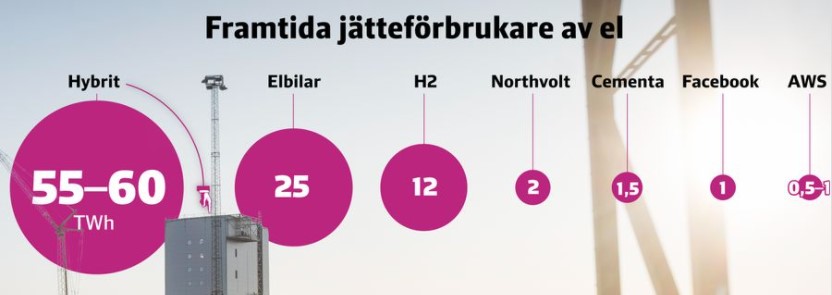
It is not only for the low-cost air conditioning that Facebook and Amazon have server halls up north. Those halls use enormous amounts of electricity. Now, producing fossil-free steel is the latest, and those industries will also be situated up north. There is where the mines are, so it makes sense. But it will also only exacerbate the the electricity problem as their electricity use makes Amazon and Facebook’s use look like a passing blip – unless: Unless hydrogen energy can fill that new need.
Grafik: Thomas Molén
source: SVD.se

Hybrit and H2 are both about producing steel with electricity culled from hydrogen, not fossil-fuel. Electricity is produced by combining hydrogen and oxygen atoms, producing a reaction that produces water, some heat, and electricity. (Thanks eia.gov for this quick explanation.) So clean it squeaks.

For the moment, though, the technology isn’t there. Which has the state Swedish Power Network (Svenska Kraftnät) worried. “I saw that H2 Green Steel will start its production in 2024. That’s tomorrow, from a network-building perspective” technology office Ulf Moberg remarked.

So what’s in store? How fast can we build out windpower? How much more water can we tap? Perhaps we extend the lifetime of the few remaining nuclear power stations. Or perhaps most likely, the southern half of the country, including Stockholm and Göteborg, has to import really dirty power from Estonia and Germany for the sake of clean steel and its accompanying international prestige.

It’s only uncomplicated if one, like Anders Ygeman, holds on to an easy answer and shouts it a lot.

Halland says Swedish adults won’t be vac’d until August

Halland, a county just south of Gotheburg (Göteborg) on the west coast of Sweden, isn’t pulling any punches: persons under 65 won’t be vaccinated until August, SVT reports.

The plan was that most everyone was going to get the first dose sometime in April and that everyone would have gotten the second dose by midsummer – late June . However, the latest with the internationally unpopular but at least local vaccine, from half-Swedish Astra Zeneca, is that the second dose needs a ten-week interval from the first dose. Which pushes the second dose date weeks later, in August.

It was unclear how many actually believed the original prediction, but for some it is undoubtedly a gut punch. It also leaves other counties’ residents wondering how much their representatives’ promises are worth. Time to revisit those summer travel plans – again.

Border restrictions may be a’changin

Nordic countries and covid
Sweden’s neighbors less than delighted with Swedish tourists
pic: Nordiclifescience.org

Sweden’s borders aren’t closed, and everyone is welcome to Sweden. Swedes, on the other hand, are not at all welcome in any one of countries it borders. No one wants Sweden’s infection rate to become their infection rate. Or, as the Finnish Minister for home affairs Maria Ohisalo put it in DN, “We must continue to be pretty careful. Finland has sacrificed a lot to decrease infections.”

And now for some covid statistics

In other words, they’re not going to blow all their hard work keeping their death toll down just to let Swedes come in and infect them with covid. (Finland’s stats: 7,234 covid cases, 329 deaths.)

The same attitude has also been found in Norway, (Norwegian stats: 8,954 covid cases, 251 dead), and Denmark (Danish stats: 12,916 covid cases, and 609 deaths).

Sweden’s stats (73,858 covid cases and 5,482 dead) are just not impressing our neighbors for some reason. The hope that herd immunity would quickly establish itself or that the economy would be spared has so far not impressed anyone either. The New York Times quotes Jacob F. Kirkegaard, senior fellow at the Peterson Institute for International Economics, saying “They literally gained nothing. It’s a self-inflicted wound, and they have no economic gains.”

These negative reviews have really gotten the dander up of Sweden’s leading politicians and the Swedish Public Health Authority. And quite possibly, the border situations will soon change.

border restrictions changing

SvD reports, that Denmark is now lightening up on their restrictions. Swedes living in Skåne, Blekinge and Västerbotten may be allowed over the border starting Saturday morning. Norway’s leading daily paper Verdens Gang reports that also Norway might open its borders to Swedes living in Skåne, Blekinge and Kronoberg. (Apparently, Västerbotten and Kronoberg are not considered same same to Norway and Denmark.) Finland will get back to us in about two weeks when they review their restrictions again.

Teacher absolved by Swedish supreme court

school hallway
The teacher did not violate the student when he was removed from the hallway
pic: twenty20

It took three years to sort it, but the final verdict was “Not guilty.” When teacher Sören Claesson saw that a student was blocking the passage of students in a hall of the school, and refused to move, Sören put a wrestler’s grip on the student and moved him. For this, Claesson was accused of violating the student’s personal integrity, and the school was sued.

The case boiled down to whether or not the teacher was allowed to physically move the student. The plaintiff was Child and School Student representative, or BEO (Barn- och elevombudet). BEO had previously lost two earlier processes in the lower courts, but they chose to push it all the way to the Swedish supreme court. The reason, they said, was because although it had been previously ruled that teachers could in some cases use physical force to intervene in some situations, it had not been tried in the case of a student that had psychoneurological difficulties. Due to other aspects of personal integrity, only some teachers knew of the student’s diagnosis, and Claesson had not been informed.

SvD reported that, according the Teacher’s Union (Lärarförbundet), six of ten teachers are hesitant to get involved in a physical situation because they aren’t sure what rights they have. At the same time, teachers have a duty of supervision (tillsynsplikt) which doesn’t allow them to walk away from a situation. “It is good that we have now gotten a precedent-setting ruling (prejudicerande dom) and I hope that it means that teachers can feel more empowered” remarked the Union’s vice-chair Maria Rönn.

“Hopefully,” said Claesson, “this will lead to more teachers daring to get involved instead of putting on blinders.”

For more posts on schools, see
law interpretation erases school information
09 Jan. – religious schools targeted by the government
18 Dec. – a new school plan
27 sep. – no school news is good news
Mon. 19/8 – GDPR takes down school photos

The corona commission

Mats Melin new Swedish corona commission
New corona commission leader Mats Melin introduces himself while appropriately distancing himself from party politicians
pic: SvD Ari Luostarinen

After the first suggestions regarding the directives and staffing of the coming corona commission were rejected by a majority of parliament, the government has now put a plan together for the corona commission. In a press conference this afternoon, DN reports, the government announced that lawyer and legal consultant Mats Melin will head up the commission, and that the commission will be comprised of six or seven other, as yet unnamed, persons.

When the idea of a commission was first floated, the governing Social Democratic party’s suggestion was not to publish any results until after the next election. “We want to remind everyone that what we hear from the municipalities and regions is that they’re a little tired of reporting, and that they need to focus on dealing with the virus. I don’t want to have a situation in which we put yet another burden on them” was the word then from Prime Minister Löfven. In addition, it was said, the staffing of the commission would largely be made up of people with specific party affiliations.

The response from the majority in parliament was along the lines of “nice try,” and the government has since been forced to back away from both suggestions. Which is good since, as DN reported a couple weeks ago, the government has a poor track record when it comes to corona-related transparency. Emails have a way of being erased, DN wrote, and meeting notes have a way of being classified as “working material” and are thus not part of the official (and public) record. This can still happen in the future, but at least the grossest risks might be avoided by more strongly separating the commission from party politicians.

The corona commission that will be formed sometime in the near future must now be staffed by people who have the trust from all the different parties in parliament. “I think it’s extremely important that those who are chosen have the trust of all parties, and that they can’t be suspected of favoring one party’s interests over another’s” said Left party leader Jonas Sjöstedt to SvD. In a remarkable constellation, the Sweden Democrats, Christian Democrats, and the Center, Liberal and Moderate parties are all united on this. (No word from the Green party but one must assume that they’re somewhere behind the Social Democrats.)

The plan is that Sweden’s elder care during the corona crisis will be the focus of the first part of the investigation, with a report due to be presented in the fall. A more in depth report will come in the fall of 2021, and then on February 28th, 2022, the final results of the commission’s findings will be presented. “I’m looking forward to seeing the results” said Löfven.

Another important date is the next election: September 11, 2022.

To stay or to go – the Green party is wavering

Isabella Lövin and Per Bolund Miljöpartiet
An unhappy couple left out in the cold
pic: miljöpartiet.se

The Green party is in crisis discussions regarding staying or leaving the government, Expressen reported today. By the end of August, the government wants to have a new migration policy, one that has broad support from all the parties, done and dusted. To this end, the Social Democrats have had long and intensive discussions with the Moderate party in particular, something the Green party doesn’t appreciate at all as they and the Moderates have largely diametrical thoughts on the immigration topic. Last Friday, the discussions were particularly comprehensive – but the Green party was left out on the doorstep.

At the moment, the Social Democrats, the Moderates and the Christian Democrats are agreed, DN reports, on some sort of asylum “max number”. Even the Center party and Liberals haven’t expressed outright opposition to the concept. These three or more parties, if they come to an agreement, would get a majority in parliament. The Sweden Democrats would likely go along though, which would make a pretty much unassailable majority, even if they say they consider the proposal “way too lame” (alldeles för mesigt).

On the other hand, however, the Green party and the Left party are indignant going on outraged. “The Social Democrats are slamming the door in both our faces by negotiating with the Moderates. There is another majority here, one that the government is actually based on. Still, they turn to the Moderates. It’s refugees who will pay the price” said Left party board member Christina Höj Larsen. “It is completely unique that the government negotiates with the opposition and not its own partner” said a Green party member to Expressen. “Are all the questions we’re not agreed on to be decided with the Moderates in the future?”

When the Social Democrats first put more restrictive policies in place after the wave of immigration threatened municipality stability back in 2015, the Green party still didn’t leave the government – to the dismay and anger from a large part of their following. They will be risking that anger again if their “partner” the Social Democrats run them over again on the same question.

One thing that might make a more restrictive immigration policy more palatable, however, is if the government says no to Preem’s expansion plan (see “Preem gets a pass” here). If not, though, losing on two issues close to their heart, if that’s what happens – and when they’re supposed to be a deciding partner – might prove to be too much to swallow.

law interpretation erases school information

Skolverket takes away school choice information
school choice blindfolded by law interpretation
pic: melbournechildpsychology.com

Swedish schools have come under a lot of critique over the last twenty years when school results have been lower, sometimes much lower, than was hoped. One of the tools parents and authorities have used to judge the performance of a school has been to check the statistics for each school. In a decision that came out today, the Swedish National Agency for Education must now make those statistics unavailable.

The statistics that have been available include how many students the school had, what percentage of the school’s teachers were certified and what percentage of the school’s students qualified for further studies. Apparently, there was a judgement earlier that came to the conclusion that these numbers were business secrets. This was not only because each student brings with them a certain amount of money, but also because school results are something the independent schools use to attract students. These statistics gave clues to the school’s economic stability. Therefore, the reasoning went, this was privileged information. Although this was originally only meant in regards to Swedish independent schools (friskolor), education agency head of analysis Eva Durhan announced that schools needed to have a level playing field and that it wouldn’t be fair that only public schools’ information would be available for scrutiny.

The upshot is that schools won’t be able to be compared in the school guide, making an educated choice of what school to attend more of a guessing game. Even the School Inspection Board won’t have any statistics to work with.

No one is particularly happy with this, reports SvD, and the national education agency is trying to find a workaround in order to supply both parents and students – but also government agencies – with this information. “Of course, we need to keep track of how things are going for our different schools” said Minister for Education Anna Ekström for DN: “We also need to know which children go to which schools so that they can pay the right resources to the schools. It is important that authorities can fulfill their tasks and that researchers and the general public have access to the information.”

“We understand that the National Agency for Education has to do what it has to do. But everyone agrees that another way has to be found. It is neither in our interests, nor in the interests of the independent schools, that parents can’t compare education institutions, says Per-Arne Andersson at the Swedish Association of Local Authorities and Regions (SKR).

Unfortunately, even with the best of intentions this will take a while. The government has asked both Statistics Sweden (SCB), and the National Agency for Education (Skolverket,) to find ways to resolve the situation. But, as Moderate party education spokesperson Kristina Axén Ohlin writes, the parliamentary education commission (utbildningsutskottet) wasn’t told anything. “We could have pushed through an initiative and forced a change in the law” she said. “The education agency will have a proposal in September but after that it will take at least six months. No state allowance or grade results will be seen during 2021.”

One possibility is that schools can voluntarily publish this information. Barring that, school information will be hard to come by.

Ringhals 1 nuclear power station restarts

Ringhals 1 to be started up to secure electricity supply
pic: wikipedia.se

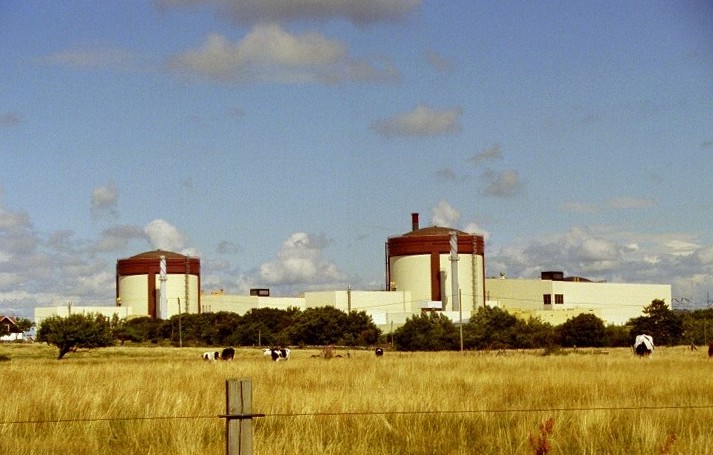
Electricity – it’s cost, where it comes from, who produces it and where – is a heated and complicated subject. The topic has been touched upon in this blog earlier (here, here, here and even here), but it’s time for an update because nuclear power plant Ringhals 1 is being started up.

Ringhals 1 closed in April per usual, and wasn’t expected to be started up ever again due to regulations enacted in the wake of the Fukushima disaster. (Ringhals 2 was closed last year.) Although many people were pleased by this decision, businesses and government officials have been more concerned. A stable and powerful electricity grid is considered by most people a requirement for a responsible running of the country. When Pågen bakery decided not to open a plant in Malmö last year, due to the fact that the city couldn’t guarantee a steady supply of power, people became alarmed.

Anders Ygeman is often all over the airwaves saying Sweden produces more energy than it uses. Although that may indeed be the case over the course of a year, it doesn’t mean that everyone (like hospitals, factories, houses in the dead of winter…) gets their energy needs met when they need them. A few recent headlines paint another picture: A few here, for reference:

It doesn’t look good. But back to Ringhals 1. It was closed, it was likely to stay closed until the end of the year, and then start the long dismantling process. But a press release from Vattenfall, and a notice from the Swedish power net (Kraftnät) on June 18th said something else, namely that they’re starting up Ringhals 1 and have a contract to run it to at least September 15th. “…the electricity grid needs a significant proportion of planned electricity generation that does not fluctuate with rain or wind” said Torbjörn Wahlsborg, Senior executive vice president at Vattenfall. “[…] we are happy to be able to make an extra effort for grid stability.”

So is everyone else that requires electricity.

Home away from home, or not

home services may be denied for summer guests
pic: senioradvice.com

In another ripple in the wake of Covid, several municipalities have petitioned the government to be able to deny summer residents (people moving to the summer houses for the summer months, for example) the home services they’re granted in their home municipalities. Many parliamentarians understood and agreed with the municipalities, and on the 3rd of June a majority said that the government must temporarily change the law and allow municipalities to deny services. But yesterday, the government said no, the municipalities must provide these services by law. This has caused consternation and anger on the part of these municipalities. Some have now said they’re ready to go their own way and ignore the law.

Home services cover a lot of things. Municipal employees are sent out to homes to help elderly, sick and/or injured with things like cleaning, shopping, getting dressed, taking a shower, making the bed, cooking food, accompaniment on shopping rounds or just helping with a walk, and more. What clients can get help with depends on their needs – there isn’t a ready-made list. Furthermore, different municipalities can grant different help: One municipality can say that a client can get help with their shopping four days a week while another might say something different. One municipality can grant 10 hours of help a week without being any more specific about what tasks the person is to get help with. It’s not free – there’s a price list for each activity and the prices can vary per place. However, it’s subsidized, and the monthly maximum price, for the user, is currently just over 2000 SEK.

This is not the real cost of the services though, and the municipalities say they can’t afford it. When people who normally receive services in their home municipality move for the summer, the summer municipality takes over the responsibility for them, including the manpower and the cost.

Lena Hallengren, Minister for Health and Social Affairs, explained the no by saying changing the law was just too complicated a thing to accomplish in a short time: It can’t be done in a wave of the hand, but needs a thorough inquiry and an impact analysis (DN.se).

Not good enough, say several municipalities. “We’re going to continue saying no” said Orust town councilor Catherina Bråkenhielm, DN reports. “We’re holding the line and denying home services for the time being” said town councilor Mats Abrahamsson.

Not even the Swedish Association of Local Authorities and Regions (SKR) is happy with the government: The muncipalities “don’t want to say no to summer guests, but they don’t have the staffing. They’re also worried about a higher local infection rate now when the government has lightened up on restrictions,” noted Gregor Bengtsson, coordinator for elderly care at SKR. There are about 60 who are saying no, Bengtsson says.

The consequences of the municipalities’ actions are at this moment still unclear. Bengtsson says the they might be investigated by the Swedish Health and Social Care Inspectorate (Inspectionen för vård och omsorg, IVO) and that some have been reported to the Office of the Parliamentary Ombudsman (justitieombudsmannen, JO). More immediate effects, though, are going to be felt by the elderly or ill, who have been granted assistance in their home area, and who are asking for it – as allowed by law – also when they enjoy the summer away from home as well.

Skål for state-owned businesses

Absolut midsommar – keeping health care funded
pic: absolut.com

Is Sweden a socialist country?! Although even through the 80’s it was still a thing, the idea that the Swedish state owned more businesses than not has pretty much been put to rest by this time. Still, there are several huge businesses that are owned or partly owned by the state, who has proven to be, at best, only a so-so business partner. SvD‘s Torbjörn Isacson went through part of the list today, with Telia’s recent sale of its Turkish business as a starting point.

Sweden owns 39.5% of Telia. The next biggest owner of Telia is Blackrock, which owns 3.1%. It’s safe to say Sweden’s ownership is the big one. Although it’s a controlling interest, the state doesn’t control Telia. Telia has a board like any other public company, who does the day to day work (for more about Telia see this blog post). However when Telia loses value or does bad business decisions it’s the state that takes a major hit as any huge shareholder would. Also when Telia does a good deal and makes money the state makes money. In this case, this means Swedish taxpayers.

That’s why Telia’s recent sale of its holdings in the Turkish company Turkcell must make the news. Not only did Telia and its shareholders take a huge, huge loss because the board’s idea was a disaster, Telia sold its holding to a buyer whose CEO is Turkey’s authoritarian leader Recep Tayyip Erdogan. As shareholders, Sweden’s taxpayers should be in the know – but in reality taxpayers have perhaps even less power than an average shareholder since the Swedish state must resign its active partner role to prevent a truly socialist state of affairs (see China for comparison).

Still, that doesn’t mean that the state ignores its business holdings entirely. Just recently, SvD reports, the parliamentary committee on enterprise (näringslivsutskottet) called on the three top state-owned businesses – Vattenfall, Jernhusen and Swedavia – to answer some questions on business practices like annual dividends, and handling the corona epidemic.

Vattenfall has been a leading money-loser. If it’s not one thing, it’s the other: too much snow, too little sun, too little snow, too much sun – and we won’t even bring up wind – they’re all reasons why Vattenfall needs to raise prices on Swedish energy consumers. Then there are other issues like nuclear power and electricity infrastructure that the state of Sweden is directly responsible for but again, must somehow disengage from their effects on its own business, Vattenfall, which, again, is somehow the reason Vattenfall must raise it’s prices on Swedish energy consumers. But it isn’t only Sweden where Vattenfall has its business. Vattenfall has business all over the world and the current record-low cost of electricity is again a reason that Vattenfall is losing money.

Jernhusen owns buildings and other real estate all along the Swedish railroad network and also has dealings inside Norway. Swedavia runs the airports. Both of these were taking losses even before Covid pulled the rug out from under them. And then, of course, we have SAS of which Sweden and Denmark each own just under 15%.

Another 100% state-owned, and Covid-hit business like all others, is Svenska Spel where the lack of sports and the closing of casinos has been financially disastrous. One would think that the state would be happy about less gambling, but it’s uncomfortable when it’s also making money for the state. We all know PostNord, which is 70% owned by the Swedish state and 30% owned by Denmark (note: for some reason, however, voting power is split 50/50). It has the impossible task of trying to be profitable while being prevented from raising prices or laying off workers, or even quitting the business entirely, by its own owners.

To make matters worse, it was in the 100% state owned LKAB (Luossavaara-Kiirunavaara AB) mines in Gällivare that a cluster of Covid virus has recently exploded. But even before that a number of questions regarding work practices were piling up.

Corona makes life more difficult for basically everybody, and misbehaving companies are common. Plus, some essential services should be guaranteed by the state, even if they’re not profitable. But as a general rule, should states be in the business of making money? Oh. Wait. We can’t forgot the good news – Systembolaget! A sure money-winner in Covid times and not. Swedes will have to keep drinking to keep the money rolling in – good thing it’s Midsommar.