
image: nexans.com
This blog has talked a lot (a LOT) about the state of electricity in Sweden. Go ahead and search the site if you don’t believe me. I’m going to talk about it again, so make sure your reading device is fully charged.
Anders Ygeman (Minister for Energy and Digital Development) says Sweden has no electricity shortages (“We export more electricity than ever before!!”). Then again, Sweden had to fire up its old oil-burning furnace and discourage people from vacuum-cleaning their homes to avoid brown-outs last month. It’s easy to be confused.
Basically, if you live up north, there is, as a rule, plenty of electricity for a low price. If you live way down south, you can pay 4-5 times more than a northern user. The electricity is there, but you’ll pay through the nose for it to go through the myriad of state and local electricity grids. During the cold snap we had last month, the paper company Holmen shut down large parts their factories because the price of the electricity made it uneconomical to keep them running. Productivity goes down the proverbial toilet, in other words, but more seriously, who will invest in employment-boosting industry in the future?
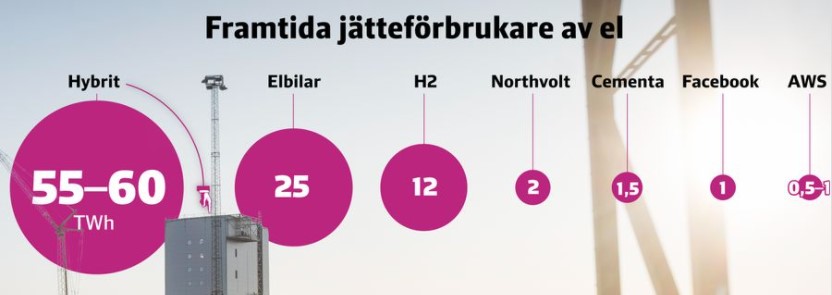
It is not only for the low-cost air conditioning that Facebook and Amazon have server halls up north. Those halls use enormous amounts of electricity. Now, producing fossil-free steel is the latest, and those industries will also be situated up north. There is where the mines are, so it makes sense. But it will also only exacerbate the the electricity problem as their electricity use makes Amazon and Facebook’s use look like a passing blip – unless: Unless hydrogen energy can fill that new need.
source: SVD.se
Hybrit and H2 are both about producing steel with electricity culled from hydrogen, not fossil-fuel. Electricity is produced by combining hydrogen and oxygen atoms, producing a reaction that produces water, some heat, and electricity. (Thanks eia.gov for this quick explanation.) So clean it squeaks.
For the moment, though, the technology isn’t there. Which has the state Swedish Power Network (Svenska Kraftnät) worried. “I saw that H2 Green Steel will start its production in 2024. That’s tomorrow, from a network-building perspective” technology office Ulf Moberg remarked.
So what’s in store? How fast can we build out windpower? How much more water can we tap? Perhaps we extend the lifetime of the few remaining nuclear power stations. Or perhaps most likely, the southern half of the country, including Stockholm and Göteborg, has to import really dirty power from Estonia and Germany for the sake of clean steel and its accompanying international prestige.
It’s only uncomplicated if one, like Anders Ygeman, holds on to an easy answer and shouts it a lot.