

Over the last weeks, no fewer than four lawyers have been expelled from the Swedish Bar Association. The latest ousting was for passing on information from two jailed clients to persons involved in their respective cases. According to DN, Edip Samuelsson contacted, and passed on information to, his client’s alibi in a murder case. In another instance, he is reported to have provided financial information from a client to the client’s wife at the same time as this client was suspected of a serious financial crime. In both these cases, Samuelsson was found by the Swedish supreme court to have acted in violation of the restrictions imposed upon him by these cases.
Originally, the Swedish Bar Association had decided to not expel Samuelsson for his actions. Instead, he was given a 50,000 SEK fine, the highest fine allowable. However, the office of Chancellor of Justice didn’t think the Swedish Bar Association came down hard enough, and took the case to the supreme court. The supreme court turned out to agree with the Chancellor, and voted to disbar the lawyer.
“I think it is important to get clarity on how to look at this kind of violation of restrictions because it has a big impact on how the legal profession is seen” Chancellor Mari Heidenborg said after the decision. “It is incredibly important, she continued, “not least for the detained: The risk with violating restrictions is that it can actually be worse for the detainee themselves.” For more on the Chancellor of Justice, see below.
more cases
In other cases this year, the Bar Association did do enough. Last month, it expelled two lawyers for leaking information on police investigations to various people connected to gang activity. Their real names, as well as their codenames “The Prince” and “the King”, were found in the now-famous Encrochat files. They were relieved of the lawyerly duties and privileges.
Also earlier this year, another lawyer was permanently vacationed when she, too, was found to have abrogated detainee restrictions. In this case, the lawyer played mail deliverer, delivering letters from her client, who was detained in a big narcotics case, to her client’s wife.
The Swedish Bar Association has not always been a vocal supporter of tougher punishments for convicted criminals. The association called doing away with the “punishment rebate” (a praxis in which the number of crimes committed automatically decreases the punishment for each crime) a “badly thought-out and criminal-political opportunistic idea trend.” But where the Bar Association might fall short, it seems the Chancellor of Justice is ready to pick up the slack.
Basically, if you want to claim damages against the state, you contact this office. Or, if the police do something wrong, this office makes the judgement call. They also are charged with protecting freedom om expression and will act as prosecutor if this right is restricted in any instance. Plus, it can also, apparently, get involved with disciplinary errands involving lawyers due to its capacity to act in the interests of the general public. (Who has heard of this agency before?)

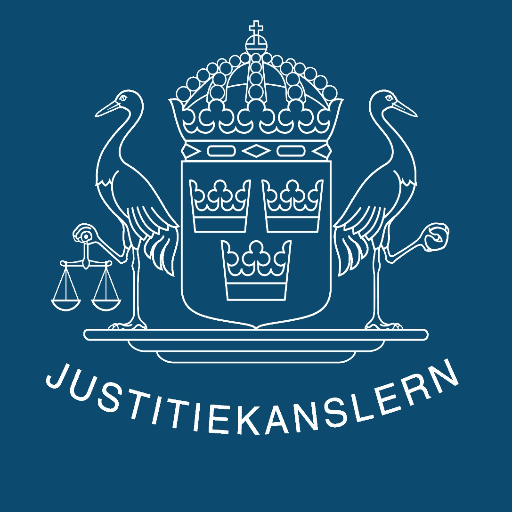
The office's symbol, besides the usual three crowns, includes two cranes. The one crane holds the traditional scales of justice. The other crane is holding a stone - if the crane falls asleep, it will drop the stone on its own foot and wake up. The cranes are meant to refer to the Chancellor of Justice's task of making sure that courts and other authorities fulfill their obligations according to what justice and the law require.

Cranes. I like it.
