Another hinder for Preem’s expansion bites the dust pic: Preem.se
Last August, in this post, it was discussed how the government was going to be the deciding party regarding whether or not Preem, Sweden’s largest fuel company, would be allowed to build an even bigger oil refinery on the west coast – and oh, by the way, become Sweden’s biggest – numero uno by far – source of CO2 emissions. For a refresher on this issue, check out the post.
Meanwhile, since that decision in August, Preem made some changes to its bid, reducing the size of its expansion and by that, the amount of CO2 emissions. According to DN, today’s ruling by the Land and environmental court (mark- och miljööverdomstolen) said two important things that strengthen Preem’s argument to build:
the climate policy framework that parliament agreed upon in 2017 serves as a guideline for climate policy, yes – but it has no legal weight in granting or not granting permits in single operational cases, and
the so-called stopping rule in the Swedish Environmental Code (miljöbalken) cannot be applied to carbon dioxide emissions from an activity already covered by the EU emissions trading system.
Having said this, the ball is now firmly in the government’s court. The court has said that there is no previous ruling, or law, or agreement that prevents Preem’s expansion. It will be completely up to the government to say yes or no to Preem.
Of course the Green party will be opposed, and they are officially a part of the government. But the real decision-making rests with the Social Democrats and it could be a tougher call there. Preem’s expansion means Swedish jobs at a time when Swedish jobs are really needed. And, if Preem doesn’t refine this oil, the argument goes, someone else will – and that someone is not going to be nearly so clean about it as Preem would be. On the other hand, the environment. And, if someone else refines the oil then at least it isn’t in (or on) Sweden’s hands.
One option for the government is to drag out the decision for so long that Preem and/or Sweden loses interest. Or the government can hope that something else happens that makes the question go away (though be careful what you wish for). Perhaps taking a page from Tegnell’s playbook could be a way to go – make a decision and stand by it regardless of whether it’s the right thing to do or not.
Yesterday afternoon, Reuters reported that Astrazeneca had signed a 400 million dollar contract to supply “european countries” with 400 million doses of an eventual vaccine. However, not all countries were actually in on the deal, and it’s unclear what the arrangement means for Sweden.
The contract is for a vaccine called AZD1222, developed at Oxford, that isn’t at all fully developed and tested yet, but is expected to be perhaps ready for delivery at the end of the year. Germany, France, Italy and the Netherlands are the countersigning parties, in a constellation called “Europe’s Inclusive Vaccine Alliance”. In another contract, Astrazeneca has another deal for 1.7 millions doses with the US, the UK and India.
SVT reports that, so far, Sweden has no similar deal. Minister for Health and Social Affairs Lena Hallengren, however, came out yesterday to say that Sweden is in intensive negotiations with Astrazeneca and other vaccine developers. As for the deal that the other European countries have made, it is still unclear as to if these countries were out for themselves or whether the deal they signed is meant to help all or any other European countries. When asked specifically whether Sweden was any kind of partner to this, Hallengren said that the signing countries should come out and say what the story is: “The ambition is to see to it that other EU countries are a part of it, but speed has been needed.”
It was only at the end of May that Sweden came around to the realization that maybe a vaccine deal might be a good thing. The strategy they put together consists of a “continued international cooperation” and the nomination of a vaccine coordinator (!) with a mandate to see that Sweden’s needs are taken care of. The Public Health Agency of Sweden (Folkhälsomyndigheten) has been given the responsibility to prioritize the vaccine’s distribution when it becomes available.
Seeing, perhaps, that these measures are likely ineffectual (bordering on pathetic) the government announced Sunday that it has upped the stakes a bit. From originally only granting a limit of 350 million kronor for “preparedness investments” (bereddskapsinvestering), the Public Health Agency has now been given permission to loan up to 2 billion kronor. “When a vaccine becomes available, the means to procure it must also be available” said Minister Hallengren.
This may mean that Sweden has come to understand that Sweden’s municipalities do not, and have not had, the muscle or the weight to bid against other countries when trying to purchase supplies: Sweden’s system of decentralization has meant that every municipality has had responsibility to get its own supplies. It was only lately realized that the municipality of Västerås doesn’t quite have the purchasing power that buying for the entire country of say, Austria has. To give a heavy purse to the Public Health Agency to swing with for Sweden, if it’s not too late, will help.
Furthermore, any vaccine doses that are procured shall be evenly distributed around the country: “it makes no difference where you live” proclaimed Hallengren. Sadly, it has been all too apparent in the case of Sweden’s elder care, that when supplies are limited, a reckoning of your importance is indeed taken into account.
many factors at play between Sweden and the EU budget pic: wired.com
The EU’s Corona crisis support package/recovery plan/budget is still being negotiated, and quite rightfully so. It’s a huge number that is being thrown around – 1.85 billion euro, or 2000 million dollars. (The United State’s bailout package is way more – 2 trillion dollars aka two million million dollars.)
Sweden has been one of the “frugal four” – countries that want the aid package to countries who have been hardest hit by covid to be in the form of a loan instead of a gift, but it looks like that position is weakening.
Sweden’s EU commissioner Ylva Johansson says that Sweden’s position is short-sighted. “The lessons learned from the finance crisis [in 2008/9] is that we acted way too slowly” Johansson said in Sweden’s Radio Saturday interview program: “If we don’t implement a big recovery, we’re going to have the worst crisis that the EU has ever experienced. Way, way worse than than the finance crisis.”
However, the package’s main financing comes from loaning money with all of the EU countries as guarantors. This would be a first, and is likely also precedent-setting, and allows the EU to act – even more – as a single, overarching government sitting far away from Sweden. The Swedish government’s critique of the plan, Sweden’s radio reports in another article, is that the budget is too big, there is too much money in the fund, the funds should be loaned out and not given out, and it should be a fairly short term loan at that. The way in which the money is spread out is not popular in Sweden either: “A lot of money goes to countries that aren’t even hard hit by corona” remarked Minister for Finance Magdalena Andersson, “and that seems a little strange.”
The Left party, never a fan of EU in the first place, is more virulently opposed to the plan. In a debate article in Aftonbladet a few days ago, party leader Jonas Sjöstedt and EU parliamentarian Malin Björk write that the recovery fund increases EU’s power over Sweden dramatically. Money that could have gone to climate investments and welfare in Sweden now goes to “Orbán’s oligarchies and Brussels’ bureaucrats.”
On the other side of the equation is the Liberal party who have always been very EU-friendly. Both of them, officially or unofficially, are supporting parties for the reigning Social Democrats. The Left party has way more votes and is an ally of old, while the Liberal party has always been on the right, before former party leader Björklund’s children pushed them into the center-left camp. The Social Democrats are getting it from both sides, and the EU is pushing as well, in the form of EU commissioner Johansson.
The next EU summit (via video this year) is – per usual – during Midsommar. Sweden was never able to persuade the EU to change the date, even by a day, to accommodate the single biggest holiday in Sweden, so it’s kind of unlikely (sadly) Sweden will have a deciding voice in the EU budget.
Special operation Rimfrost leaving the scene pic: Izabelle Nordfjell/TT
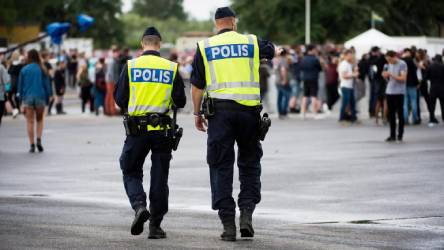
Operation Rimfrost is officially over tomorrow. Rimfrost was the name given to the special police operation last fall after the particularly spectacular shooting death of a woman holding a baby on the street in Malmö last year. The outrage that followed was such that all resources were going to be gathered together for a particular period of intense police presence and law enforcement.
Rimfrost was called, in official Swedish terms, a särskild händelse, which allowed for increased police authority to arrest, charge and hold suspects. As written about in this post, hopes were that more criminals would be taken off the street and that there would be with far fewer shootings as a result. The results would be seen in six months, it was said.
Sadly, six months have now gone by and nationally, shootings have only increased. In official-speak, SvD reports, Rimfrost “had an effect but did not reach the target.” The effect spoken of is in the Malmö and Uppsala region, where shootings and explosions have actually decreased. The number of shootings in the last two years (from well before Rimfrost started, however), has been cut in half. Even the number of explosions has been slightly reduced. The number of shootings and explosions, however, has only increased outside Malmö and Uppsala, making the the total numbers go up. One of the features of these special operations is that police officers can easily be moved to one area from another, reducing forces in one area to increase them in another. The increase in crime outside focus areas has perhaps been the result.
Another result of the Rimfrost operation has been, alas, to see how criminal activity is truly focused in exposed areas. “Crimes are committed more often in those areas that are classified as vulnerable. Crimes are committed up to eight times more often in these areas than outside these areas” said Mats Löfving, chief of the National operations division (Noa): “For criminality to go down […] it is absolutely necessary to fortify security in these areas.” However, as Stefan Hector – chief of national command for Rimfrost – noted, Rimfrost was more meant to break the development of a pattern in shooting and explosions rather than to cure social ills.
Minister for the Interior, Mikael Damberg, said that he “had hoped for fewer shootings” but said he would not call the operation a failure: “The police have become much more aggressive. I see that as a success.”
June 16th was the third, and last, date the government and opposition parties were to get it together and agree on the defense budget. Today, Minister for Defense Peter Hultqvist made an offer of no new money at all to Sweden’s national defense. The negotiations were shortly thereafter declared stone cold dead.
With no new funds, only about 40% of the need for reinforcements and additions to troops, ammo, carriers, training – the works – will be met, if that, according to SvD. This on top of the security crisis spoken of and worried about at top levels throughout Sweden and the rest of the world. We’ve just seen first hand how well Sweden’s crisis management works (Minister for the Interior, Michael Damberg is responsible for Sweden’s civil defense after all). Now the army will have its capacity cut from under them as well.
Christian Democrats, Moderates, Sweden Democrats, the Liberal party and even the Center party have all worked to increase monies to defense. The Social Democrats have only their usual associates the Green and Left parties at its side. The Left, for its part, is not opposed to a strong military, and can see a need to increase its capabilities if only to keep Sweden from being the easy target it looks like not being in NATO. Even the Green party says it wants a strong civil defense (though it otherwise writes that democracy and diplomacy are its foremost weapons). Since leading Social Democrat Björn von Sydow was the main writer of the original contract that significantly increased the military budget way back when the topic was first brought up and before Hultqvist reneged on it, even the Social Democrats could be split over backtracking on defense promises. However, most Social Democrats don’t really want to see an increased military budget, so saying “split” could be an exaggeration.
After the Swedish summer vacation, the government will have to put forth its own military budget plan. The opposition will do the same. Right now, the opposition has the numbers on its side, but the military will have to sit and twiddle its thumbs until autumn – and hope that Sweden’s security doesn’t face any challenges in the meantime. We still probably only have a week.
Covid meets national security pic: shufordprinting.com
When China became one of the biggest shareholders in Norwegian Air this spring, a bunch of red flags suddenly went up for the government. Quite correctly, the market crash that was a result of the initial Covid shock opened the way for some big and little investments in different industries – just ask any one of the thousands of small investors that took the opportunity to buy some expensive stock at rock bottom prices. But for many people, it’s one thing for some guy to buy some Ericsson stock (and, sadly, it generally is some guy) and it’s quite another when a foreign government becomes a controlling shareholder.
Up until this point, people who thought that foreign ownership of more or less strategically crucial national assets was worrisome were basically ignored. It was a very near miss when Russia was about to buy the chance to “cooperate on maintaining” the Slite harbor in Gotland for their oil pipeline Nord Stream 2, for example. At first a lot of breath was wasted trumpeting that Swedish municipalities could verily make their own decisions about these things (kommun självbestämmande) – but then both Slite and Karlshamn voted in favour of the “cooperation project”.
Only in the 11th hour did the Social Democratic government step in and manage to convince Slite, at least, to say no to the deal. Karlshamn didn’t say no, and the government couldn’t convince its own municipality that a slew of Russian engineers crawling around laying cables and whatever else was perhaps a poor idea. Karlshamn got jobs and a slew of cash from a Dutch company named Wasco, who provides for and supplies the Russian pipeline, and Slite got some vague promises of similar levels of investment from the government.
The same government also gave the go-head (read: silence) to other sales. Imego, Norstel och Silex, all advanced hi-tech companies with products that can be used for both civilian and military purposes, are now owned by China (see this article for more information). These are just three examples of many. At the time, Minister for the Interior Michael Damberg expressed “dismay” that not more Swedish hi-tech companies could remain Swedish, but that was all that was done or said. It took the Norwegian Air example to finally get Sweden’s attention.
As anyone who has lived here knows, for any issue there is a commission to investigate it. The issue of direct foreign ownership by not-so-friendly and not-so-democratic regimes also has an ongoing investigating commission, whose conclusions are set to be made public sometime late next year. The Moderate party, and now a majority in parliament, has said that the issue is too important to wait on some commission’s report. “Threats of these kind have actually existed for a long time. Other countries have had laws about this for a long time. What no one could have known was that Covid would make the issue [of direct foreign ownership] so acute” said Ulf Kristersson to SvD.
That was in April. At a press conference late yesterday, the Social Democratic government announced that it was now taking the bull by the horns, and presented list of measures it was getting ready to take in order to protect Swedish assets. Foremost among them? Another commission is going to look at the issue.
“Sweden, and the EU, are vulnerable in a pandemic” stated Michael Damberg. So one of the most immediate actions he’s taking is giving the Swedish Defence Research Institute the authority to do a study on foreign investment in “protection worthy” operations (skyddsvärda verksamheter) in order to have better background knowledge. The Institute is to map out which branches in particular could jeopardize Sweden’s security (if, say, they were to be bought up by non-friendly states). Another measure is to authorize Sweden’s Inspection for Strategic Products (ISP) to collect information on foreign companies that want to buy Swedish companies.
If those measures do not a good night’s sleep make, the EU is taking its own steps. Due to be done in December of this year, the EU is putting together a framework for laws that can help prevent foreign ownership of assets that have security implications. Germany, and other EU countries, already have laws that allow the government to put a stop to sensitive sales.
This is not to say that SAS couldn’t be majority owned by China in the future though. When the Norwegian government was tasked with saving Norwegian Air with taxpayer’s money, one of the requirements to be bailed out was that Norwegian convert its leasing obligations into stock. Norwegian had a leasing arrangement to the tune of lots of billions to a company that in the end is owned by the Chinese state. When it had to convert the leasing agreement into stock, suddenly that company owned a lot of Norwegian Air stock. In other words, it wasn’t like the Chinese government went discount shopping and bought a bunch of Norwegian Air on purpose and because it was such a great deal (it could actually be a really bad deal – how long will it be before people fly like they used to?). SAS also has plane leasing obligations with Chinese companies, so much will depend on how much they might need to be bailed out and what the requirements for a bailout will be.
One would hope that the requirements made to SAS, if an even huger bailout becomes necessary, could not result in the same ownership that Norwegian now has, but you never really know. And besides, foreign direct investment is something Sweden always tries to encourage – it brings jobs and development. The trouble is foreseeing what human rights and environmental track record a direct investment brings along.
The PISA test is an international test (about 80 countries take part) that tests the knowledge and skills in science, reading comprehension and math of a huge sample of 15 year-old students. Basically, it’s a test of what every 15 year old should know at that point in their school career. It’s given every three years.
From always believing Sweden was on top, Sweden’s actual PISA-test results have has gone down almost every single year since the beginning of 2000, to the extreme dismay of government after government. But last year, in 2018, Sweden appeared to have turned a corner, with scores landing a bit above the OECD average. Everyone was jubilant. Everybody took credit. Yesterday, however, the dream was punctured: Expressen published an article saying the gain was fake.
The fact is that every country is allowed to exclude 5% of their tests from being part of the final result if the test-takers are unable to be fairly judged on their knowledge due to their poor language ability. This generally means that the test results of students who are new to a country are excluded. For this last test, Sweden (the Swedish National Agency for Education, Skolverket) apparently asked, and was given the go-ahead, to exclude 11% of its results from the final tally, more than any other country. Since 11% of Sweden’s 15 years old surpasses the actual number of new 15 year-old immigrants to Sweden, this meant that more than just new arrivals to Sweden were excluded. Basically the low score of any student, even those born and raised in Sweden, could potentially have been excluded. Sweden’s better than average results could be because of the unusually large numbers of students that were excluded.
The director of the Swedish National Agency for Education (Skolverket) says that he is confident everything was done by the book, but Minister for Education Anna Ekström has now asked the OECD to recheck Sweden’s PISA numbers. Both the Liberal and the Moderate parties have asked Ekström to meet with them to explain what’s going on. “It is worrisome that so many students leave grade school without passing grades” said the Moderate party’s education spokesperson Kristina Axén Olin. “We need to discuss what to do, and it is therefore a disservice if we hide the real results.”
A significant part of Sweden’s self esteem is based on their being above average on every single international comparison, and the PISA-test results over the last nearly 20 years has been a shadow on an otherwise pretty sunny self-image. It is therefore important that each and every one of these shadows is shown to be false – if they are false. Stay tuned for what the OECD has to say about Sweden’s results.
employment law affects everyone pic: hungarianinsider
The government’s commission to assess the current Law on Employment Protection (lagen om anställningsskydd, better known as “las”) came out with its report yesterday, and no one in the government is happy.
There are basically two reasons a person in Sweden can be fired: for lack of work, and for personal reasons. Under current rules, if employees need to be terminated due to a lack of work (and if they basically have the same qualifications) it has to be done in accordance with last-in, first-out rules. If two employees were hired at the same time, the younger one has to go first. Also, when a person is let go for these reasons, they must also be hired back first, if there is work available within nine months or so of being let go (given that they have given notice that they are interested in being rehired).
There are some legal exceptions to this rule. For employers with a certain number of employees, a certain number of exceptions to this last-in, first-out rule may be made. In other words, if an employer has an employee they think is really good, they can make this person their exception and someone who has been there longer can be asked to leave instead.
Furthermore, if a person is let go they can have a long wait before they actually stop working where they have been let go, depending on how long they have worked at the company. The wait time for having to leave can be several months during which time the employee is paid per normal. This has been made a rule so that an employee has some time to make the adjustment if the termination comes as a shock.
For a person to be let go for personal reasons – if they are really messing up their job due to, for example, negligence, difficulties working with others, refusing to do the work, if they’re harassing other people – the rules are strict. The employer basically has to do every possible thing in their power to keep on a person, even if the person can’t really do the job for which they were once hired to do. In general, a employee can only be let go after a thorough investigation into all other possibilities for this person to remain in their job or at the company. If they aren’t getting along with the other employees, the company is obligated to see if the person can be moved to another department, for example. This also prevents employers from being able to fire workers who happen to land on their employer’s wrong side for some random reason.
Among other things, the commissions suggestions include allowing more exceptions to the last-in, first-out rule. From around two exceptions for a ten-person company, for example, five exemptions could be made. Furthermore, companies with less than 15 employees will not have to give personal reasons (negligence, etc.) for firing a person. For the employee, on the other hand, an employer is required to increase the amount of on-the-job training and education (kompetensutveckling) to keep the workforce up to date with changes in the field.
The main fear of these changes is that the conditions for the employee will be less secure, and that they will open up for discriminatory firings. For the employer, there would be more freedom to keep the employees they want to keep and to let go the ones they don’t think are a fit.
The commission’s report was not an unexpected event. In fact, it was a condition for the support of the Liberal and Center parties for the Social Democrats to remain in power. Back in the fall of 2018 when no party won a clear majority, the Center and Liberal parties agreed to support the Social Democrats as long as they began an investigation into changing the las-laws.
In reality, a change in these rules is that last thing the government wants to be responsible for. The first-in, last-out rules are almost engraved in stone in Social Democrat ideology and it would be devastating for them to have the rules changed, especially if they are not unequivocally positive for the worker, especially if the changes are made during their watch.
As luck would have it, maybe, the yearly negotiations between various unions under the umbrella of the Swedish Labour Organisation (LO) and the employers’ representation (Svensk näringsliv), which were put on hold due to Covid, are soon to resume (see this post for more info). If the two representatives can reach an agreement, then the commission’s report will be moot. If they can’t though, it will remain to the government to enforce the commission’s report.
Unfortunately for them, the Left party has vowed to bring a no-confidence vote to the floor if the government does just that. The Sweden Democrats have said they would back that no-confidence vote, and even the Moderates and Christian Democrats might go along with it, if only to bring down the Social Democratic government. This would pretty much be the height of irony since the Moderates, Christian Democrats and the right parties currently supporting the government have been pushing for these changes to las for a long, long time. The Moderates and Christian Democrats would be bringing down the government because of changes they have pushed for for years.
On the other hand, if the Social Democrats refuse to enact the changes, their supporting parties the Liberals and the Center parties may renege on the January agreement – which would also bring the government down. So far, the government hasn’t made a lot of progress on the 73-point plan that was the backbone of the Liberal and Center parties’ January agreement (januariavtalet). This would be another blow to the agreement, coming on the back of their failure to reform the Swedish Employment Agency (Arbetsförmedlingen) which was also one of the 73 points. This failure was largely due to Covid, but still, it doesn’t look good.
Everyone will be hoping that the negotiations between LO and Svensk naringsliv will be fruitful. Not only because these negotiations have kept Swedish labor unrest at a minimum and have therefore increased the attractiveness of the Swedish market, but also because there are enough problems in Sweden and the wider world already. Still, even LO is split these days (see this post, again), so who knows if the negotiations mentioned above will be honored by the unions who have bowed out of LO.
This orange envelope tells you your pension pic: affärslivet.se
The pension system in Sweden is made up of three parts – all of which are affected by Covid. Now even the age at which people can go into retirement is changing – that is, it’s staying the same because the Swedish Pension Agency has their hands full dealing with the bump in pension payments the government mandated as a part of their Covid survival plan.
The Swedish pension system, putting it in its simplest possible terms, has three parts: your own savings, the public pension that comes from the state and which is based on how many years you’ve worked and how much money you made, and then the work pension that many people, but not all (sadly), have because their job set aside extra for them. (There is also a tiny sliver called the Premium pension, which is 100% stock-market based, but it only accounts for a very small fraction of a pension.)
Because the stock market is now at depression levels, SvD reports that the public pensions are likely to be 1.5% less because of market effects. The work pension, tjänstepension, isn’t that effected for the moment, the paper reports, but they will be if Covid goes on for a long time. The people with the lowest pension will be affected the most – per usual.
On, perhaps, the upside, the pension age – at what age people can be allowed to go into retirement – was also going to go up this year. People were going to have to work longer (see this post for more info). However, because the pension agency is kinda busy, they’re just not going to get it together in time for these changes to kick in. They’ll likely get it together next year, but for some people who were really looking forward to not going to work anymore, it’s a bit of a reprieve.
It’s not much of a silver lining, but it’s a little something.
rest your eyes in Sweden’s national museum pic: nationalmuseum.se
Sweden’s national museum, in Stockholm, closed in mid March due to Covid. Earlier, they had closed certain installations and certain events, but remained open for individual visitors for as long as they could. Then it all came to an end.
But now there’s an end to the end. Although some rooms will be closed, and there will be a slew of signs saying what you can do, can’t do, or can do under certain conditions (if you absolutely must sneeze, for example, for heaven’s sake pull a Dracula and go nose to elbow!), you will be free to wander around and take your mind off things with the help of art.
pic: tidningen vi
Art – or Nobel festivity dresses. The regularly scheduled installation of Sara Danius’ Nobel dresses (and they were really fabulous creations) as well as an installation on Gustavsberg porcelain will also be open.
Zorn, detail (pic: barnebys)
Sadly, the “Zorn – a Swedish superstar” exhibit won’t open but has been put off until February of next year.