24 Nov. – SD’s land days of plenty

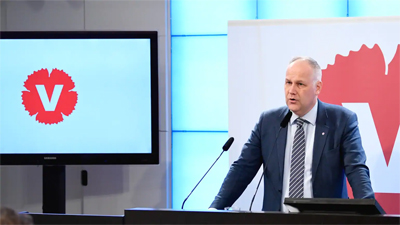
SD’s Jimmie Åkesson revels in his popularity
pic: SVT.se

The Sweden Democrats are in the middle of their “Land days” (landsdagar) congress in Örebro and the changes in their platform have been several. A change of heart? A maturing social and political awareness? Or a paint job to look a little more up to date?

The official SD political platform will likely include the following changes:

  • ok for homosexual couples to adopt kids: “all children have the right to have a mother- and father figure in their lives” they write
  • will go along with the current, legal 18-week limit for question-free abortions (not their previous platform of a 12 week limit)
  • no upper age limit for free mammograms or cervical cancer screenings (SvD.se/congress).

As Ewa Stenberg at DN writes, SD’s core ideology is still intact, though: people who come to Sweden must adjust to Sweden, or leave; the number of people emigrating to Sweden must decrease – in fact, more should leave than stay; SD will see a minimum of language differences, cultural differences and religious differences; public service radio and television should act to increase social cohesion, and; previously convicted, repeat offenders can just be tossed into jail again without trial – if they’re really, really hopeless cases.

Moreover, the party held that: asylum seekers should only come to Sweden first via the United Nations’ quota system, and that preference should be given to women, children and persecuted minorities such as HBT-persons and Christians; the requirements for citizenship should be raised and more clearly be coupled with high degrees of societal integration; citizenship can be recalled if the person lied on their application or if they joined a terrorist organization; police training can be paid in some cases; legal parameters for crime fighting should be widened and that it should be made illegal to join a criminal organization.

SD’s group leader (soon to be ex-group leader) Mattias Karlsson raved that only SD could save the country. “The situation for Sweden is a total catastrophe. Sweden is, seriously, in a do or die position” (SvD.se/congress).


22 Nov. – moderation in advertising

An open road to the gold!” “Lightning fast payments!

too risky to see
pic: play.diabetes.org.uk

According to Swedish law, gambling advertisements must be on the temperate side, nothing too crazy: They must be in moderation (vara måttfull). In December of last year, the Swedish Consumer Agency’s ombudsman sued Elec Games, the owners of Ninja Casino, for breaking the law – for not being moderate in their advertisements.

As evidence in their lawsuit, KO (Consumer Ombudsman) named Ninja’s slogans such as “Play now!” “Your win at your bank in five minutes” and “250 games and chances for miljons of kronor are only a click away. What are you waiting for?” as being much too obtrusive. A pop-up ad was deemed particularly egregious. Everyone recognized that one person’s egregious could be another person’s yawn, so the court’s decision was looked forward to (SvD.se/case).

Today, the Patent and Market Court of Appeal (patent- och marknadsdomstolen) agreed with the plaintiff and ruled that Ninja Casino’s advertisements were over the line. 20 advertising phrases that Ninja used, as well as the pop-up ad, did not meet the requirement for moderation. Furthermore, any future slogans “with the same meaning” will also be considered in breach of the law. Should Elec games ignore the judgement, a half million kronor fine awaits them (SvD.se/gambling).

Gunnar Wikström, who worked the case for the Consumer Agency, said that the verdict was important to establish how the word “moderation” should be interpreted. “It’s a pretty general concept, and therefore this case could provide answers. It’s been said in the preparatory legislative work that it was up to the court to draw that line, and that’s what the court has done now. “

“The court has judged that there is a connection between gambling advertisements and gambling disorders, and has taken into special account the effect that advertising has on persons who have, or who are danger of developing, a gambling disorder” wrote Chief Judge Alexander ramsay in a statement (DN.se/gambling).

Ardalan Shekarabi, the Minister for Social Security, was understandably glad. Shekarabi brought the responsibility for the gambling issue with him from his previous job as Minister for Public Administration because it bothered him so much (see this post). “This is a huge victory for everyone who has been engaged in the fight against aggressive gambling ads” he said. “Now no gambling company can say that the law is unclear.”

21 Nov. – another no confidence motion in the works

Sjöstedt has no confidence
pic: Jessica Gow/TT

Jonas Sjöstedt, leader of the Left Party, has threatened to set a no confidence vote into motion against Minister for Employment Eva Nordmark (read about no confidence votes here). Sjöstedt has made five demands, of which the first one is the big one:

  1. the government stops the privatisation of the Swedish Public Employment Service, aka Arbetsförmedlingen,
  2. the government allocates extra funds to stabilize the Employment Service’s ongoing work,
  3. the government creates an economically detailed and timely plan for stopping the closing of Employment Service offices, and ensures a continued presence across the country creates a plan and make the necessary decisions in the law or in regulations to maintain and develop the Employment Service’s special competencies regarding special needs and support for the disabled,
  4. the government states that any reform of the Employment Services will first be fully investigated in all relevant aspects, including cost estimates and transition procedures, before any part of the Employment Service is changed. An important part of this investigation is how municipalities’ responsibilities and economic situation is affected.

Reforming the Employment Service was a condition set by the Center Party to not vote down the Social Democrats in their bid to remain in power after the last election. Together with the Liberal party, the Center party and the two government parties agreed to a 73 point plan (also known as the January Agreement) that was filled with demands, including a total change in how the Employment Service was set up.

Many of the changes were anathema to Social Democratic voters, let alone Left party voters. The point that likely most sticks in the Left party’s craw is where it says ““This agreement means that the Left Party will not have influence over the political direction in Sweden during the coming term of office” (socialdemocraterna.se).

Sjöstedt is now considering calling the government’s bluff. Only together with the Left party does the government, together with the support from the Center and Liberal parties guaranteed by the government fulfilling the 73-point agreement, have the votes to pass legislation. Up until now, and even with the clause that was created to shut them out, the Left party has not withdrawn their support for the government: The alternative was clearly worse for them.

However, it seems that the Left party’s acquiescence is over, and that they’re even willing to accept support for their no-confidence motion from political opponents. The Sweden Democrats are already 100% behind the Left party’s idea, and even the Moderate Party is considering it. “We want to unseat all this government’s ministers, so it’s very likely that we’ll go along with a vote of no confidence” remarked Jimmie Åkesson, leader of the Sweden Democrats. Although reforming the Employment Service has been part of their platform for a long time, the Moderate party has problems with how it’s been implemented. Group leader for the Moderate party in Parliament, Tobias Billström, commented that although the Left and Moderate parties have very different ideas on how the Service should be run, the current plans for reforming it are “poorly thought out and badly instituted” and lack parliamentary support, to boot (SvD.se/Nordmark).

The question is what the government can do to appease the Left party, while not alienating the Center party. Also the Liberal party is left in a crunch situation: they went along with supporting a Social Democratic government largely to keep the Sweden Democrats isolated,and only as long as the January Agreement was upheld by all sides. If the government downshifts on its commitment to the agreement, the Liberals will be left hanging, and this when they are only just barely above the 4% threshold.

Sjöstedt has said that the government has two weeks to respond before he makes a no confidence motion.

20 Nov. – Will the EU renew Sweden’s exemption?

bus biofuel threatened by subvention ending
pic: mostphotos.com

Traveling by bus could be become more expensive if EU has their way with Sweden. Sweden has been enjoying an EU Commission-approved exemption from taxes on biofuels for several years, which has not only spurred use of the environmentally-friendly propellent, but has made it cheaper than regular gas or diesel (pwc.se). According to SVT.se, this subsidy is likely to end by 2021.

All of Stockholm’s busses are fossil-fuel free. 15% run entirely on biogas, and 51% of Stockholm buses run on biodiesel, according to biofuel express.

Just over 10 years ago, ethanol-driven cars were all the rage, and were considered the future. In 2006, the government passed a law requiring all gas stations to install ethanol pumps – those that couldn’t afford it had to close. Then, it turned out that motors didn’t actually handle ethanol that well, and questions were raised about how fabulous it really was if food stuffs were being turned into driving fuel. As SVT reports in this older article, the government also decided, at about the same time, to cut its subsidies for ethanol – as it was all going so well. It was soon curtains for ethanol, and everyone turned to wonder-fuel diesel instead. Fast forward a few years and we find that diesel is bad and electricity is transportation’s future.

Stockholm’s buses, however, have been using biogas very successfully, cheaply and cleanly. If Sweden is to enjoy the current lower cost, a new subsidy application to the EU will be needed. Right now, though, the EU is trying to get Sweden to pay more to the EU budget (negotiations on the next five-year EU budget are already very heated), and the EU isn’t likely to look too favourably on bailing Sweden out on this issue.

19 Nov. – don’t drink and drive even more

a Swedish jail, but still
pic: ticketsnipers.com

Reckless driver? Drunk driver? Repeat offender? The government today announced proposals to significantly increase the penalties for breaking traffic laws.

The maximum sentence for driving unlawfully and/or drunken driving is proposed to be raised from six months to one year. The maximum sentence for gross drunk driving is proposed to be changed from two years in jail to three.

Someone who repeatedly acts particularly recklessly in traffic can get a minimum sentence of 6 months or up to 5 years imprisonment. Recklessly can mean drunkenly, carelessly, and/or unlawfully.

In a written comment, Minister for Justice Morgan Johansson was positive to the proposals. “We cannot allow certain people to put others in danger again and again” (SvD.se/driving).

Johansson might have been referring to a certain case in Kramfors where a repeat offender has racked up 100 convictions for drunk driving, thievery, and threatening behaviour over the past thirty years. As one of his neighbours put it “He’s very shy when he’s sober, but when he’s under the influence he becomes rather a nasty person” (SVT.se/Karmfors).

The new laws are projected to come into effect in January, 2021.

18 Nov. – suicide assistance gave manslaughter

Ångermanland’s district court
pic: domstol.se

A man who helped his wife to commit suicide received a 1.5 year jail sentence for manslaughter today in Ångermansland’s district court (tingsrätt). The woman, his wife, had been sick for many years and had asked for help in dying several times. In both a video and a letter, the woman had expressed a wish to not live any longer.

Earlier in the evening, he said, his wife had not managed to depress the needle’s plunger by herself. In the end, the man gave his wife the deadly dose of morphine and oxycontin. The man did not deny his actions, but pled not guilty of a crime.

The court disagreed. “To take another’s life with intent is a criminal act even if it was with the person’s consent” wrote Chief Judge Lena Wahlgren in a statement (DN.se/dom). “Even if there’s consent, it doesn’t mean that you are released from responsibility if you intentionally kill someone (SvD.se/dom).

The prosecutor was satisfied with the judgment. “There’s no evil in this, it’s not about that. It’s just that one doesn’t want to have this be something that can be allowed” said Stina Sjökvist.

Suicide is not a crime in Sweden, and there are some instances where helping a person commit suicide (medhjälp till självmord) is not a crime either. For example, to give a gun to a suicidal person is not a crime, or to place a pill on a person’s tongue. Then, if the person pulls the trigger or swallows the pill, they commit suicide of their own free will, says professor Madeleine Leijonhufvud in this article.

However, as in this instance, if the person helps in a way that is an independent, decisive and ultimate action, it’s another story.

The minimum sentence for manslaughter is 6 years, but the court found there to be mitigating circumstances, for example that the man’s actions were meant to free his wife from suffering, and that he cooperated in the investigation.

Despite that the sentence he received was well under the minimum, the case will be appealed. The man’s lawyer, ex-Minister and radio personality Thomas Bodström, said in his statement that if ever there was a case that should go to the supreme court, this was it (SvD.se/dom).

17 Nov. – yes, pepper spray is illegal

working dogs on the job
pic: svt.se

Swedish Radio reported today that Swedish Customs (tullverket) has broken all records in confiscating pepper spray and tear gas at the border. Last year, customs seized 226 illegal products. This year, so far, they’ve seized 615 products – an increase of nearly 200%.

Jonas Karlsson, an expert with the National Coordination office at Customs, attributed the increase to rising anxiety and feelings of insecurity. “When people want to be able to defend themselves, they don’t usually choose a firearm but turn instead to tear gas or pepper spray.”

However, both tear gas and pepper spray are illegal to have without a license in Sweden. Both of them are considered weapons (read about the law here).

Not so in a couple of our neighbouring countries. Most of the goods are smuggled in from Denmark, where pepper spray is allowed in the home, and from Germany, where they’re both available without a license.

Customs believes that the number of canisters coming into the country is much higher than what they catch. “Our dogs aren’t trained for pepper spray” explained Karlsson. “We’ve also been told to prioritize firearms and narcotics.”

There are pepper-like sprays available for the nervous at heart, so called “defense sprays.” Using them, however, can still have serious legal consequences (see lawline.se). It might be better to sit tight and wait until the end of this government’s term of office – Minister for Home Affairs Mikael Damberg claimed today that he was certain that gang violence will have decreased by that time (Svd.se/Damberg).

16 Nov. – Sabuni’s kick-off speech

Nyamko Sabuni starts party congress in Västerås
pic: folkbladet.se

The Liberal Party started their party congress today in Västerås with a speech by party leader Nyamko Sabuni, her first since being elected in late June. SvD reports that Sabuni’s speech avoided all sensitive topics, like support for the Löfven government and the January Agreement, and instead focused on the issue of suburban zones, or hotspots (utsatta områden).

“Parallell societies grow because we politicians allow it” Sabuni stated. “Today, we launch a program for the suburbs with an ambitious goal – that there will be no vulnerable zones in Sweden in the year 2030.” Sabuni mentioned reforms on all fronts – crime fighting, extremism, economical self sufficiency, gender equality, democratic values and safer residential areas. “The suggestions deal with stopping the slumification that is a breeding ground for a negative progression. It’s about measures to lessen overcrowded living conditions and measures to reduce the number of people living off of government support (Svd.se/Sabuni).

In more general terms, Sabuni tried to raise the profile of the Liberal party on other issues as well. “Liberalism must answer,” she declared, “when it comes to dealing with the important questions – not least climate issues, immigration and the socioeconomic gap that is only widening in this age of globalisation.”

Taking a page from her predecessor Jan Björklund’s favorite playbook, Sabuni also stressed the importance of schools, saying that for the Liberal party, schools form the basis for everything. “It is there dreams and hopes for the future are born. This is why we Liberals have always prioritized schools.”

Also honor violence was mentioned. “After every summer vacation we see empty chairs where a girl once sat. But few municipalities follow up and ask what happened with these girls, and no one knows how many there are. We know exactly how many Almas were born in Sweden in 2018 -564 – but not how many were taken from school and married off. It can’t continue like this.”

15 Nov. – the PEN award: rubber meets road

know before you go
pic: 123rf.com

Tonight is the night Sweden’s Minister for Culture and Democracy, Amanda Lind, can be declared persona non grata and unwelcome in China. If the Swedish PEN prize is awarded to the jailed Swedish-Chinese publisher Gui Minhai, wrote the Chinese embassy on their website, there will be “consequences” (DN.se/Gui).

The Chinese embassy characterizes Gui Minhai as a “liar and a rumor-monger” DN reports. In an interview on Sweden’s Radio, the Chinese ambassador said that what Gui Minhai writes is based on lies, and that “Swedes, with a good conscience, cannot hurt the Chinese people’s feelings and damage Chinese interests.”

In response to the Chinese declaration, Prime Minister Löfven stated that the Minister for Culture and Democracy Lind will award the prize on Friday evening regardless of Chinese opinion. “She has been asked to give out the prize and she has said yes and it’s obvious we’re going keep that committment. In Sweden, we have freedom of expression – and that is what matters, period.”

China responded in turn that Amanda Lind will no longer be welcome in China if she gives out the Tucholsky Prize, which is specifically awarded to persecuted authors and publishers.

Gui Minhai left China for Sweden in 1988 to study. He became a Swedish citizen in 1992 and got his doctorate 4 years later. In 2012, he started a publishing company in Hongkong which gave out, among others, books on the Communist Party – which are forbidden on the Chinese mainland. About four years ago Gui Minhai disappeared during a visit to Thailand. It became clear afterwards that he had been picked up and detained by Chinese security. He is charged with a traffic violation that supposedly happened in 2003 (SvDse/GuiMinhai).

The question is not whether or not Lind attends the PEN event, but if she actually presents the prize herself. Lind says that it was obvious that she, as Minister for Culture and Democracy, would be there for the award ceremony – självklart att vara med på utdelningen (Svd.se/Lind), which isn’t the same as giving out the award. According to DN, the Chinese statement was that she would be denied entry to China if she participated in the prize ceremony – om hon deltar i prisceremonien. It remains unclear what will satisfy both the Chinese and the Swedish demands.

14 Nov. – statistically speaking

when you get the numbers wrong
pic: Christine Olsson, DN

The good news is that unemployment in Sweden was 6%, not the 7.1% that was the official number made public in September (see this post). The bad news, is that the number was revised not because unemployment went down, but because the first number was completely wrong.

Statistics Sweden (SCB) is the official government agency tasked with supplying government agencies with statistics on which to base their decisions and policies going forward. But when SCB does their surveys, it costs somewhere between 345 to 620 kronor per interview. Looking to outsource and cut costs, SCB took in some offers. One company came back with an offer of 217 kronor per interview, while another said they would take 210 kronor per interview. But Evry, the consulting company who won the job, offered to do the interviews for 140 kronor per interview (SvD.se/Evry).

Evry “didn’t live up to what they promised they would” said Joakim Stymne, general director at SCB (SvD.se/Evry). The contract with Evry has now been terminated.

Robert Bergqvist, cheif economist at Svenska Enskilda Banken (SEB) remarked that the main worry isn’t so much the outcome but the mistake as such. “Statistics are incredibly important for economical and political decisions, and unemployment data plays an important role for both the government and the Swedish Central Bank.”

Handelsbanken’s senior economist, Johan Löf, echoed his colleague’s sentiments. “For example, the Swedish krona dipped in response to the numbers, even if the effect was over after a couple days. The numbers were still so surprising that it had an effect on the financial market. For many Swedes, the upcoming salary negotiations are central. In this beginning phase, when the sides are formulating their cases, we’ve had a situation with almost catastrophic numbers. This has been seen in their arguments”(SvD.se/Evry).

Minister for Finance Magdalena Andersson was equally unhappy. “It’s obviously extremely serious when a government authority publishes incorrect statistics” she stated. “When the unemployment numbers first came out, SCB was contacted because the numbers looked strange. We had meetings and telephone calls with SCB.” When asked what the result was from those calls Andersson replied that she couldn’t answer that question for the moment (SvD.se/Andersson). But, she said, “I could never have dreamed that it could be wrong in this way” (DN.se/Andersson).

Questions have been raised regarding the reliability of SCB going forward, as well as questions regarding what their budget has been and how the money has been spent. In related news, however, Aftonbladet reported late this afternoon that the Swedish Transport Administration (Trafikverket), no stranger to similar scandals and problems, is requesting that the government change the law of public procurement (lagen om offentlig upphandling) so that authorities, such as themselves and SCB, are no longer required to accept only the lowest offer. Trafikverket just made public the news that their project Ring Road Stockholm (förbifart Stockholm) is now going to be years late and billions of kronor more expensive than the original plan, because of mismanagement by the entrepreneur they hired to do the work – who has also now been fired (Aftonbladet.se/förbifart).

For those who are interested, the unemployment rate for October – according to SCB, and “smoothed and seasonally adjusted” – is 6.8%. Really.