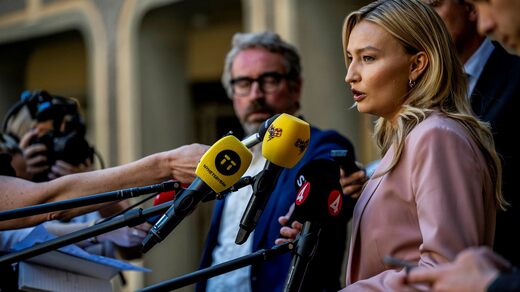
“Yes, I said the truth out loud” Ebba Busch did not say. image: Alexander Mahmoud (DN)
Ebba Busch, the leader of the Christian Democratic party, admitted today to committing gross defamation (grovt förtal). Busch referred to a person representing a man against whom she is embroiled in a court case as a convicted felon. The person actually is a convicted felon. In Sweden, this is still considered gross defamation.
Busch admits to committing a punishable offence, but that in her “heart and soul” she does not believe she is guilty: There are, according to Busch, judicial ambiguities (juridiska oklarheter), but she explains that she is putting these issues aside in order to “lead a country with considerably bigger problems than my personal honor.” She is, Busch continues, admitting to a crime in order to put an end to it, and says that she doesn’t “have the time to go through with examining a legal precedence that today is not clear.”
By admitting guilt, Busch skips the public grilling that a court case would give rise to. But her declaration that her case highlights legal equivocality is simply wrong, says DNs legal reporter Martin Schultz. “It has been well documented over the last few years that even the truth can be defamation” Shultz says. “By bringing up earlier crimes, she has called a person a criminal – which is technically a defamation.”
In American law, a statement must be false to be defamatory. Such is not the case in Sweden.
In American law, a statement must be false to be defamatory. Such is not the case in Sweden. Busch wants the complaint done and gone, but at the same time doesn’t want to really say she was in the wrong. It remains to be seen just how well Busch’s admission (and the real estate court case that gave rise to it) goes over with Swedish voters.
As promised, a review of the new laws and regulations for 2020, part 2:
Banks must maintain ATMs throughout the country. The major banks are now required to keep a minimum service level, including cash services, within certain distances from populated areas. For more, see this post that explained it already last June.
A reduced tax on gas and diesel. Everytime you fill ‘er up you pay a tax for the energy you use, and the CO2 you produce, while driving. This tax is going to be reduced, to make up for the increased cost for gas and diesel you’ll pay because distributors need to meet the requirements for the “duty of reduction” (reduktionsplikten). This is a requirement that requires that they mix in more biogas, which is more expensive, which they will pass on to drivers, so in turn, the government is reducing some of the tax you pay at the gas station.
The punishment for murder is increased. A life sentence may now be the penalty if a murder was carefully planned (föregåtts av noggrann planering), was particularly shrewd or clever (förslagen), was part of another crime, resulted in particular suffering (svårt lidande) or was in some other way particularly ruthless or unscrupulous (hänsynslös).
The minimum penalty for buying sexual favours from children is increased from fines to time in jail. The maximum sentence is 4 years.
Interfering with the work of first responders (blåljuspersonal, or blue-light personnel) is now punishable with time in jail. Sabotage mot blåljusverksamhet can give up to a life sentence. Also threatening or attacking a civil servant (tjänsteman) can land you in jail for anywhere from one to six years.
In other news, the previous name of the different administrative sections of Sweden was “landsting” but from now on and everywhere it is officially “region.” For example, landstingsfullmäktige (the body of representatives at the landsting level – those who have fullmakt (in this case, a mandate) – will now be regionfullmäktige. A region is bigger than a municipality, but smaller than the country. Stockholm is a region (used to be landsting) and Jönköping is a region, but also all of Värmland is a region.
In October 2017, a member of the Green party posted on her Instagram account that a colleague in her party, who then sat in Parliament, had assaulted both women and children in various ways, and over a period of time. Today, in Södertorns district court, the woman was convicted of defamation, fined, ordered to pay her victim, Stefan Nilsson, 40,000 kronor, and given a suspended jail sentence (SvD.se/pedo).
The reason she did it, the woman said, was to prevent him from getting another trusted position (förtroendeuppdrag) in the party. In addition, she said that she had no intention of erasing her comment on Instagram (although the account has since been closed). The case against the man was never taken to court, and she had never asked the police to investigate.
Her crime is not just what she said, but where she said it – on a social media account. “By calling this man, Stefan Nilsson, a pedophile, the woman has labelled him both reprehensible and a criminal” wrote the court in its judgement: “Such an attribution is in no way defensible” (DN.se/pedo).
Another, similar case is in the courts right now. Cissi Wallin accused a well-known journalist, Fredrik Virtanen, of rape – also via her Instagram account. She is also being charged, by Virtanen, with defamation. In both cases, because the accusations were posted on social media, they were particularly and seriously damaging – hence being taken to court (DN.se/media). Both men lost their previous positions.
However, in neither of these cases is the truth important. At least, not to the court. In other places (like the USA and the UK) truth is an absolute defense to defamation claims. One can’t claim unfair treatment/insult/slander/libel if the statement that was made is true. In Sweden, though, that isn’t what’s at stake: It’s that you said it at all, in some public manner. As Ängla Eklund, a a lawyer with Mannheimer Swartling, explained to SVT “In Sweden, even true information can be defamation.”
SD’s Jimmie Åkesson revels in his popularity pic: SVT.se
The Sweden Democrats are in the middle of their “Land days” (landsdagar) congress in Örebro and the changes in their platform have been several. A change of heart? A maturing social and political awareness? Or a paint job to look a little more up to date?
The official SD political platform will likely include the following changes:
ok for homosexual couples to adopt kids: “all children have the right to have a mother- and father figure in their lives” they write
will go along with the current, legal 18-week limit for question-free abortions (not their previous platform of a 12 week limit)
no upper age limit for free mammograms or cervical cancer screenings (SvD.se/congress).
As Ewa Stenberg at DN writes, SD’s core ideology is still intact, though: people who come to Sweden must adjust to Sweden, or leave; the number of people emigrating to Sweden must decrease – in fact, more should leave than stay; SD will see a minimum of language differences, cultural differences and religious differences; public service radio and television should act to increase social cohesion, and; previously convicted, repeat offenders can just be tossed into jail again without trial – if they’re really, really hopeless cases.
Moreover, the party held that: asylum seekers should only come to Sweden first via the United Nations’ quota system, and that preference should be given to women, children and persecuted minorities such as HBT-persons and Christians; the requirements for citizenship should be raised and more clearly be coupled with high degrees of societal integration; citizenship can be recalled if the person lied on their application or if they joined a terrorist organization; police training can be paid in some cases; legal parameters for crime fighting should be widened and that it should be made illegal to join a criminal organization.
SD’s group leader (soon to be ex-group leader) Mattias Karlsson raved that only SD could save the country. “The situation for Sweden is a total catastrophe. Sweden is, seriously, in a do or die position” (SvD.se/congress).
Reckless driver? Drunk driver? Repeat offender? The government today announced proposals to significantly increase the penalties for breaking traffic laws.
The maximum sentence for driving unlawfully and/or drunken driving is proposed to be raised from six months to one year. The maximum sentence for gross drunk driving is proposed to be changed from two years in jail to three.
Someone who repeatedly acts particularly recklessly in traffic can get a minimum sentence of 6 months or up to 5 years imprisonment. Recklessly can mean drunkenly, carelessly, and/or unlawfully.
In a written comment, Minister for Justice Morgan Johansson was positive to the proposals. “We cannot allow certain people to put others in danger again and again” (SvD.se/driving).
Johansson might have been referring to a certain case in Kramfors where a repeat offender has racked up 100 convictions for drunk driving, thievery, and threatening behaviour over the past thirty years. As one of his neighbours put it “He’s very shy when he’s sober, but when he’s under the influence he becomes rather a nasty person” (SVT.se/Karmfors).
The new laws are projected to come into effect in January, 2021.
A man who helped his wife to commit suicide received a 1.5 year jail sentence for manslaughter today in Ångermansland’s district court (tingsrätt). The woman, his wife, had been sick for many years and had asked for help in dying several times. In both a video and a letter, the woman had expressed a wish to not live any longer.
Earlier in the evening, he said, his wife had not managed to depress the needle’s plunger by herself. In the end, the man gave his wife the deadly dose of morphine and oxycontin. The man did not deny his actions, but pled not guilty of a crime.
The court disagreed. “To take another’s life with intent is a criminal act even if it was with the person’s consent” wrote Chief Judge Lena Wahlgren in a statement (DN.se/dom). “Even if there’s consent, it doesn’t mean that you are released from responsibility if you intentionally kill someone (SvD.se/dom).
The prosecutor was satisfied with the judgment. “There’s no evil in this, it’s not about that. It’s just that one doesn’t want to have this be something that can be allowed” said Stina Sjökvist.
Suicide is not a crime in Sweden, and there are some instances where helping a person commit suicide (medhjälp till självmord) is not a crime either. For example, to give a gun to a suicidal person is not a crime, or to place a pill on a person’s tongue. Then, if the person pulls the trigger or swallows the pill, they commit suicide of their own free will, says professor Madeleine Leijonhufvud in this article.
However, as in this instance, if the person helps in a way that is an independent, decisive and ultimate action, it’s another story.
The minimum sentence for manslaughter is 6 years, but the court found there to be mitigating circumstances, for example that the man’s actions were meant to free his wife from suffering, and that he cooperated in the investigation.
Despite that the sentence he received was well under the minimum, the case will be appealed. The man’s lawyer, ex-Minister and radio personality Thomas Bodström, said in his statement that if ever there was a case that should go to the supreme court, this was it (SvD.se/dom).
Swedish Radio reported today that Swedish Customs (tullverket) has broken all records in confiscating pepper spray and tear gas at the border. Last year, customs seized 226 illegal products. This year, so far, they’ve seized 615 products – an increase of nearly 200%.
Jonas Karlsson, an expert with the National Coordination office at Customs, attributed the increase to rising anxiety and feelings of insecurity. “When people want to be able to defend themselves, they don’t usually choose a firearm but turn instead to tear gas or pepper spray.”
However, both tear gas and pepper spray are illegal to have without a license in Sweden. Both of them are considered weapons (read about the law here).
Not so in a couple of our neighbouring countries. Most of the goods are smuggled in from Denmark, where pepper spray is allowed in the home, and from Germany, where they’re both available without a license.
Customs believes that the number of canisters coming into the country is much higher than what they catch. “Our dogs aren’t trained for pepper spray” explained Karlsson. “We’ve also been told to prioritize firearms and narcotics.”
There are pepper-like sprays available for the nervous at heart, so called “defense sprays.” Using them, however, can still have serious legal consequences (see lawline.se). It might be better to sit tight and wait until the end of this government’s term of office – Minister for Home Affairs Mikael Damberg claimed today that he was certain that gang violence will have decreased by that time (Svd.se/Damberg).
can this wave be stopped? pic: watersource.awa.asn.au
In the wake of the shooting and the explosion over the weekend, that the police now suspect are connected, there are several actions in the works: the police have labelled their response an “extraordinary operation” (särskilt händelse), the Moderate party has said they are behind the Sweden Democrats’ decision to call a vote of no confidence in Minister for Justice Morgan Johansson, and the Malmö police are organizing a special conference, with the local criminals.
Only the terrorist attack on the pedestrians on Drottninggatan in April of 2017, and the forest fires in the summer of 2018, have previously been classified as “extraordinary operations” by the police department. The current operation is being called Operation Rimfrost (hoarfrost in English), and allows the police department to make the decision-making process faster and increases their authority to reprioritize and move police forces around. “The number of persons in criminal networks shall be reduced by force” said Stefan Hector, chief of operations for NOA, the national operations division, “by which we mean arrests, charges and sentencing.” The police hope to seize more weapons and explosives as well. “In about 6 months we will have seen a difference” Hector predicted (SvD.se/rimfrost).
In related news, the Sweden Democrats have said they will be bringing a motion of no confidence in Minister for Justice Johansson to the floor at the party leader debate on Wednesday – and the Moderate party has said they will support it. Jimmie Åkesson, leader of the Sweden Democrats, declared that it was “obvious that the Minister for Justice, who in this case has the ultimate responsibility to handle this situation, does not understand its seriousness. He can’t handle it, and therefore parliament should in some way make clear its dissatisfaction with the work that is unfortunately not happening” (SR.se/Åkesson).
Moderate party leader Ulf Kristersson echoed his colleague. “It is right to direct a vote of no confidence in the Minister for Justice. For the last five years, he has been ultimately responsible for the situation we’ve arrived at in Sweden. It’s untenable. Either the minister does his job or he takes the consequences and resigns. We will be voting no confidence” (SR.se/Åkesson).
For a vote of no confidence to go through, at least 35 parliament members need to demand it. If a majority in parliament (175 members) vote yes, the minister in question must resign. So far, in Swedish history, there have only been nine – count ’em, nine – votes of no confidence. None of them has ever resulted in a minister’s resignation.
As far the other more right parties go, the Liberals have said they will not support a vote of no confidence, but that the government must “take vigorous measures against gangs.” The Christian Democrats haven’t yet commented. It is unlikely in the extreme that the more left Green or Center party will support it, altogether making the resignation of Johansson equally unlikely. The Moderate party’s youth wing, MuF, went its mother party one better and demanded a vote of no confidence in not just the Minister of Justice Johansson, but also on Minister for Home Affairs Mikael Damberg (DN.se/MuF). That one won’t be going anywhere, for the moment at least.
Meanwhile, the local police in Malmö have called a meeting for Tuesday. With the local criminals. The criminals that come don’t have to be the most violent ones, or the leaders – as long as they have legitimacy and that the others “listen when they talk” said Glen Sjögren, coordinator the “Stop Shooting” project (read more about the project here).
“We’re giving them a message – that we don’t want them to die and we don’t want them to kill someone. If they, or someone in their group, commit a crime involving lethal violence or explosives we’re going to focus on their whole group. If they want to leave their criminal life behind them, we’re ready to help them with that too” said Sjögren. “The goal is to stop the current crime wave and to prevent an escalation” (DN.se/slutaskjuta).
It seems like it’s all hands on deck, but whether or not talking leads to actions and then to an effect is anyone’s guess.
Welcome to Malmö pic: liveablestreet.wordpress.com
The death of a 15 year old who was shot in Malmö yesterday evening has caused a minor uproar. The pizzeria where he was shot is in a central part of Malmö, Möllevångstorget. One other, slightly older boy was also shot and is in serious condition. As of yet, there is no formal idea of who might be responsible.
DN interviewed several people who came to light a candle in a show of sorrow at the pizzeria. One woman, named Johanna, didn’t want to say her last name or have her picture taken at the scene. “I feel a huge hopelessness for the children who grow up in this town” she said. “I’m so scared that this will feed anti-democratic sentiment.”
DN quotes another passer-by as well, a sixty year old man, who describes the latest development as a nightmare: “A country like Sweden should take care of its citizens, but then this happens. I’ve been on the other side myself, I lived in this world for almost four decades. This is just crazy. They’re children. What can a 15 year old have done to deserve this? It’s the older ones who are using the younger ones: It can’t be anything else. And this whole thing with explosions. It’s only a small number who deal in these kinds of things. It shouldn’t be so hard to figure out.”
Only two kilometers away, reports of an explosion were called in, close to the time of the shooting. The police are treating these incidents as unrelated, SvD reports. But “per capita,” Henrik Häggström, senior analyst at the Swedish Defense University (försvarshögskolan) said in an interview with TV4: “you have to go to Afghanistan to find a similar situation to the one in Sweden” (SvD.se/15).
The shooters were said to have fled the scene on bicycles – being, perhaps, too young to have a drivers license.
It’s difficult to get a good sense of the numbers of explosions that have occurred in Sweden over the past year. In August, SVT reported that there were 120 explosions to which the bomb squad was sent out between January and July of this year. After the three latest bombs in Malmö this weekend, DN is reporting 102 explosions where the bomb squad was sent in so far this year.
The one sure thing in all these numbers is that no other country in Europe has these kind of statistics. In fact, DN reports, experts are coming to Sweden to take a closer look at this development for themselves, and to think about how they can keep it from happening where they come from.
So far, there have not been large number of deaths and injuries from detonations, but there are concerns that as the bombs become more advanced and able to be set off from far away, via a mobile, for example, the number of casualties will rise. “Previously, these cases dealt with hand grenades, and there could be witnesses” said criminologist Amir Rostami to DN. “But now, when one can plant a bomb and set if off from a distance, it gets more complicated.” Very few of these crimes are solved – in many cases, material that could be used to identify the criminal parties is simply blown up.
It’s not just anybody doing this, but anybody can be hit” said one man to DN in regards to the bomb in Almgården early on Saturday. “I was sleeping with my kids, 11 and 4 years old, when the bomb went off. We all jumped up in our beds and for the rest of the night it was impossible to calm down.”
Police in the South Region have created a committee to examine the issue and to see how to infiltrate the groupings of people behind the bombings (sprängningskommission). Meanwhile, Veronica Truedsson and her family are pulling up stakes and leaving Malmö. “We’re scared to death of the escalating violence here” (DN.se/leavingMalmo).