10 Dec. – and nothing’s on

enjoying a wide variety of broadcasts
pic: freepik.com

“There’s nothing on” is a favorite refrain, but the worry is now that the choice of things not to watch could be even less.

When Telia (the huge telecom company) got the go-ahead, and went ahead, to buy Bonnier Broadcasting there were some concerned voices. Namely that the Swedish state owns a whole 38% of Telia. Bonnier owned TV4 and C-more. Now that Telia bought Bonniers, the state now also owns a chunk of TV4 and C-more. Remember that the state also has the state-owned channels SVT1 and SVT2. This means that the state has pretty much a lock on a big part of the media landscape in Sweden.

There are many voices that say that the state doesn’t really, really control SVT1 and SVT2 – there are independent boards in between, there are laws saying the state can’t get too involved… but the uncomfortable fact remains that the state has pretty much a lock on a big part of the media landscape in Sweden.

One little uncomfortable blip came up only last week when SVT News announced that they planned a big new news program on SVT1 at 10pm every night. 10pm is when TV4 has (and has had for years) their own news program. This meant that the broadcasts conflicted with each other, and that “the public had to choose between the programs instead of being able to take advantage of a variety of news in the evenings” wrote TV4 journalists in a debate article. The journalists asserted that sending a news program at the exact same time as TV4 broke the newly agreed upon broadcasting license in which it is stated that SVT must work to present a variety of perspectives.

SVT changed their plans for their program, but the problem highlighted what can happen when they both largely belong to the same actor: two programs could easily have become one. Two perspectives could have become one. Representation could have been halved.

Both the Sweden Democrats and the Moderate party are pushing for the state to first look over how much of Telia and its network that the state should hold on to for national security purposes, and then to sell the rest, SvD reported back when the sale was initiated. Ibrahim Baylan, the social democratic Minister for Business, Industry and Innovation was less direct but said that it was up to Telia to be a responsible owner as the deal was getting a lot of political heat.

There’s been more shenanigans recently, although a TV4-less Christmas holiday has been avoided. Com hem, the cable distributor, is owned by Telias competitor Tele2. TV4 (now owned by Telia and by extension partly also by the state) is distributed by Com hem (DN.se/TV4). The contract between them is up at 12 tonight, but they somehow haven’t been able to reach a new agreement: TV4 was about to go to black on a third of Sweden’s televisions at the stroke of midnight. However, just this afternoon, TV4 said that they’d allow Com hem to send their programs without being paid for them until January 10th. In other words, fans of Jul med Ernst are saved. Also it would have looked bad for Telia (see above) if TV4 wasn’t able to be seen by a third of the country just when everyone is free to watch TV.

correction: news tweets have just gone out to say that TV4 will actually go to black at midnight tonight – the free offer wasn’t a free offer it turns out, and negotiations have broken down. This isn’t good, as it basically leaves viewers with SVT if they’d like some news besides from international cable channels. TV3 has The Real Housewives of Beverly Hills and Extreme Makeover: Home Edition though, so that’s something.

It’s time for the government to get out of the broadcasting business.

9 Dec. – political Twister

strange political twists
pic: amazon.com

As expected, the government and its partners, the Center and Liberal parties, agreed today to postpone and rethink the Employment Service’s reform and privatisation. As written about in this post and this post, Jonas Sjöstedt threatened to bring a vote of no confidence to the floor if the government didn’t stop the reform. The Sweden Democrats (SD), as well as the Moderate and Christian Democratic parties, hopped on the Left party’s train. This was an unexpected development for the government, never having imagined these parties to side with each other on anything.

After a weekend of negotiations with the Center and Liberal parties – the Center party being the main instigator of the Service’s privatisation to begin with – the government has proposed a new timetable for the reform. As Göran Eriksson at SvD puts it, the government backed off on all the points that SD and the Moderate, Christian Democratic and Left parties agreed upon and had a majority in parliament to back it up with, but kept the points that those parties didn’t agree on and didn’t therefore have a parliamentary majority on. In other words, the government satisfied the SD, Moderate and Christian Democratic demands, but not all of the Left party’s demands. How the Center, for whom this matter was close to the heart, is going to frame the postponement remains to be seen.

The gist of the new proposal is that “the law of free system choice” (Lagen om valfrihetssystem, or LOV) will not be the only regulation implemented for employment actors ( – so not just private employment companies will be allowed to help job seekers, but also public organizations like the current employment service and even voluntary organisations can be involved). The government has also gone along with instituting a control system so that there is some kind of check on which companies are being paid from public coffers for doing what. Finally, the reform timetable is being put off a year, to 2022 (DN.se/reform).

So the government is saved, and what remains is how the parties are spinning it. Liberal party leader Nyamko Sabuni, one of the government’s supporting parties, is insisting (despite all evidence to the contrary) that the Left party had no influence over the government’s decision (according to the January agreement that allowed Löfven to hold onto power, the Left party is not “allowed” to have any influence over government policy). The Moderate party is calling the Liberal statement “nonsense“. As previously noted in this blog, Löfven is likely delighted over the postponement.

What he is likely not at all delighted about is this newfound spirit of cooperation between opposition parties with completely different political bents. It is hard to see where they might cooperate next (and they’re certainly not saying) but who knows. The Left party didn’t mind using public support from SD to get their way – gasp – which was also somewhat interesting (they didn’t have lunch or anything though). The Moderate party leader has had lunch with the SD leader Jimmie Åkesson just recently, but now has also just backed the Left party.

What bizarre political constellations can possibly follow?

6 Dec. – Nobel news

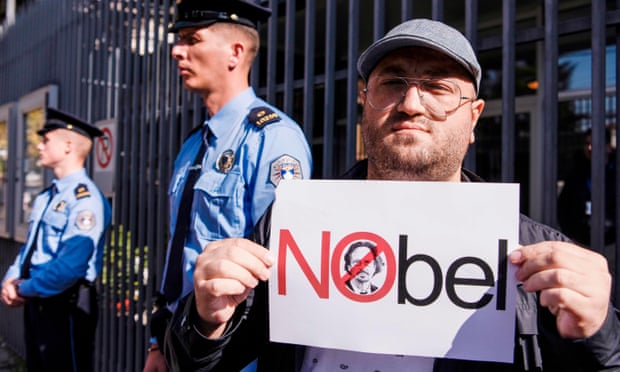
the Handke nomination still causing an uproar
pic: Armend Nimani/AFP/Getty

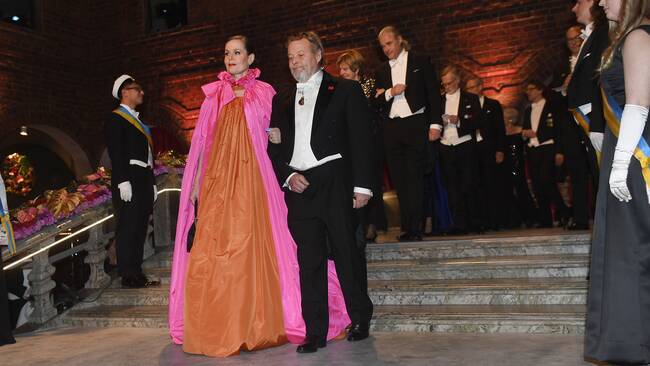
Besides Lucia and her flickering crown on the 13th, the other bright point in the otherwise compact darkness of December is the Nobel festivities. We will certainly miss the late permanent secretary of the Swedish Academy, Sara Danius, a bright point in a bright point, and the way she would sweep down the stairs in a fabulous dress (putting everyone else to shame in more ways than one).

Sara Danius at the Nobel festivities
pic: DN.se

Despite frantic measures to put the Nobel Prize for Literature back on its feet, it was again lambasted this year for its choice for the 2019 prize. Already two members of the external committee that helps the Academy choose a prize winner have stepped down this last week, and now, a long-term member of the Academy, Peter Englund, has said he will not participate in the award ceremony in protest of the 2019 choice, Peter Handke.

The critique of Peter Handke is in regard to his not very critical stance towards the Serbian regime during the war in former Yugoslavia. He is accused, among other things, of relativising mass murder, and of denying the genocide of 8000 muslim men and boys in Srebrenica in 1995 (SvD.se/Handke). Peter Englund saw the war first hand as a reporter for Expressen and Dagens Nyheter: “To celebrate Peter Handke’s Nobel prize would be extreme hypocrisy from my side” he wrote in a mail to DN.

Others are not so categorical. “He is basically anti-fascist; there is a lot of evidence for this” said Thomas Steinfeld , a professor of theory and literary criticism. “When he avoids the use of the word genocide for anti-fascist reasons, it’s interpreted as though he’s denying it.” Steinfeld goes on to say that this is the biggest misunderstanding of Handke’s work (SvD.se/Handke). (There are reams of articles about Handke’s nomination in all sorts of languages, if interested).

Meanwhile, 2018’s prize winner, Olga Tokarczuk, will – yes – be visiting school children at a Rinkeby school during her week in Stockholm after all. The tradition has been that this particular school studies the literature of the prize winner (why it isn’t Peter Handke, see above), and then the prize winner visits the school. Earlier, Tokarczuk was not going to visit the school at all, but someone reminded her that these are children, this is what is done, and that she needed to get with the program. It was just a misunderstanding, said her translator.

5 Dec. – saving Unemployment and face

future uncertain
pic: Per Gudmundson, SvD

Remember back in November, when Jonas Sjöstedt threatened to bring a no confidence vote to the floor to protest the government’s plan to completely reform the Swedish Public Employment Service (better known as Arbetsförmedlingen)? If you forgot, there’s a post to read about it here. And if you didn’t, well, time is almost up. If nothing happens, the vote of no confidence on Eva Nordmark, Minister for Employment, will happen on Tuesday.

When Sjöstedt, leader of the Left party, first made this threat, he was not just protesting the disassembly and privatisation of the Employment Service, but also the provision of the January Agreement that said that under no circumstances was the Left party to have any influence over government policy. The provision was stipulated by the Center and Liberal parties specifically as a requirement for their support for the formation of the Löfven government.

It’s understandable that this was part of the Left party’s anger, as the government is absolutely dependent on the Left party to stay in power (otherwise they don’t have the votes to pass their budget). Still, it was likely the government thought that they were safe because the Left party would never vote with the Sweden Democrats, and the two right block parties, to topple them…

Until today, it turned out, when the Left party became willing to do just that. Apparently, the meetings held between the Social Democrats and the Left party have not been assuaging enough. The Left party is determined to change the course of the government in respect to the current privatisation of the Employment Service.

Despite the appearance of a wrench being thrown into the disassembly work, threats being tossed about, and very serious looks on all party leader’s faces, it’s likely most of them are glad for Sjöstedt’s moves. The Unemployment Services’ quick and dirty disassembly was causing a lot of worry and problems at the municipal level: When workers are getting unemployment help they do it through the Employment Service. Without an Employment Service office nearby, the sooner the unemployed would turn to the local municipality for help – and that would be expensive, as well as more than the municipalities thought they could handle.

With the way things were going, it looked like a disaster was shaping up. Despite having previously been very much in favor of dismantling the Employment Service, the Moderate party and the Christian Democrats are now saying that they have always thought the deconstruction was going too quickly, and that’s why they are backing Sjöstedt. They are also happy when their former Alliance parties, the Center and Liberal parties, don’t get what they said they were going to get by leaving the Alliance and throwing their support behind the Social Democrats: If they can make the Center and Liberal parties look bad, the Moderate and Christian Democrats won’t be fussy about how.

Even Löfven is secretly happy because he has definitely not been a fan of this process, but was forced into moving quickly by the Center and Liberal parties and the agreement they signed back in January. The Left, Moderate, and Christian Democratic parties are actually doing him a favour if he can get out of it.

What remains to be done is for Löfven to spend the next few days finding ways to pacify the Center and Liberal party leaders and help them find ways to save face when the Unemployment Service is now not going to be disassembled as rapidly as first imagined. The Center and Liberal parties know that if the no confidence vote goes through, the government will be significantly weakened and they could find themselves on their own. A way to avoid this is most likely going to be found.

Meanwhile, Minister Eva Nordmark must be feeling a bit like a punching bag. A no confidence vote is supposed to mark no confidence in the Minister. The Left, Moderate, and Christian Democratic parties, plus the Sweden Democrats, though, are not actually protesting her, or the way she is doing her job: They’re using a no confidence vote against her to not just protest a current political course of action, but to get back at the government and its supporting parties. It’s going to be hard to see any impressed faces on the voters anytime soon.

4 Dec. – Kristersson at the Rubicon

Åkesson now allowed to join in some reindeer games
pic: expressen.se

As DN’s Ewa Sandberg put it, the Moderate party leader Ulf Kristersson ripped the bandaid off, and had an official chinwag today with Jimmie Åkesson, leader of the Sweden Democrats. The taboo of speaking to Åkesson in an official capacity has officially been challenged, even more than when the Christian Democratic party leader had lunch with him. DN’s editorial board called it “wrong”, and “ill-judged”, and “unwise” – because the Sweden Democrats (SD) are “not a party like the others. It’s a movement with roots in nazism” (DN.se/bandaid).

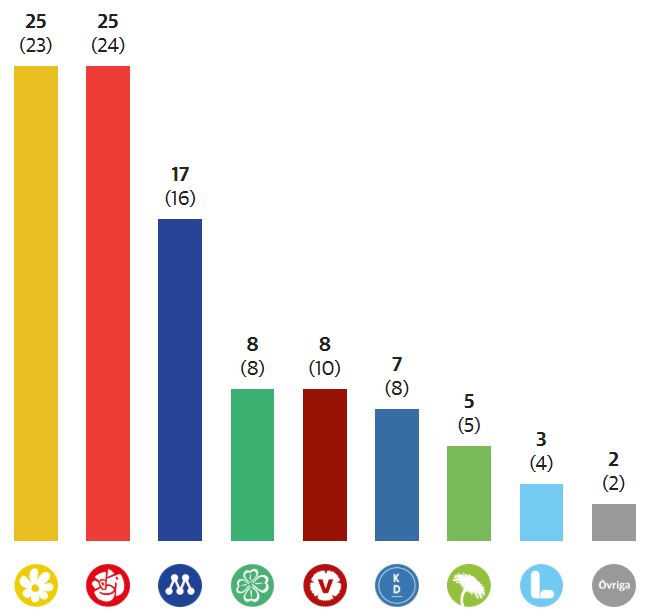
The latest and most stodgy poll of them all, the poll done twice a year by Statistics Sweden, had the Social Democrats at their lowest level in years (for the SCB poll) at 26.3% and the Sweden Democrats at their highest, with 22.6%. The Moderate party, who has almost always been Sweden’s second most popular party and opposition leader, was, again, a decided third (DN.se/SCBpoll).

When he was first elected party leader, Kristersson said he would never speak with, negotiate or compromise with the Sweden Democrats. But that was over two years ago, when it was still possible to bully them in parliament, and not let them join in any reindeer games. SD has since only become more popular, and nearly a quarter of the population is giving them the thumbs up. For the Moderate party (still the party that knows what fork to use between them) to gain power and get its policies through parliament to make its supporters happy, it needs SD. The Moderates appear to have given up the idea of getting the previous Alliance together completely, and are throwing a feather of their hat in with the Sweden Democrats. Rubicon, crossed.

As previously noted in this blog, the Sweden Democrats have had it easy, having never had to face the music for their enacted politics because they’ve never had the chance to enact any of their policies on a national scale (just in Sölvesborg and the jury is out over there).

But even if the majority of Sweden’s voters might someday vote for SD, which isn’t likely, maybe it won’t really matter – because according to Dagens Nyheter “the majority is never definitively right, even if it calls itself “the people” (DN.se/bandaid). Some people might think a statement like that is even more scary than SD.

2 Dec. – truth not an issue

when truth isn’t the point
pic: sverigesradio.se

In October 2017, a member of the Green party posted on her Instagram account that a colleague in her party, who then sat in Parliament, had assaulted both women and children in various ways, and over a period of time. Today, in Södertorns district court, the woman was convicted of defamation, fined, ordered to pay her victim, Stefan Nilsson, 40,000 kronor, and given a suspended jail sentence (SvD.se/pedo).

The reason she did it, the woman said, was to prevent him from getting another trusted position (förtroendeuppdrag) in the party. In addition, she said that she had no intention of erasing her comment on Instagram (although the account has since been closed). The case against the man was never taken to court, and she had never asked the police to investigate.

Her crime is not just what she said, but where she said it – on a social media account. “By calling this man, Stefan Nilsson, a pedophile, the woman has labelled him both reprehensible and a criminal” wrote the court in its judgement: “Such an attribution is in no way defensible” (DN.se/pedo).

Another, similar case is in the courts right now. Cissi Wallin accused a well-known journalist, Fredrik Virtanen, of rape – also via her Instagram account. She is also being charged, by Virtanen, with defamation. In both cases, because the accusations were posted on social media, they were particularly and seriously damaging – hence being taken to court (DN.se/media). Both men lost their previous positions.

However, in neither of these cases is the truth important. At least, not to the court. In other places (like the USA and the UK) truth is an absolute defense to defamation claims. One can’t claim unfair treatment/insult/slander/libel if the statement that was made is true. In Sweden, though, that isn’t what’s at stake: It’s that you said it at all, in some public manner. As Ängla Eklund, a a lawyer with Mannheimer Swartling, explained to SVT “In Sweden, even true information can be defamation.”

Good to know.

29 Nov. – China, Sweden, Huawei and Lind

FOI’s who’s who in ownership
pic:unctad.org

Due to a lack of cooler political news, the topic today is the Swedish Defense Research Industry’s report that came out this afternoon on how much China has invested in Sweden. It’s not peanuts.

You’ve driven, perhaps, a Volvo? Enjoyed some Oatley with your morning cereal? Seen a movie distributed by Filmstaden, or sung along to a favorite playlist on Spotify? These companies-of-Swedish-origin, and many more, are entirely, or partly, owned by Chinese companies. The purchase price of the biggest nine companies is 94 billion kronor (SvD.se/China).

Sweden isn’t the only supermarket where China’s shopping. Huge American companies like Smithfield and Hoover and AMC Entertainment and many (many many) more are also Chinese owned. Other countries’ businesses own US companies too, of course. Gerber, whose pureed peas have fed millions of American babies, is owned by a Swiss company.

But China isn’t Switzerland, mainly because it’s a major economic and political-system competitor with an economy controlled by the state with muscles they regularly bring to bear to sway, ignore, or break market regulations. US President Trump ordered companies to move their business out of China last August, but CNBC reports (here) that many companies were already on their way out. China, on the other hand, is not ordering its companies out of anywhere.

The Chinese telecom company Huawei’s forays into the 5G network being set up in the US has been stopped, also in Australia and Japan, due to security concerns. Two laws in particular were too worrisome to dismiss: one was the Chinese 2014 Counter Espionage law that said that companies could not refuse to provide information if or when the state security organ requests it; the second was the 2017 National Intelligence Law stating that “any organization or citizen shall support, assist and cooperate with the state intelligence work in accordance with the law” (CNBC.com/China). Although Huawei has insisted they would never, ever, access their network for nefarious purposes, there’s still a niggling worry at the back of a lot of people’s minds.

Seemingly not in Sweden (although one must assume Ericsson has the corner on building Sweden’s 5G network?). Many European countries haven’t made a final decision on whether to allow Huawei a role in building their 5G network. But a change might be coming. Germany was all set to embrace Huawei, and have them build their 5G network, when just the other day, members of Merkel’s own party threw a monkey wrench in the works and refused to back her plan (FI.com/China). Surprise! There are worries that China will respond, at a time when Germany’s economy is not at its strongest.

Which only illuminates the economic issue. No matter how bad China might act, Chinese ownership of big companies distributed over different industries makes it hard for a country to protest. “Biotech, electronics and industrial products are the most common investments” reported Oscar Almén, one of the investigators at FOI.

When Minister for Culture Amanda Lind went ahead and presented the Swedish PEN prize to Gui Minhai, the Chinese ambassador was not pleased at all (see this post). Speculation is, that China’s refusal to distribute a Swedish film, Cold Case Hammarskjöld, as well as another Swedish film, is an act of reprisal (DN.se/China). If so, let’s face it, they clearly aren’t that mad at Sweden. But it’s still a jab. A 5G network is a much bigger issue. As is ownership of sensitive companies or building out Stockholm’s subway system. For more information on why Sweden always takes the lowest bidder’s offer, and where that can lead, see this post.


28 Nov. – Johansson at the gate

Ylva Johansson finally on the job
pic: epthinktank.eu

The European Union’s Commision is finally fully staffed, approved, and ready to get to work. With a vote of 461 for, and 246 against, the commission headed by Ursula von der Leyen was approved by the EU parliament yesterday after an occasionally bruising interview process.

Sweden’s own Ylva Johansson (see this post) officially begins her stint as Commissioner for Employment and Integration – in other words, Migration – one of the most visible and controversial posts in the EU (see this post). She is starting off with getting her boots on the ground in Greece, where she will speak to Greek representatives and NGOs to discuss how they can move forward.

The Greek refugee camp at Moria has been regularly labelled a human rights disaster for its wretched conditions, most recently in a report from EU’s auditors (you can read it for yourself here) describing situations of 16 boys sleeping in a container built for max 10, people and families living in tents in the bush, and more. Although the initial contact regarding asylum is supposed to take place only a few days after arrival, the average time is 218 days for a decision at the first level. Asylum seekers who arrived in 2018 have appointments for 2023.

Greek officials are in the process of closing the camp, and transferring the refugees inland, but nothing is expected to essentially change just because of a new location.

One of the suggestions for an EU-wide migration policy is that countries would pay to not take refugees – in which case a price would be attached to each migrant.

“Not a suggestion I would choose at first go” said Johansson. “What’s been discussed between member countries, that I’ve heard, is that they could contribute in a practical way with personnel or other efforts. That’s perhaps a better track to start discussions on.”

Von der Leyen has gone on record to say that “Migration is a phenomenon that is not going to disappear. Our job in the EU is to develop an overall migration model that is humane and effective. A model that can make us an example for the rest of the world in how migration can be handled” (DN.se/UvdL).

No pressure for Johansson, in other words.

27 Nov – unavoidable poll results

It happened again – the Sweden Democrats tied for first place in the latest poll. This time it was the Dagens Nyheter/Ipsos poll, whose results came out this afternoon. In the previous poll, the Sweden Democrats (SD) and the Social Democrats were also equal at the number one spot, but the margin of error negated the certainty of results. This time’s results confirm the trend (DN.se/Poll).

For a party that all the other parties wouldn’t speak to – ignoring them like children in a playground – the Sweden Democrats have done ok. More than ok. And the irony is that they’ve done so well – arguably – because everyone else was excluding them from their games and policy making. The Sweden Democrats have gotten votes from everyone who blames immigration for Sweden’s woes, from those tired of the current parties, and from those who protest how things seem to be going in Sweden – all the while being spared from having to face voter fire and ire because they haven’t been responsible for any of it: They’ve been kept away from any formal position of power, but also from responsibility.

The changes in percentage points were small and can easily sway another way come next poll. However it appears clear that Nyamko Sabuni is not raising her Liberal party’s numbers, and that Moderate party leader Ulf Kristersson is going to have a very hard time over the next few months (weeks?) making the decision of how close to the Sweden Democrats he’s willing to get. If he’s willing to formally stand with SD, the right block composed of (theoretically speaking) the Moderates, the Christian Democrats and SD get 48% of voter support, in contrast to the 42% the consortium of Social Democrats, Center, Liberal and Green parties have together. However, these parties have the support of the Left party: However unhappy the Left is with the Social Democrats, it’s highly unlikely they’ll help to vote them out. The Left gets generally at least 8% of voter support, which tips the scale.

The problem with lumping the right block parties together is that SD isn’t really a conservative party, but instead has often actually voted with Social Democrats on policy questions. What unites them with the right block is largely opposition to the current Social Democratic and Green party government, and a promise for a tougher stance against crime. How close they really want to dance, especially at future balls, is hard to say.

As mentioned in this blog the other day, the Sweden Democrats have made a lot of platform changes, making themselves over into a party you could invite in without having to be too scared of what the neighbours might think. They are, and have been for years, much too big to ignore. 25% of the population, at last poll, is ready to come to any party where SD is included.

25 Nov. – layoffs causing anxiety

clouds gather over South Hospital
pic: stockholmdirekt.se

It seems to be going around. “It” being hospital staff being laid off.

First it was the two Karolinska hospitals- the old one Karolinska University Hospital, and the new, but disaster-prone, New Karolinska Hospital in Solna. This newest hospital in the country was going to be the bestest and most specialised care available for money. (Bestest isn’t a word, but the superlatives used in describing the hospital ran amuck when the hospital was being built.) Alas, they have no money. After the cost of building the new hospital came to twice the original estimate (and it still doesn’t work well – see lack of sterilized instruments, specialised child care but no play rooms, phones not working, and the list goes on), Stockholm region couldn’t cough up any more money to cover the hospital’s budget deficit this coming year. Three weeks ago, the hospital administration gave notice to 600 doctors and nurses’ aides – this even after it gave notice to 550 administrative positions earlier this spring (SvD.se/Karo).

Today, both Danderyd Hospital and South Hospital (Södersjukhuset) gave notice they’re letting personnel go – 100 jobs at Danderyd (so far undetermined which categories), and 25 doctors, 25 nurses and 25 others at South Hospital.

Göran Stiernstedt, chair of Region Stockholms common board for Danderyd, South and Södertälje hospitals, said the budget deficit is to blame. Cutting staff was the only way to manage the budget, he explained. “I understand if patients are concerned. It is our ultimate goal that care will be affected as little as possible” Stiernstedt wished aloud to SvD. “But there are no guarantees that the personnel retrenchment (åtstramningen) won’t go unnoticed. There is that possibility. It can’t be avoided.”

Left party care spokesperson Jonas Lindberg called it a complete catastrophe. Also the main opposition party in Stockholm, the Social Democrats, took issue: Opposition counsellor Aida Hadzialic (see this post) said that the notices can be a threat to patient safety. “I’m seeing all the warning lights blinking. Care for the sickest patients in Stockholm is threatened. Patient safety is threatened – there’s a wave of notices being given at our hospitals at a time when we know staffing is a problem” (DN.se/Karo).

Even Moderate party Stockholm veteran, responsible for finance, Irene Svenonius called the situation serious – and she’s one of the major players in the issue. “Naturally, it’s a serious situation when a hospital must let people go to manage a budget deficit. And they must redimension their operation in regards to the agreement they have with the health and hospital board” (DN.se/Karo).

(By the way, substitute her “And” for “But” and the sentence makes more sense. This rhetoric trick is making the rounds from schools to businesses.)

Green party Environment and Public Transport counsellor Tomas Eriksson added his voice to the issue, saying he understands if Monday’s announcements cause worry, but: “At the same time, the hospital runs a deficit, and more care is being moved closer to the patient level – it isn’t tenable. The resources need to move as well” (DN.se/Karo).

But back at Kommunal, the largest union in Sweden and the main union for health care workers, managers were angry. Anne-Li Rosengren, a negotiator for Kommunal representation at South Hospital, got word of the notice only in the morning. “It’s been a couple of hours since I heard. At first, I was sad. Now I’m mad as hell (fly förbannad)” (SvD.se/South).

Sweden has one of the highest number of doctors per capita, although this varies a lot by region (see a report here). It also has some of the longest waiting times for surgery, and the fewest number of hospital beds per capita in Europe (see this report).