16 Jan. – apartment queue at record high – again

get in line – you’re behind 676,000 people
pic: dreamstime.com

It’s not really new, but SvD published the latest figures – a new record – on the Stockholm apartment queue today. Over the last year, 40,000 new names were added to the list – bringing the number of people in line to get a rental apartment to a nosebleed high of 676,000 people. It’s almost twice the number of the people already living in Stockholm’s inner city limits.

The Stockholm apartment queue is an institution: you sign up, you pay a yearly fee, and sometime – around fifteen-twenty years down the line if you want an apartment in downtown Stockholm – you’ll be given an apartment. Not for free! No, you still have to pay rent and all. It’s just that you’ll have a chance to get an honest-to-God apartment in Stockholm without any hassle. All you need is patience and 200 kronor a year to keep your place in line (bostadskö).

There are faster ways to get an apartment, but it’s a tradeoff in time and money. There are also different queues, for example if you’re a senior citizen (over 65) there’s another queue, and it’s even a little shorter – the average waiting time is 10 years. If you have special needs, there’s another queue. For students, there’s an average wait time of 5 years.

According to this older article, about 12,000 apartments are announced out every year but they’re not always snapped up. Stories abound of apartments to let, with announcements sent out to hundreds of people, that nobody then accepted (see one story here). The system’s inflexibility also means that someone suddenly in need of a place to live due to health or divorce and the like, can be completely out of luck.

It has become something entirely different than the what it was set up to be back in the 40’s. These days, there are tens of thousands of people that are in the queue “just in case” and who already have an apartment. Martin Lindvall, public policy chief at the property owners association Fastighetsägarna, told SvD that the queue functioned a bit like an insurance policy: “Those first in line” he said, “are those who are already well established.”

However, 676,000 people paying 200 kronor a year brings in 135 million kronor to the city, which is not to be sneezed at. We can only hope that some of that money goes to people for whom the queue was supposed to help.
14 Dec. – health care protests in Stockholm

healthcare workers hit Stockholm streets in protest
pic: Claudio Bresciani/TT

“The section is closed,
and the patient is dead,
“but everything’s fine”
the hospital board said.” *

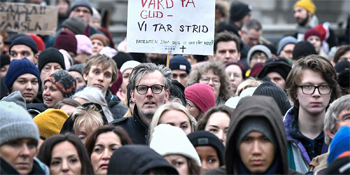
So went the poem (roughly translated, and with a good dose of poetic license) by medical student Alexander Radkiewicz, at the demonstration protesting hospital staff layoffs in front of the parliament building in Stockholm today (SvD.se/demo). As written about earlier, in this blog post, a total of 1350 layoffs have been announced over the last several months, and an additional budget cut to the tune of 1.1 billion kronor has been mandated by Stockholm Region council.

The facebook group behind the demonstration has 16,000 members. “The younger people are the ones that are the first to be affected by the layoffs” said Laura Björnström to SvD. “This can wipe out an entire generation in health care” added Akil Awad, one of the demonstration organisers. “You hear it all the time – it’s like a mantra – that patient safety isn’t at all threatened (by these layoffs)” he continued. “But for us who are there working, we see that it is. We see it all the time.”

Anna Starbrink, Region Stockholm councilperson responsible for healthcare, told SvD that she understands the tough situation: “Obviously, a lot of thoughts go through one’s head when you see such a demonstration. At the same time, you need to remember that it’s fantastic that so many are so engaged in the healthcare issue.”

Be sure to remember that, next time you need health care in Stockholm.

* “avdelningen är stängd/och patienten är död/men på patientsäkerheten går det iiiiingen nöd

25 Nov. – layoffs causing anxiety

clouds gather over South Hospital
pic: stockholmdirekt.se

It seems to be going around. “It” being hospital staff being laid off.

First it was the two Karolinska hospitals- the old one Karolinska University Hospital, and the new, but disaster-prone, New Karolinska Hospital in Solna. This newest hospital in the country was going to be the bestest and most specialised care available for money. (Bestest isn’t a word, but the superlatives used in describing the hospital ran amuck when the hospital was being built.) Alas, they have no money. After the cost of building the new hospital came to twice the original estimate (and it still doesn’t work well – see lack of sterilized instruments, specialised child care but no play rooms, phones not working, and the list goes on), Stockholm region couldn’t cough up any more money to cover the hospital’s budget deficit this coming year. Three weeks ago, the hospital administration gave notice to 600 doctors and nurses’ aides – this even after it gave notice to 550 administrative positions earlier this spring (SvD.se/Karo).

Today, both Danderyd Hospital and South Hospital (Södersjukhuset) gave notice they’re letting personnel go – 100 jobs at Danderyd (so far undetermined which categories), and 25 doctors, 25 nurses and 25 others at South Hospital.

Göran Stiernstedt, chair of Region Stockholms common board for Danderyd, South and Södertälje hospitals, said the budget deficit is to blame. Cutting staff was the only way to manage the budget, he explained. “I understand if patients are concerned. It is our ultimate goal that care will be affected as little as possible” Stiernstedt wished aloud to SvD. “But there are no guarantees that the personnel retrenchment (åtstramningen) won’t go unnoticed. There is that possibility. It can’t be avoided.”

Left party care spokesperson Jonas Lindberg called it a complete catastrophe. Also the main opposition party in Stockholm, the Social Democrats, took issue: Opposition counsellor Aida Hadzialic (see this post) said that the notices can be a threat to patient safety. “I’m seeing all the warning lights blinking. Care for the sickest patients in Stockholm is threatened. Patient safety is threatened – there’s a wave of notices being given at our hospitals at a time when we know staffing is a problem” (DN.se/Karo).

Even Moderate party Stockholm veteran, responsible for finance, Irene Svenonius called the situation serious – and she’s one of the major players in the issue. “Naturally, it’s a serious situation when a hospital must let people go to manage a budget deficit. And they must redimension their operation in regards to the agreement they have with the health and hospital board” (DN.se/Karo).

(By the way, substitute her “And” for “But” and the sentence makes more sense. This rhetoric trick is making the rounds from schools to businesses.)

Green party Environment and Public Transport counsellor Tomas Eriksson added his voice to the issue, saying he understands if Monday’s announcements cause worry, but: “At the same time, the hospital runs a deficit, and more care is being moved closer to the patient level – it isn’t tenable. The resources need to move as well” (DN.se/Karo).

But back at Kommunal, the largest union in Sweden and the main union for health care workers, managers were angry. Anne-Li Rosengren, a negotiator for Kommunal representation at South Hospital, got word of the notice only in the morning. “It’s been a couple of hours since I heard. At first, I was sad. Now I’m mad as hell (fly förbannad)” (SvD.se/South).

Sweden has one of the highest number of doctors per capita, although this varies a lot by region (see a report here). It also has some of the longest waiting times for surgery, and the fewest number of hospital beds per capita in Europe (see this report).

20 Nov. – Will the EU renew Sweden’s exemption?

bus biofuel threatened by subvention ending
pic: mostphotos.com

Traveling by bus could be become more expensive if EU has their way with Sweden. Sweden has been enjoying an EU Commission-approved exemption from taxes on biofuels for several years, which has not only spurred use of the environmentally-friendly propellent, but has made it cheaper than regular gas or diesel (pwc.se). According to SVT.se, this subsidy is likely to end by 2021.

All of Stockholm’s busses are fossil-fuel free. 15% run entirely on biogas, and 51% of Stockholm buses run on biodiesel, according to biofuel express.

Just over 10 years ago, ethanol-driven cars were all the rage, and were considered the future. In 2006, the government passed a law requiring all gas stations to install ethanol pumps – those that couldn’t afford it had to close. Then, it turned out that motors didn’t actually handle ethanol that well, and questions were raised about how fabulous it really was if food stuffs were being turned into driving fuel. As SVT reports in this older article, the government also decided, at about the same time, to cut its subsidies for ethanol – as it was all going so well. It was soon curtains for ethanol, and everyone turned to wonder-fuel diesel instead. Fast forward a few years and we find that diesel is bad and electricity is transportation’s future.

Stockholm’s buses, however, have been using biogas very successfully, cheaply and cleanly. If Sweden is to enjoy the current lower cost, a new subsidy application to the EU will be needed. Right now, though, the EU is trying to get Sweden to pay more to the EU budget (negotiations on the next five-year EU budget are already very heated), and the EU isn’t likely to look too favourably on bailing Sweden out on this issue.

Mon. 29/7 – loaning books by the suitcase

pic: prisonbooksinfo.com

Earlier this year, Region Stockholm’s culture department decided to take down and move the International Library. The main reason cited was that there wasn’t enough interest (read: book loaning) to keep it going. The International Library, currently housed in the the Stockholm Public Library near Odenplan, specialises in books and magazines in languages other than Swedish.

The people who frequent the library – and those who don’t, really, but want it to stay open anyway – have protested the closing by organizing massive book loaning actions. Over a thousand activist book loaners have streamed to the library during its few Saturday open hours to browse and borrow – loans increased by 400% already the first day. Books have been borrowed by the suitcase, SvD reports ().

Most people had no idea the library was even in danger of closing – and anyone who has stayed in Stockholm over the summer knows just how dead town is, or seems to be. Nothing happens over the summer, or is supposed to. The suspicion is that this decision was deliberately taken at this time so no one would get around to doing anything about it. Also because this particular library focuses on books in other languages (where else can you loan books in Thai or Ukrainian?), the protest (and perhaps the closing) has a political bent. As Viola Bao writes in DN (), Stockholms Commission for Sustainability (hålbarhetskommissionen) (and yes, there is one) found that new Swedish or foreign born girls use the library frequently. Plus, this is a time when the Sweden Democrats are exercising their electoral muscles – so what kind of signal is the local Stockholm blue-green government sending? (Blue being the Moderate, Liberal, Center and Christian Democratic Party and the green being the Swedish Green Party, currently in a coalition since the election in 2018.)

Whether this closing lands on the devious scale or not, it does reflect a distressing trend for both reading and city priorities.

PS If you feel like taking action yourself, check out the Facebook page for Rädda Internationella bibliotek.

July 15 – moving out moving in

pic: discover magazine.com

It is thanks to new immigrants and babies that Stockholm is still a growing city – otherwise, SvD writes, there are more people moving out of the city than in. For the last few years, suburban areas that have gained in population thanks to people in Stockholm who decide they want more space / a garden / open windows and, if you’re Swedish-born, kids. The price of apartments in Stockholm, as well as the new mortgage requirements are additional reasons for moving out. 

Does this mean an end to Stockholm city? Hardly. There just isn’t much room to grow, one researcher says: there is a limit to how tight you can build buildings, and Stockholm’s islands can’t get bigger. Manhattan builds upwards though, so maybe that will be the next step here too.


