There once were four small parties

Four parties bottoming out

Voters aren’t leaving small parties in droves, but they’re leaving. Statistics Sweden published the results of its annual survey the other day. If the election had taken place last month, the changes would have been mostly small, yet decisive. Three big parties remain big, and the Left Party is holding relatively strong. However, there are now four parties bobbing around the 4% required percentage to gain a seat in parliament. The small parties often make up the crucial votes that decide a block’s victory or loss. Why have their voters left them?

Rally round the flag

For some commentators, the reason is the behemoth quality of major parties – the closer you stand the more likely you’ll be crushed. The smaller, supportive parties who help form a government are often overshadowed, and their separate, political identities dissipate. Another reason might be the tendency to “rally around the flag.” When things seem shaky and the times are uncertain, it feels safer to seek shelter in something or someone bigger. Finally, since the Social Democrats in particular have surged ahead in popularity it could be voters blaming the government for the mess in the world (or for making it worse).

One response to dissatisfaction can be to form your own party. You wouldn’t be alone.

Form your own party!

There are 107 parties to choose from registered in Sweden for the 2024 election to the European Union parliament. These include the Evil Chicken Party (Ond Kyckling Partiet), the Least Awful party (det minst dåliga partiet), and the Chill party (Chillpartiet). The requirements to register a party in Sweden are few: At least one person to be the party, between 50 and 1500 signatures (depending on the post to which the person wants to be elected), and navigating a minimum of red tape.

In a democratic sense, it’s important to have the freedom to create a political party. Small parties capture people’s interest and can encourage interest in the political process. They can give marginalized people a chance for broader recognition, and can expand a national and/or local political discourse. Perhaps the four above parties have failed in those efforts.

The Evil Chicken Party’s platform calls for a lower parliamentary threshold. They might get some unexpected support.  

Gods and guns

On allemansrätten – the right to roam
Something you don’t see in Sweden very much. If at all.
image source: www.emedco.com

One of the best things about Sweden is the ability to wander around freely in the woods, fields, and waterways. These places are open to everyone thanks to allemansrätten.  Allemansrätten is translated as the right of public access, but there are other inherent meanings. “Everyman’s right,” “freedom to roam,” and “right to roam” are a few.

Don’t disturb, don’t destroy

The concept allemansrätten is first found in the report of a commission on leisure activity in the late 1930s. The purpose of the commission was to find ways to make it easier for city dwellers to get out into nature more often.

Later in 1994, it was written into law that “every man should have access to nature in accordance with the right to roam.” The right itself, however, was never clearly defined. It is more a negative right, meaning you can mostly wander where you will as long as you “don’t disturb and don’t destroy.”

The right to roam has deep roots. Much of the romantic soul of Sweden is embodied in the majesty of the forest and in the wealth of mushrooms and berries found there. Walking in a forest is life-giving. It began with the gods.

The gods then created people from trees

In the Nordic creation myth, trees were created from the hair of the giant Ymir, who was slain by Odin and his brothers Vile and Vé. Some time later, while out walking by the sea, Odin and his brothers saw two trees, an ash tree and what some say was an elm tree. From these two trees they created people, Ask and Embla. Ask and Embla went on to populate Midgard.

The oak tree symbolized, and was dedicated to, Odin’s son, Thor (the god of thunder). If lightning struck and split an oak tree it was under no circumstances allowed to be cut down. It was considered Thor’s place of abode. In her book on oak trees, Åsa Torlind writes that one of the first things Christian missionaries did to convert the Scandinavian heathens was to burn down oak trees and forests. When no ill effects were felt, she writes, people drew the conclusion that the new god must be more powerful than the old gods. They were converted.

Don’t get shot

Felling trees is still not a simple issue. Nor is keeping meadows open by grazing cows and sheep. And even if no one owns the water, a company still can’t install wind turbines where it likes (see this post). Between military needs, the environment, commercial interests, and simple land ownership the right to roam isn’t as uncomplicated as it looks from the outside. Especially now when you might get shot.

It is well known that the military is going through a massive upgrade. There are more recruits, and more training exercises. This includes more active firing ranges. Previously, people have quite blithely, if illegally, walked by a warning sign to go picnicking in a meadow. Now, the message is that visiting your favorite little corner of the universe may put your life in danger.  

The right to roam has some limitations, as well as a number of responsibilities. The number one responsibility is perhaps making sure that there is nature left to go roam around in.

How to grow a steel forest

wind energy at sea
image source: https://www.mvrdv.com/projects/98/north-sea-wind-park

Earlier this week, the government gave the green light to two offshore wind parks. It’s a start.

Conflicts of interest

The wind park application process is known to be expensive and extremely complicated. However, the Swedish Armed Forces and the municipal veto are the two main reasons many new “steel forests” (stålskogar) haven’t been approved in the last ten years.

While Sweden is working hard to up its military capacity in response to the war in Ukraine, it is also trying to increase its energy production. Unfortunately, the operations of the Swedish Armed Forces and operating wind parks are often not compatible. Wind parks want wide, open spaces – where the military has operations as well, particularly at sea. In addition, wind turbines disrupt radar, sensors, and other communications which strikes at the very heart of Swedish military capacity. Adding to the conflict is the impression that the military won’t discuss the issue. When Radio Sweden requested a comment, it responded by saying it wasn’t their job to talk about wind power.

The veto

The Swedish military’s ability to do their job is a national security issue. But local concerns can stop a wind park’s establishment just as effectively, albeit with more discussion. According to Timbro, over 1300 new wind park proposals have been nixed since the “veto” was first allowed in 2009. (It’s actually not a veto, but more an absence of support for an application. If the municipality doesn’t indicate support for a project, the project doesn’t happen.)

The reasons for not supporting a park establishment are many. Steel forests kill migrating birds and get in the way of migratory animals. They make a distinctive sound that many find unpleasant, and can’t exactly be said to increase the value of one’s home.

Compensation

Animals are out of luck, but various compensation plans have been floated in an attempt to make wind parks more attractive to people. One popular suggestion is that some compensation would be paid to the municipality for its pain and suffering. However, there is disagreement on what amount would be needed to placate a hesitant municipality, and how it would be granted.

Compensation based on how near one is to a turbine, the height of it, and a rebate on the electricity it generates are some options. Locals might also have the right to sell their property based on its value before the local wind park went up. These possibilities are all difficult to implement. Another worry is that compensation could be so expensive that no wind park is built at all.

The government’s go ahead doesn’t mean the wind parks will be built. The Land and Environment court has yet to give its approval, and there is enormous opposition on behalf of the fish- and birdlife. It takes time to grow a forest.

Lies, damned lies, and statistics.

I love statistics so should you, statistics say what I want them to.
image source: mentehealth.com

The above quote was at one time attributed to American writer Mark Twain. That has now come into doubt, but there is no doubt the phrase still comes in handy. Still, sometimes statistics, though imperfect, are what you have. What we have as of last Thursday are the Swedish unemployment figures for April.

According to the Swedish Public Employment Service (for those in Sweden, arbetsförmedlingen), only 6.3% of working age persons were signed up with the unemployment bureau as of the end of April. According to Statistics Sweden, it hasn’t been this low since 2008.

Not ‘pink slip’ as in Cali car ownership

The economy these last years has been very confusing. We’re supposed to be in very bad shape. Pink slips have been handed out left and right. Volvo, Trustly, Kry, Storytel and Klarna are some big Swedish names that have signaled coming layoffs. Offsetting these numbers, however, is an overall shortage of workers that is left over from covid.

How much workers work is another figure that gets tossed around in regard to a country’s economy.  The Swedish measure, sysselsättning, is translated as employment in this context (although it can also mean just keeping busy). Statistics Sweden defines an employed, sysselsatt, person as someone who, during a reference week, performed some work for at least one hour as an employee. April statistics show that the vast majority of people in Sweden work 35+ hours a week., as opposed to part time.

For the first quarter of 2023 and using this employment standard, 69.5%  of people (this figure adjusted for seasonal variations, etc.) between the ages of 15 to 74 years old were employed.

The foreign borns

“Foreign borns” is a huge, and hugely diverse group, but Statistics Sweden works the numbers anyway. To start, 87.9% of Swedish born persons are in the labor force, which means that they are between 20 and 64 years of age. That number is 86.7% among foreign borns. Most of Sweden is in the work force.

The relative employment rate (see sysselsättning above) for the first quarter of 2023 was 85.5 percent among Swedish born persons and 74.7 percent for foreign born persons. Happily, the number of foreign borns who got a job is up a couple percentage points since last quarter. (Both figures are adjusted for seasonal and other variations.)

The biggest difference was in the unemployment figures for the first quarter of 2023. For Swedish born persons, the unemployment rate was only 3.4 percent. It was 13.8 percent for foreign born persons according to official statistical figures. It’s a significant difference. It could be more, or less, than one thought.

Statistics Sweden is the source for all these figures. If going down a rabbit hole on numbers is a fun way of spending an early summer afternoon for someone, a look at the latest numbers gives an interesting picture of Sweden.

idle threats?

Looking rather peaceful at the moment.
image source: viator.com viator.com https://tinyurl.com/yc6vcwum

Edited to add – I was wrong. The government today announced it is going along with the Sweden Democrats and reducing the amount of biofuel that is mixed in with regular fuel. This is just the beginning – there are still questions. The question of what happens if/when Sweden doesn’t meet its climate goals, how this announcement is met by the general population, and where Sweden might have to try and make up for increasing CO2 elsewhere, remains to be seen.

The Sweden Democrats threatened the government with pulling their support and causing a governing crisis twice this week. There’s nowhere else they can go on these particular subjects, so the response has been a collective ho hum. But the fossil fuel reduction obligation and immigration are two issues that are not going to go away.

The price at the pump

The Sweden Democrats garnered a lot of votes with their promise to cut gas prices. A large part of the cut was to come from drastically reducing the percentage of biofuel mixed in with regular fossil fuel.

In 2018, Sweden passed legislation to successively reduce the percentage of fossil fuel at the pump – hence the name “reduction obligation” (reduktionsplikten) – in favor of a larger percentage of biofuel. However, biofuel is almost entirely imported (di.se) and expensive to make, which raises the pump price. 

Define “minimum”

The Sweden Democrats want to lower the amount of biofuel to the lowest level possible under EU rules and by that, decrease the cost of gas. The EU hasn’t set a fixed percentage, but instead has a general carbon emissions goal in the transport sector that nations can reach the way they want. Therefore, the Sweden Democrats think the required percentage might be zero.

No one else is going along with zero. Finding other ways to cut carbon emissions to meet EU rules and avoid paying a fine is a huge headache that might lose voters. That SD loses some votes isn’t keeping anyone other than SD up at night.

immigration shwimmigration

Reducing immigration, however, is more than a one-off election promise for SD. It’s their reason for existence. After three years of negotiations, the European Parliament passed a proposal this week on how the EU will manage asylum and immigration. One passage has every single hair on SD’s head standing straight up. The proposal allows the EU to require member states to take in a certain number of third country nationals should a crisis arise.

SD’s Mattias Karlsson demanded that the government stop the EU agreement. Otherwise, he tweeted, it would be “hard to see how their cooperation with the government could continue.“

As it is quite a long road between a parliament decision to EU law, the government doesn’t seem to be sweating the threat. The negotiations between the parliament and the council of ministers over a final wording are likely to take time. It’s not until next year a binding vote might be taken. By that time, Sweden’s presidency will be long over, and with it its responsibility for shepherding the law through the system.

Strike!

Have fun getting to work.
image source: sverigesradio.se https://tinyurl.com/46e5w4mk

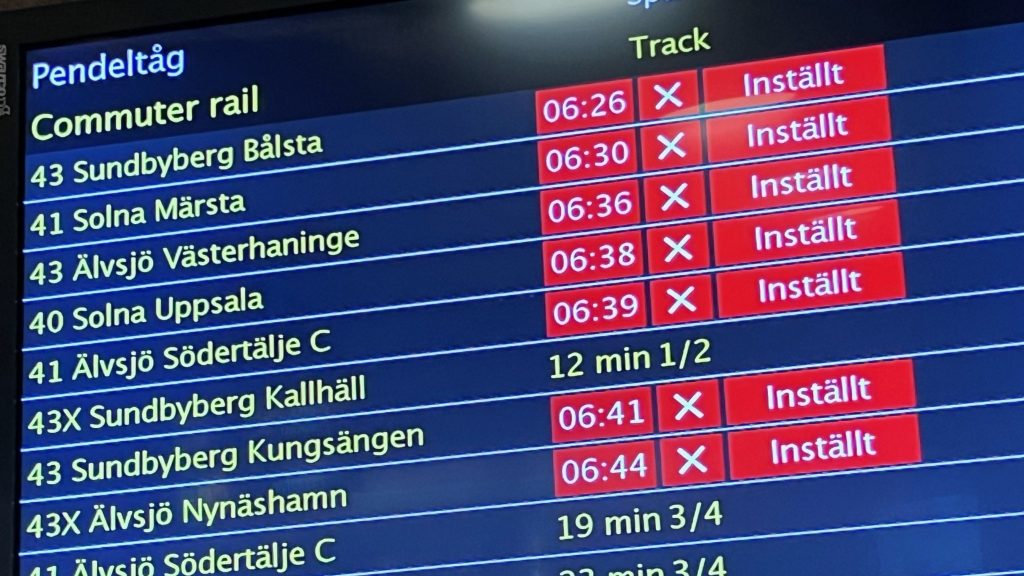
Thousands of Stockholm commuters this week were inconvenienced by striking train conductors. The strike by 20-30% of commuter train conductors in Stockholm resulted in many canceled and delayed rides. It did not result in any change in the staffing plans that the conductors struck to prevent.

“The Swedish model”

Strikes are rare in Sweden, especially since the 1990s. Up through the 1930s, however, there were many. The government at the time finally stepped in and told both employers and employees to sit down and work it out. Which they did.

The outcome of the negotiations, the Saltsjöbaden Agreement of 1938 (updated), was groundbreaking. In it, it was decided that the employer had the right to distribute work as they saw fit. Employees, on the other hand, were free to join a union. The government was to stay out of it. The employers and employees would arbitrate workplace issues themselves through collective agreements.

When these signed, collective agreements were in place, an obligation to maintain peace in the workplace (fredsplikt) was also understood. In other words, strikes would not be allowed as long as there was a collective agreement.

Breaking the law

This is what the striking train conductors broke in their so called “wild strike.” There is a collective agreement in place, but they struck anyway and disrupted the workplace peace. The strike is considered illegal, even by the union.

The train conductors knew this even as they considered their cause important enough to risk being sued and even dismissed. So far, however, Stockholm Region’s decision to replace train attendants with cameras, alarms, and other technology stands. Conductors will likely be the sole employee on commuter trains in the future.

Whatever happened with…

A mixed-topic post with updates on four topics written about previously
image source: https://www.thespruceeats.com

Several previous topics in this blog have made the news again. Here are updates on: Archer; Botkyrka; the lay judge (nämndeman) system; and, of course, inflation and food prices.

Say I’m in a meeting

Public pressure pushed Minister of Finance Elizabeth Svantesson to call a meeting with the dominant grocery chains ICA, Coop, and Axfood (Willy’s and Hemköp). On the agenda? To discuss how to keep food prices down, and to make sure that no one is price gouging.

No actual meeting has been reported as of yet. It also remains unclear what pressure Svantesson can, and would be willing, to apply. Like during covid, the government is most likely to only “recommend” and then let everyone decide for themselves what they want to do. In France, an agreement between the finance minister and Carrefours ended with an agreement to freeze prices on daily goods (see this post). But Carrefours is leaving it up to their individual grocers to actually implement any freeze.

The government may be playing a waiting game. Many expect inflation to come down this year without any particular intervention in market prices. One prognosis has inflation at 4.8% at the end of the year, and back to normal (around 2%) by 2025. The reasons for this optimism are assumptions that the current lower prices for both energy and raw materials will continue, and that central banks will continue to raise interest rates.

Sadly, lower inflation does not mean lower prices for food, or anything else, really. It means only that prices will not rise so fast.

Back in Botkyrka

Meanwhile in Botkyrka, the Social Democratic party has acted. The rumor was that new members have been recruited solely in order to secure their votes on a particular measure. (For a quick review of the Botkyrka conflict, see this post.) To be an official Social Democrat, party secretary Baudin stated, you have to be 15 years old and share the party’s social democratic values – but membership isn’t automatic. Baudin upheld the decision to deny 98 party membership applications on the ground that their reasons for membership did not ring true.

Not just a phone call

The recruitment and application process to become a lay judge was under fire even more this week.  As became clear in the Snippa sentence, contact between a political party and a lay judge is not always as distant as it should be (see this post). In the aftermath, there have been many calls to overhaul the recruitment system, even from a former minister of justice. The damage may be deep. Just the thought that they might receive a phone call from a sponsoring party can already have lay judges checking their opinions.   

At least two reports (2002 and 2013) suggesting it would be good for at least some lay judges not be beholden to a party for their position have been ignored. Chances that these new calls will be heeded are low.

Archer deliveries

Ukraine’s call for more firepower will be soon answered, at least from Sweden’s end. Minister for Defense Pål Jonson announced this week that 8 Archers and even 10 Leopard tanks are ready to be sent over. For security reasons, details are sketchy. To learn more about the Archer system, as well as the other items Sweden is sending, see this post.

The price of eggs

Finally, the price of eggs is relevant. And up 30%.
source: https://food.unl.edu/article/cracking-date-code-egg-cartons

Been To Norway recently? Swedes are taking trips across the border to take advantage of Norway’s lower food prices. The traffic used to be in the completely opposite direction. Calls for the government to do something about the price of food in Sweden are increasing. Unfortunately, nothing about this situation is easily solved.

Reasons behind the rollercoaster

Taking a trip to the grocery store has become an emotional rollercoaster – shock, consternation, maybe anger, and resignation. We have to eat, after all. Bloomberg and Eurostat show that food prices in Sweden this January were 20% higher than January last year. Covid, China’s extended lockdown, Russia’s war against Ukraine, inter alia, are all reasons for inflation and higher food prices. Another reason for the food price increase is the strong dollar and the weak krona.

The US economy is, to many, surprisingly strong (low unemployment and a 2.9% GDP increase in 2022). Interest rates are high and will likely rise more. Other countries put their money in US dollars because they can count on getting it back, and more. Sweden has only recently raised interest rates, GDP prospects are the worst in Europe according to the EU, and the earmarks of a housing bubble has global investors looking elsewhere. Simply put, Sweden isn’t attractive right now and the weak krona is a reflection of that.

Greedflation and other complaints

Consumers’ complaints about high food prices have not led to changes. The governor of the Swedish central bank, Erik Thedéen, responded by telling consumers to buy only the cheapest products so they don’t increase inflation. Sweden’s Minister of Finance Elizabeth Svantesson told consumers to look for the cheapest goods at the cheapest stores. Charges of “greedflation” – that food stores were raising prices beyond what was necessary – led the Swedish Competition Authority to investigate. Although they found no evidence of wrong doing at the end of last year, they are now going to look again to make sure. Finally, Left party leader Nooshi Dadgostar has called for setting a price cap on certain basic goods.

Svantesson immediately put the kibosh on Nooshi’s idea, saying that determining prices was not the government’s strong suit.  Other countries’ governments, however, have approached the topic somewhat differently.

Other countries

In France, food prices have risen about 14.5% over the last year. The food giant Carrefours recently announced a “very good agreement” with Minister of Economy Bruno La Maire. The understanding is that Carrefours will freeze the current price on 100 basic foods and products like detergent, diapers, yoghurt, eggs, bread and cereal.

Government-imposed price caps on twenty food staples in Hungary have been in place since last fall. Shortages of these items (milk consumption is apparently up 81%) has since forced the Minister of Agriculture to exhort Hungarians to buy only what they need and not to hoard the price-fixed items when they find them.

30% is how much the price of olive oil has risen in Spain. The government is facing internal pressure to lower some food staples’ prices by 14%. That, and/or raise taxes on supermarket chains to finance other inflation measures. The Spanish government has raised the minimum wage 8% this year alone.

The goal

The Swedish government is so far avoiding making any changes that they think might increase inflation. Together with supporting Ukraine and joining Nato, bringing down inflation is the country’s overriding goal. Less than two years ago, the goal was to raise inflation – to go in the opposite direction, in other words. Kind of like the traffic between Norway and Sweden.

Finland first?

Sweden got lucky with neighbors
image source: By JayCoop derived from BlankMap-World.svg, CC BY-SA 4.0, https://tinyurl.com/kuemt6ey

Sweden’s application for Nato membership has stalled. At the high level Munich Security Conference this weekend, even Nato chairman Stoltenburg seemed to imply that it was certainly possible that Finland would get full Nato member status before Sweden.

Sweden’s road to Nato has been rocky from the start. After Paludan’s Koran-burning stunt, a time-out was called but diplomatic back-and-forths have continued.

Post-Paludan and the freedom of expression

Since Paludan, the police have twice denied permission to burn the Koran publicly. The first they denied was a Paludan copycat. The second was similar, but in front of Iraq’s embassy. The denials have opened a whole debate on Sweden’s freedom of expression.

The police denied permission to burn the Koran in front of the embassies on the grounds that it would cause allvarliga störningar av den nationella säkerheten. They worried that the demonstration would disturb or perhaps weaken national security.

National security

National security is not officially a reason to deny permission to demonstrate. It’s not in the lawbooks. Instead, permission to demonstrate can be denied only if it seriously disturbs the order or safety of the public at the demonstration. Permission can also be denied if there was a serious disturbance or danger to those present at a similar, previous event.

Paludan’s similar, previous event caused no disturbance to those few who were present. These two recent denials are therefore a wider interpretation of the law than has been seen for decades.

These decisions have not, however, been recognized by Türkiye to be the deviations from the norm that they are. Nato chair Stoltenberg was glad that more Koran demonstrations were averted (as were many people). Still, Türkiye’s foreign minister stated at the same meeting that Sweden has not done enough to stop PKK or YPG activities. Furthermore, Türkiye considers Koran burnings a hate crime.

Hate speech?

In Sweden, Koran burning alone is not equated with hate speech against a specific group of people. Burning a Koran has not been regarded as speech in the same way as actually speaking, writing, drawing, or even wearing certain clothing has been regarded as speech. One legal opinion states that while the Koran is written and therefore speech, the physical act of burning is neither speech nor illegal. Freedom of expression is a point of pride in Sweden, and a lot is required to shift that sentiment.

Awkward, but not bad news

With these divergent views on fundamental legal definitions, it may be a longer road to Swedish Nato membership than anyone thought. It will be awkward and uncomfortable if Finland becomes a Nato member while Sweden remains outside, but it’s not a dead end.

While efforts are stalled for the moment, Türkiye’s acceptance of Finland is not necessarily bad news for Sweden. It means that Türkiye is not running Russia’s errands, that it is not opposed to Nato’s expansion, and that it recognizes the worth of additional countries in this region to Nato. Its acceptance of Finland shows that it is not unsusceptible to pressure. In addition, Türkiye has said it realizes that it is not anti-Muslim or anti-Türkiye sentiment driving some extremist actions, but anti-Nato sentiment.

Erdogan still has an election to get through and the situation between Sweden and Türkiye is fluid. The hope is that if Finland indeed gets in before Sweden, they will continue to push for Sweden’s inclusion from the inside.

Country-city-country

A face we’ll be seeing a lot of.
Image source: https://www.centerpartiet.se/partiledarvalet/muharrem-demirok

All politics is local, it’s said. But even local politics can have national and even international angles. So it is with the election of the new Swedish Center Party leader, Muharrem Demirok. Outside of the Center party in Linköping, no one had really heard of him. All eyes are on him now, though, and not only on his Turkish citizenship but also on the fact that Center party has traditionally been a rural-based party and Demirok is a Stockholm suburbs baby.

Demirok was born in Sweden in 1976 of a Swedish mother and Turkish father. Swedish citizenship was a possibility via his mother, but dual Swedish and Turkish citizenship was not. Muharrem’s parents gave him Turkish citizenship. When he was 21, Demirok applied for and received Swedish citizenship.

The rules for citizenship are as complex as human relations are complex, and the rules change over time as well. Only in 2001 did Sweden allow dual (actually, multi) citizenship. Demirok applied for Swedish citizenship in 1997. However, since dual citizenship was allowed in Turkey, it was not a problem for Turkey that Demirok became Swedish. In its turn, Sweden probably never specifically asked that Demirok renounce his Turkish citizenship, or check that he had. Sweden at that time was already considering loosening the single citizenship rule that had been in place since 1963. It’s unclear, but having both might not have seemed to matter. Now though, Demirok has said he is formally renouncing Turkish citizenship, in response to real or imagined national security concerns evinced by Center party members and others.

Besides citizenship, a matter that concerns party members is to what degree the Center party is losing is rural voter base. The Center party has always been “the farmer’s party,” with deep roots outside of city centers. Even as late as 2017, the Center party campaigned (among other things) for increasing the number of horses in the countryside – “for every ten horses a new job is created!”.

In his first long speech as Center party leader, Demirok invoked the countryside several times, claiming “all of Sweden must live.” One of the reasons that Demirok is now party leader, though, is that his predecessor Annie Lööf led a rather unsuccessful election campaign. Many of the voters she and the Center party lost were those rural voters. Demirok will have his work cut out for him to win them back.