Books, Nato, and opinion polls

These kinds of images are not going away
image: Reuters.com https://tinyurl.com/3h6mjk8s

It’s not often a Swedish administrative law makes international, political news. But when a Stockholm court decided that the police did not have a legal leg to stand on when they denied permission to burn the Koran at two different demonstrations, it did not go unnoticed.

Burning books part II

An administrative court is where a conflict between a state agency and a private person (or business) is decided. In this case, both a private person and an association calling itself “Apallarkerna,” appealed the police’s decision to not allow either of them to burn a Koran in public. The private person wanted to burn a Koran in front of the Iraqi embassy to protest Islam in general. The association thought (perhaps not incorrectly) that burning a Koran in front of Türkiye’s embassy, à la Paludan, was a good way of preventing Sweden from joining Nato.

The police denied both demonstration applications on the grounds that their actions would threaten national security (see this post). However, the court found that according to the way the law is written, national security is not a legal reason for denying permission to hold such a demonstration.

Sweden’s Nato application

This will not do anything to further endear Sweden to Türkiye. In a recent meeting at Nato headquarters in Brussels, Türkiye’s foreign minister even drew a parallel between the court’s decision and Nazi Germany. “The Nazis started by burning books, then they attacked religious gathering places, and then they gathered people in camps and burned them to achieve their ultimate goals. That’s the way these things start” he is reported to have said.

Should it be illegal?

If (or more likely, when) a burning next takes place, Türkiye may not be the only who is seriously upset. A recent DN/Ipsos poll found that 51% of Swedes think that it ought to be illegal to burn holy books like the Koran or the Bible.

In an interview with SvD, former prime minister Carl Bildt said that he was not sure if burning a book was actually a protected right, but that it was complicated. “It is quite obvious that it is not freedom of expression to burn down a mosque. But burning a book, is it freedom of expression? Leave it to the lawyers to draw boundaries, but it is reasonable to think that somewhere there is a limit to what you can burn as part of freedom of expression.”

Others are not so sure it is time to change Sweden’s laws. “Only a few months ago we were proud that we allowed book burning – it was proof of our freedom of expression” Antje Jackelén, Swedish archbishop emeritus, commented. “Then along comes Erdogan, and our Nato negotiations break down, and suddenly we think completely differently. It’s a little meager.”

In the same poll, support for a ban on publishing images that denigrate religious symbols, or a ban on ridiculing religious scriptures in a text, was just under 30%. It is unknown what support there is for a ban on other actions, like putting a glass of wine down on a religious book or otherwise not showing respect. Those actions may or may not go unnoticed in the future.

Finland first?

Sweden got lucky with neighbors
image source: By JayCoop derived from BlankMap-World.svg, CC BY-SA 4.0, https://tinyurl.com/kuemt6ey

Sweden’s application for Nato membership has stalled. At the high level Munich Security Conference this weekend, even Nato chairman Stoltenburg seemed to imply that it was certainly possible that Finland would get full Nato member status before Sweden.

Sweden’s road to Nato has been rocky from the start. After Paludan’s Koran-burning stunt, a time-out was called but diplomatic back-and-forths have continued.

Post-Paludan and the freedom of expression

Since Paludan, the police have twice denied permission to burn the Koran publicly. The first they denied was a Paludan copycat. The second was similar, but in front of Iraq’s embassy. The denials have opened a whole debate on Sweden’s freedom of expression.

The police denied permission to burn the Koran in front of the embassies on the grounds that it would cause allvarliga störningar av den nationella säkerheten. They worried that the demonstration would disturb or perhaps weaken national security.

National security

National security is not officially a reason to deny permission to demonstrate. It’s not in the lawbooks. Instead, permission to demonstrate can be denied only if it seriously disturbs the order or safety of the public at the demonstration. Permission can also be denied if there was a serious disturbance or danger to those present at a similar, previous event.

Paludan’s similar, previous event caused no disturbance to those few who were present. These two recent denials are therefore a wider interpretation of the law than has been seen for decades.

These decisions have not, however, been recognized by Türkiye to be the deviations from the norm that they are. Nato chair Stoltenberg was glad that more Koran demonstrations were averted (as were many people). Still, Türkiye’s foreign minister stated at the same meeting that Sweden has not done enough to stop PKK or YPG activities. Furthermore, Türkiye considers Koran burnings a hate crime.

Hate speech?

In Sweden, Koran burning alone is not equated with hate speech against a specific group of people. Burning a Koran has not been regarded as speech in the same way as actually speaking, writing, drawing, or even wearing certain clothing has been regarded as speech. One legal opinion states that while the Koran is written and therefore speech, the physical act of burning is neither speech nor illegal. Freedom of expression is a point of pride in Sweden, and a lot is required to shift that sentiment.

Awkward, but not bad news

With these divergent views on fundamental legal definitions, it may be a longer road to Swedish Nato membership than anyone thought. It will be awkward and uncomfortable if Finland becomes a Nato member while Sweden remains outside, but it’s not a dead end.

While efforts are stalled for the moment, Türkiye’s acceptance of Finland is not necessarily bad news for Sweden. It means that Türkiye is not running Russia’s errands, that it is not opposed to Nato’s expansion, and that it recognizes the worth of additional countries in this region to Nato. Its acceptance of Finland shows that it is not unsusceptible to pressure. In addition, Türkiye has said it realizes that it is not anti-Muslim or anti-Türkiye sentiment driving some extremist actions, but anti-Nato sentiment.

Erdogan still has an election to get through and the situation between Sweden and Türkiye is fluid. The hope is that if Finland indeed gets in before Sweden, they will continue to push for Sweden’s inclusion from the inside.

Space needed

A time-out in the Nato process

The light by which you see.
image source: Reuters: Umit Bektas https:www.abc.net.au

A thorough review of the Swedish Nato and Turkey carousel would take meters of space. But here’s twenty centimeters on the subject.

The invasion and the reaction

In response to Russia’s invasion of Ukraine, Finland abandoned their careful and delicate handling of their eastern neighbour and threw their hat in the ring with Nato. Sweden abandoned its neutrality doctrine (that had some holes in it, but was a popular idea) and did the same. The membership process was largely smooth sailing, with Nato members accepting the two countries’ applications with no problem or debate. Then there was Turkey.

In a surprise, and despite previous assurances, Turkey said no to Swedish Nato membership on the same day that Sweden said it would apply. Erdogan accused both Sweden and Finland of giving safe haven to terrorists, namely PKK, PYD and YPG members.

Who?

PKK stands for the Kurdish Workers’ Party and is a militant political party based mostly in southeast Turkey and northern Syria and Iraq. Their aim is to establish a Kurdish state, or at least gain autonomy. Using violence to that end is fully sanctioned. PKK’s attacks and Turkish reprisals – as well as Turkish attacks and PKK reprisals – have been going on for decades. The PKK is officially regarded as a terrorist organization by the USA, the EU, and others.

Turkey considers both the Kurdish PYD and YPG to be terrorist groups as well, but Nato and the EU don’t. Sweden has given safe haven to persecuted Kurds, and allows demonstrations at which the PKK flag can be seen vigorously waving. In addition, the previous Social Democratic government signed a deal to support the Kurdish PYD (if not its military branch, the YPG) to get an important yes vote from parliament member and Kurd Amineh Kakabaveh. (Kakabaveh’s yes vote was necessary for Magdalena Andersson to become Prime Minister.) In sum, Sweden hasn’t given Turkey the impression that it respects Turkey’s side of the Kurdish conflict.

We thought it was a done deal

After more negotiations, however, a 10-point agreement was reached between the three countries for Turkey to accept Sweden and Finland as Nato candidate countries. Two points in particular regarded strengthening and enacting new measures against terrorism – mostly PKK terrorism and the Kurdish YPG/PYD organizations. Sweden has indeed taken measures, and Nato’s chairman Stoltenberg stated that he considers Sweden’s and Finland’s responsibilities fulfilled.

Turkey didn’t exactly agree. Instead, Sweden got lists of people Turkey wanted extradited. When the judiciary or Immigration says there are no grounds for extradition, though, then there are no extraditions. Turkey remained displeased. 

PR disasters

When a life-size doll of Turkey’s president Erdogan was hung by the feet outside of Stockholm’s town hall a few weeks ago, it confirmed Turkey’s suspicions that Sweden wasn’t quite discouraging these actions. Of course, Turkey’s government knows exactly how much, or how little, Sweden can do about such actions (hello freedom of expression), but Erdogan has an election coming up. Accusing Sweden of disrespect is perfect for appearing the strongman.

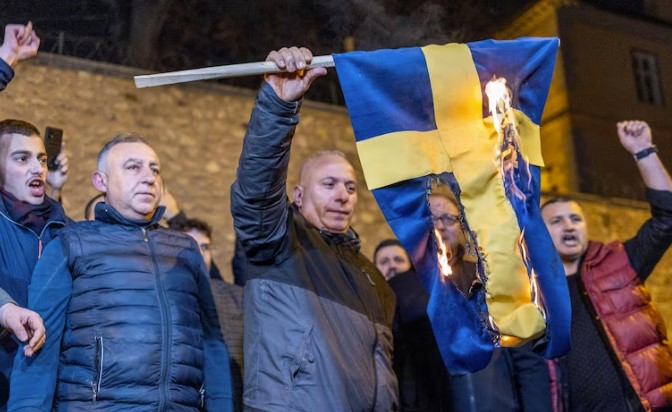
Things got worse this last week when the far-right activist Paludan was allowed to burn a Koran in front of the Turkish embassy (freedom of expression again). Now, most of the Muslim world has exploded in indignation. Swedish flags are burning, and Erdogan looks like a hero.

As for the Nato membership process, ranking diplomats have said it’s time to take a long step back and let tempers’ fires burn themselves out. To stop responding to everything, and to stop with the press conferences. Don’t give it so much space, you might say.