Country-city-country

A face we’ll be seeing a lot of.
Image source: https://www.centerpartiet.se/partiledarvalet/muharrem-demirok

All politics is local, it’s said. But even local politics can have national and even international angles. So it is with the election of the new Swedish Center Party leader, Muharrem Demirok. Outside of the Center party in Linköping, no one had really heard of him. All eyes are on him now, though, and not only on his Turkish citizenship but also on the fact that Center party has traditionally been a rural-based party and Demirok is a Stockholm suburbs baby.

Demirok was born in Sweden in 1976 of a Swedish mother and Turkish father. Swedish citizenship was a possibility via his mother, but dual Swedish and Turkish citizenship was not. Muharrem’s parents gave him Turkish citizenship. When he was 21, Demirok applied for and received Swedish citizenship.

The rules for citizenship are as complex as human relations are complex, and the rules change over time as well. Only in 2001 did Sweden allow dual (actually, multi) citizenship. Demirok applied for Swedish citizenship in 1997. However, since dual citizenship was allowed in Turkey, it was not a problem for Turkey that Demirok became Swedish. In its turn, Sweden probably never specifically asked that Demirok renounce his Turkish citizenship, or check that he had. Sweden at that time was already considering loosening the single citizenship rule that had been in place since 1963. It’s unclear, but having both might not have seemed to matter. Now though, Demirok has said he is formally renouncing Turkish citizenship, in response to real or imagined national security concerns evinced by Center party members and others.

Besides citizenship, a matter that concerns party members is to what degree the Center party is losing is rural voter base. The Center party has always been “the farmer’s party,” with deep roots outside of city centers. Even as late as 2017, the Center party campaigned (among other things) for increasing the number of horses in the countryside – “for every ten horses a new job is created!”.

In his first long speech as Center party leader, Demirok invoked the countryside several times, claiming “all of Sweden must live.” One of the reasons that Demirok is now party leader, though, is that his predecessor Annie Lööf led a rather unsuccessful election campaign. Many of the voters she and the Center party lost were those rural voters. Demirok will have his work cut out for him to win them back.
Space needed

A time-out in the Nato process

The light by which you see.
image source: Reuters: Umit Bektas https:www.abc.net.au

A thorough review of the Swedish Nato and Turkey carousel would take meters of space. But here’s twenty centimeters on the subject.

The invasion and the reaction

In response to Russia’s invasion of Ukraine, Finland abandoned their careful and delicate handling of their eastern neighbour and threw their hat in the ring with Nato. Sweden abandoned its neutrality doctrine (that had some holes in it, but was a popular idea) and did the same. The membership process was largely smooth sailing, with Nato members accepting the two countries’ applications with no problem or debate. Then there was Turkey.

In a surprise, and despite previous assurances, Turkey said no to Swedish Nato membership on the same day that Sweden said it would apply. Erdogan accused both Sweden and Finland of giving safe haven to terrorists, namely PKK, PYD and YPG members.

Who?

PKK stands for the Kurdish Workers’ Party and is a militant political party based mostly in southeast Turkey and northern Syria and Iraq. Their aim is to establish a Kurdish state, or at least gain autonomy. Using violence to that end is fully sanctioned. PKK’s attacks and Turkish reprisals – as well as Turkish attacks and PKK reprisals – have been going on for decades. The PKK is officially regarded as a terrorist organization by the USA, the EU, and others.

Turkey considers both the Kurdish PYD and YPG to be terrorist groups as well, but Nato and the EU don’t. Sweden has given safe haven to persecuted Kurds, and allows demonstrations at which the PKK flag can be seen vigorously waving. In addition, the previous Social Democratic government signed a deal to support the Kurdish PYD (if not its military branch, the YPG) to get an important yes vote from parliament member and Kurd Amineh Kakabaveh. (Kakabaveh’s yes vote was necessary for Magdalena Andersson to become Prime Minister.) In sum, Sweden hasn’t given Turkey the impression that it respects Turkey’s side of the Kurdish conflict.

We thought it was a done deal

After more negotiations, however, a 10-point agreement was reached between the three countries for Turkey to accept Sweden and Finland as Nato candidate countries. Two points in particular regarded strengthening and enacting new measures against terrorism – mostly PKK terrorism and the Kurdish YPG/PYD organizations. Sweden has indeed taken measures, and Nato’s chairman Stoltenberg stated that he considers Sweden’s and Finland’s responsibilities fulfilled.

Turkey didn’t exactly agree. Instead, Sweden got lists of people Turkey wanted extradited. When the judiciary or Immigration says there are no grounds for extradition, though, then there are no extraditions. Turkey remained displeased. 

PR disasters

When a life-size doll of Turkey’s president Erdogan was hung by the feet outside of Stockholm’s town hall a few weeks ago, it confirmed Turkey’s suspicions that Sweden wasn’t quite discouraging these actions. Of course, Turkey’s government knows exactly how much, or how little, Sweden can do about such actions (hello freedom of expression), but Erdogan has an election coming up. Accusing Sweden of disrespect is perfect for appearing the strongman.

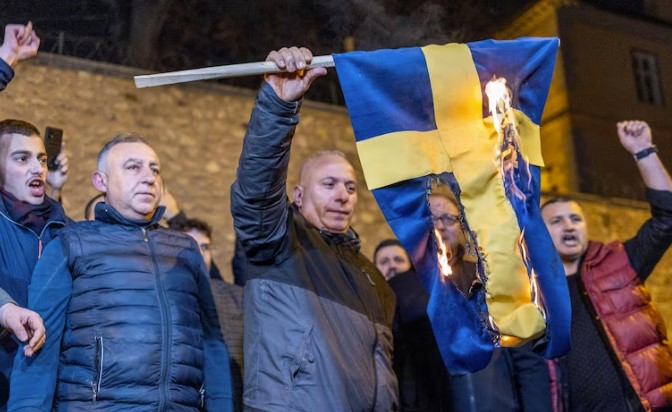
Things got worse this last week when the far-right activist Paludan was allowed to burn a Koran in front of the Turkish embassy (freedom of expression again). Now, most of the Muslim world has exploded in indignation. Swedish flags are burning, and Erdogan looks like a hero.

As for the Nato membership process, ranking diplomats have said it’s time to take a long step back and let tempers’ fires burn themselves out. To stop responding to everything, and to stop with the press conferences. Don’t give it so much space, you might say.

Safer, freer, and heavy weapons

Sweden to send in the big guns
image source: Andrea Adriani https:esgnews.com

Greener, safer, freer. With these words, Prime Minister Ulf Kristersson summed up Sweden’s vision for the EU during its presidency. A large part of the “safer and freer” bit is shoring up, and even increasing, support to Ukraine. A few days, later, and to that end, the government announced that Sweden will be sending the biggest package of military help to Ukraine than it has ever sent before.

“Fastest Howitzer in the world”

The Swedish package consists of the artillery system called Archer, the infantry carrier called “90,” as well as other military items. The Archer is a relatively zippy and mobile wheeled vehicle, that can send artillery grenades over a 50km range and can go 65 km/hour. The gun carriage is mounted on a long bed truck from Volvo and that tips up to fire. As it can be controlled via computer, a soldier doesn’t need to leave the relative safety of the cab to operate it. Youtube’s Extreme World calls it “the fastest howitzer in the world,” and Ukraine has been asking for it for months.

Sweden will also send around 50 armored infantry light tanks called “90,” that can transport up to eight soldiers and that has a mounted 40mm automatic canon. The package will also include the light, portable, Next generation Light Anti-tank Weapons (NLAWs), mine clearing equipment and assault rifles according to USNews.

Gathering dust anyway

It will take months for the main events, Archer and 90, to arrive in the Ukraine and be up and running. Ukrainian soldiers need to be trained on the Archer system somewhere – perhaps here in Sweden, which would be new. Also, the Archers that Sweden may now send to Ukraine are not the latest model, but the Archer B model that are mostly sitting in garages under car covers. The latter is due to the fact that Sweden must still be able to mount a defense itself should it be attacked, while the former’s time factor is due to current laws on weapons export. 

In the future, the time lag might be shortened. To enable Sweden to send Ukraine these heavier munitions, Sweden and Ukraine have to enter into an agreement to cooperate on defense equipment procurement. This way, Ukraine can jointly order defense equipment with Sweden, allowing Sweden to place additional orders to existing contracts and give the equipment to Ukraine. Time and money saved.

All this is not 100% uncontroversial, but a full-scale war happening on the European continent has changed everyone’s notions on what the future was going to look like. To be greener, we’ll need safer and freer.

When a chat is complicated

Computers studying – so you don’t have to.
source: https://www.theatlantic.com/technology/archive/2022/12/openai-chatgpt-chatbot-messages/672411/

Ta-da! A five hundred word essay on the theme of the hero in contemporary literature. Or how about the history of the Parthenon? Or a letter to a friend one hasn’t seen in a long time? Ten seconds later and you have an advanced piece of writing, thanks to OpenAI’s ChatGPT.

It’s scary. And so much fun! Type in “Write a blog post on ChatGPT in Sweden” and you’ll get a fine answer, like “ChatGPT, a chatbot developed by OpenAI, has been gaining popularity in Sweden as a useful tool for business and organizations. It uses a variant of the GPT (Generative Pre-training Transformer) language model to generate human-like responses to text input in a conversation context.”

Boring, but accurate. After having read a dozen or more ChatGPT texts, it’s easy to get tired of the dry and lifeless language it uses. For facts and details, ChatGPT can also be straight-out incorrect. But it’s early days.

We speak Flashback

It’s also in English, so far. ChatGPT has been trained on the internet (lots of Wikipedia), archived books, and even real human conversations it’s been party to. All in English. A Swedish chatbot, GPT-SW3, is of course in the works. However, as Per Gudmundson (SvD) wrote the other day, its development is hindered by the fact that the National Library of Sweden (Kungliga biblioteket) won’t yet allow chat developers access to its vast digital content. Instead, the developers have had to turn to, among other things, posts on Flashback and Swedish Reddit for examples of human speech and interaction.  With content like that, it’s going to be great.

The issue is sensitive. Sweden’s research institute, RISE, says on its website that GPT-SW3 is absolutely not training on Flashback. So who knows? The royal library took issue with Gudmundson as well. In SvD’s online edition the next day, the library protested that it is indeed helping Sweden develop its AI capabilities – by allowing its texts to be read and understood by computer programs. Chat development, though, gets a hard no. The library is not able to foresee the consequences of allowing its database to be used for that purpose, wrote the chief librarian.  

For chat-interaction development, there are apparently two projects that are crucial: Natural Language Understanding (NLU) and Processing (NLP). These two projects are meant to be able to make it possible to sort through, tag, and find relevant information in huge amounts of Swedish. Then, in the next step, they’ll be able to respond with relevant answers and information, even for those who pose poor questions, or grammatically imperfect ones.

“Thank God I’m retiring.”

Until GPT-SW3 is well-sourced and developed, it’s in English where the rubber meets the road. A teacher’s “Thank God I’m retiring soon” is echoed everywhere. Articles entitled “The End of High School English” and the like have popped up like pimples on a teenager. In the New York Times Opinion, columnist Frank Bruni wonders if his career is over. Somewhat alarmingly, he doesn’t actually answer that question. Instead, he takes it to a more philosophical level, namely – If we are what we do, and we outsource what we do, what is left is aimlessness, purposelessness, even pointlessness. This is surely not OpenAI’s intention, but we all know where intentions can lead.

OpenAI was cofounded by Elon Musk and Sam Altman, among a few others. If you’re not a Musk fan, you might find purpose in not using ChatGPT, but it could be pointless. Ta-da!

You do you!

say the courts (sort of)

People will do what they want to do. What can you do.
source: https://tinyurl.com/dy8ky79b Myrtle Beach vacations

It has been a busy week for Swedish courts, with many cases being covered in the news. Rulings this week on Cementa, hijab, and union membership have (believe it or not) something in common, namely rulings on behalf of the beleaguered part.

Cementa – the movie

Cementa has been covered in this blog earlier (here). But hang on to your hats, here’s a refresher: Cementa has been mining limestone on Gotland for a hundred years. Limestone is needed to make cement, and Cementa produces most of the cement Sweden uses for building. When Cementa applied to extend its mining license, the first court said “Sure.” Several environmental organizations appealed the decision, and the appeals court then ruled against Cementa.

At this point, the then-Social Democratic government stepped in. Without Cementa, it was argued, construction in Sweden would stop and mass lay-offs would result. With unanimous support from parliament, they passed a law that essentially granted just Cementa a temporary license to continue mining. This caused an uproar immediately – could the government even do that? Environmental organizations protested the government circumventing the court in that way. On Thursday this week, the highest administrative court in Sweden came back and said what the government did was legal. 

For some, the special law that was passed to extend Cementa’s license was welcome, necessary and even commonsensical. The administrative high court’s decision has now upheld the government’s ability to do what it did. For others, both the government’s action then, and the high court’s decision now, is a weakening of the power of the courts.

If this isn’t fascinating enough (if you’re nerdy), though, wait a few days when the temporary license extension runs out. On December 13th, Cementa’s new application to continue mining will be accepted or denied. Cementa part V: the New Application.

Go ahead, express yourself

Meanwhile in Skåne, another case of acceptance was on the docket. Staffanstorp municipality voted to forbid girls in elementary school from wearing a hijab or other head covering while in school. Parliament took up and rejected such a prohibition years ago, but Staffanstorp persisted in the administrative court. The prohibition was rejected in the first instance, and has now been rejected also at the highest instance, although not for the same reason.

At the district court level, the court disallowed Staffanstorp’s prohibition on a freedom of religion basis. The highest administrative court, however, rejected the prohibition on a freedom of expression basis instead. Clothing is an expression of religious belonging, the court said: Restricting the clothing that someone wants to wear affects the individual and their freedom to express themselves. A restriction is therefore not allowed.

Free time and work time

Neither is the Transport Workers’ Union allowed a restriction; in this case to its membership. This case began in 2018, when a regular member of the union was elected to represent the Sweden Democrats party at the municipal level. He was swiftly kicked out of the union for being an active member of a party that, according to the union, was not compatible with their organization’s statutes stipulating people’s equal value. Mats Fredlund sued the union, arguing that the union existed for its members and their work environment, and not for judging what its members did in their free time. The district court agreed, but the Transport Workers’ Union appealed. Now it has lost again. The court of appeals ruled that booting out Fredlund was abridging his right to freedom of association.

In each of these cases, the higher court ruled on behalf of the part that wanted to do what it wanted to do, and not for the part that wanted to restrict that action. This, for a country whose smallest party in parliament is the Liberal party.

Weather worries

weather – it’s not just the climate, anymore
source: https://tinyurl.com/498tcbxc digital worksheets

The news on the electricity front remains bad. Despite some hopes earlier in November that the worst was over, prices over the last few days have been record-breaking. The reason for this is the weather, and that we’re largely dependent on it. Cold, windless days, ice building on turbine blades, and slush-infused rivers have all contributed to apex prices.

The Europe-wide factors that can mitigate this dependency, however, have also faced problems. The restart of nuclear power plant Ringhals 4, that was set for the 31st of January, will now be delayed an additional three weeks according to the latest press release. In addition, it was recently announced that Oskarshamn nuclear reactor 3, which stands for 8% of Sweden’s total energy production, will be offline for needed repairs between the 9th and 18th of December. Half of France’s 56 nuclear reactors are currently offline and being repaired as well: Recent war-inspired inspections showed signs of wear and tear that needed patching up. Finally, Finland’s newish nuclear reactor Olkiluoto is many millions of dollars late and has yet to even start producing electricity.

slush – even hydropower doesn’t like it

There are also other temporary factors that are increasing the current prices, namely ice formation. In the deep regions of Norrland, ice is starting to form on the rivers that supply water turbines. Currently, the rivers are streams of sub-zero slush that can pile up and clog the water intakes. Water power companies cut down on their intake to prevent the buildup which can otherwise wreck infrastructure and/or stop production entirely. In time, when the ice is a nice, stable surface for the rest of the season, waterpower production can increase again.

Unfortunately, electricity taxes will also increase. Thanks to inflation, and because the electricity tax is linked to the rate of inflation, electricity tax will rise 9% starting January 1st. (There’s no escaping this either – air travel taxes will be going up for the same reason come 2023.)

There is, maybe, some light in the tunnel. Water magazines in Norway and Sweden are full again after the fall rains, helping stabilize energy reserves. Gas reserves in Europe are apparently full. The rivers will freeze over. There will be wind, sometimes. Atoms will be split, again (especially if France fulfills its plan to build six new reactors starting 2028). And of the 55 billion kronor Sweden’s Power Net (Kraftnät) has collected via so-called “bottleneck fees,” 18 billion will be doled out to 4.4 million Swedish households in the lower half of Sweden in February. Unless something unforeseen happens, as Ebba Busch, Minister for Energy, Business and Industry, put it. And that is, precisely, the problem. Something always happens. Not least, weather.

1766 to the present

Hats, caps, and freedom of the press

All the news you need to know?
source: Stanford digital https://tinyurl.com/2xej2hb7

Back in 1766, while American colonists were grumbling over the British proclivity for passing laws that abridged their freedom, a similar kind of protest was forming over the Atlantic. In Sweden, three political groupings were having it out – the hats (hattar), the caps (mössor), and the king.

Brimmed and unbrimmed

The king had a weak position during this period, and the real power had been held by the hats – hats with brims – for some time. Two lost wars and a shaky economic situation later, a change came. In 1765, many members of the caps group – the unbrimmed hats – were voted in.

With them came many changes: Censorship was largely abolished; a closer relationship with Britain, as opposed to France, was espoused; the public could access government papers and print as much of it as they wanted (classified documents exempted); and any official who denied such access could be punished. Freedom of the press was born, and even the seeds of the Swedish principle of public access, as well as the Fundamental Law of Freedom of Expression, were sown.

Change

With such a history, it’s no wonder that changing the laws for freedom of the press and freedom of expression has caused an uproar. Changing any part of Sweden’s four fundamental laws requires two parliamentary votes, one on either side of an election. Changes to these laws are meant to be difficult. Yet, such a change has now occurred.

A few days ago, a second vote inserted a clause in Sweden’s fundamental law that criminalizes disclosure of classified information that damages Sweden’s relationship with foreign powers or organizations. The new law’s detractors fear that a journalist can now be charged if, say, they see some misconduct by another state’s or organization’s representative and report on it, thereby damaging Sweden’s relationship with that country or organization.

The new law’s defenders, including the Moderate, Social Democratic, Center, Christian Democrat and Sweden Democrat parties, point to the so-called safety valve. This says that it will not be illegal to disclose damaging information if it’s “justifiable.” What constitutes “justifiable” is not specified, however.

See something say something

A worry is that journalists may in the future decide not to investigate or publish a story if they risk serious jail time. In its coverage of the new law, the newspaper DN listed several instances in which Swedish journalists have irritated other countries – stories that might not have been reported on if the new law had been in place at the time. These examples included information regarding a formation of an EU military unit, the behavior of EU soldiers on missions abroad, on Sweden’s efforts to sell its jet fighter Gripen to Switzerland, and on the conditions facing Swedish soldiers in Mali.

Back in the 1770s, the caps’ changes were short-lived. Only a few years later, King Gustav III disbanded parliament and eroded the press’ freedom until there was nothing left. His son Gustav IV reestablished official censure. However, this didn’t last either – freedom of the press, and by extension of expression, was back in the fundamental law by 1809. Some freedoms are irrepressible.

Where did the money end up?

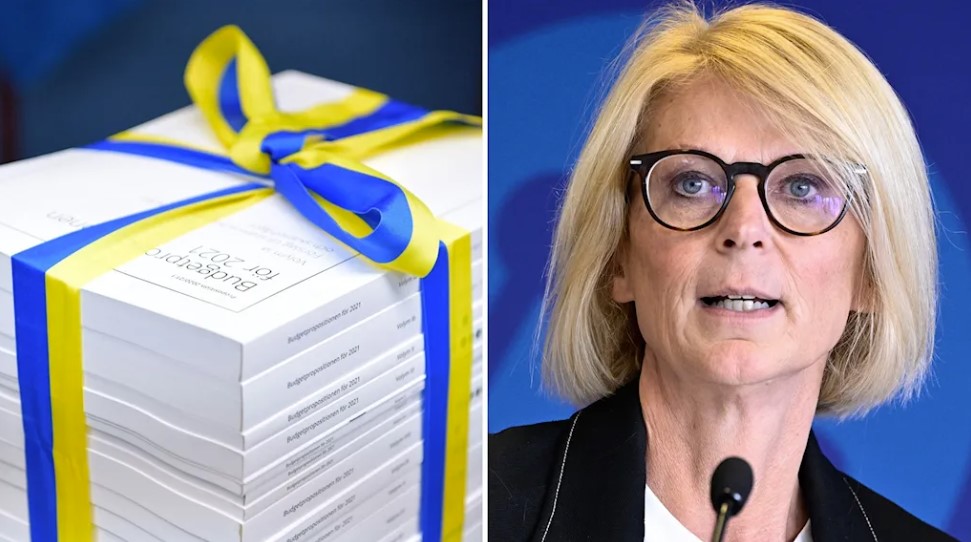
Told you it would have a ribbon. The budget and Svantesson
Sveriges Radio http://www.tinyurl.com/msf6994t Foto: Jessica Gow/TT och Claudio Bresciani/TT

Deceit. Disappointment. Restraint. They sound like tag lines from the latest season of “the Crown,” but they’re actually reactions to the budget upon its release last Tuesday. As soon as the nearly 3000-page document was made available at 8am Tuesday morning, a number of parties, organizations and interest groups made their opinions on it public.

Accusations of deceit were actually the loudest from the Social Democrats. What seemed to be upsetting was that the Kristersson government didn’t announce any big tax cuts or help with coming electricity bills the way they had promised pre-election. It’s natural that the opposition complains, but actually complaining on behalf of the voters who elected the current government was a turnaround. The lesser amount to international aid and even the lesser number of UN quota refugees went by without particular Social Democratic comment (though the Liberals had difficulty with it). It lends some credence to the suspicion that the Social Democrats, in reality, have few problems with the right coalition’s budget.

No. Not happy.

On the other hand, however, many members of the right coalition’s parties were not at all pleased with what Minister of Finance Elisabeth Svantesson presented. Their displeasure was not so much about the lack of broad tax cuts, but what they considered a weak pro-work stance and too many expensive gives. Unemployment compensation remains at the high pandemic-era level (a demand from SD but more the opposition’s idea), and while labor immigration will be more restricted, there were no new economic incentives for those jobs to be filled with Swedish workers. An employee who has to drive to work will have continued compensation, and the price of diesel and gas will sink only marginally. None of these things, it is charged, change the employment dynamic.

Cars and Caravaggio

What was very dynamic was the rush to car dealerships all over the country following the government’s surprise declaration that the electric car rebate would be ending almost immediately. There was not the same rush to state museums following the government’s surprise declaration ending free admission, though. The former means paying up to seventy thousand kronor more, the latter perhaps 100 kronor.

How much for the tree?

Harder to price is the budget’s effect on the environment. As the Tidö Agreement laid out, the Ministry for the environment is now combined with the Ministry for energy, business and industry. Depending on one’s leaning, the consolidation is either a natural development as climate and business are interrelated, or a serious deprioritization. As it turns out, the budget showed a plan to cut the allocation for “General environmental protection and nature conservation” in half by 2025. The tax on plastic bags is still in place, but it’s doubtful that’s any comfort to anyone.

Not moving on the generally hated plastic bag tax is perhaps part of the restraint Svantesson has talked about. Tax cuts have been avoided not to increase inflation. The biggest increased outlays were defense, energy cost compensation, and lower prices at the pump, all of which were no surprise by the time the budget was formally presented, and are already priced in by banks and international agencies. The budget caused no tumultuous waves (see the United Kingdom). So far, the paradigm shift the new government declared following the Tidö Agreement doesn’t seem to have materialized.

Government plans revealed

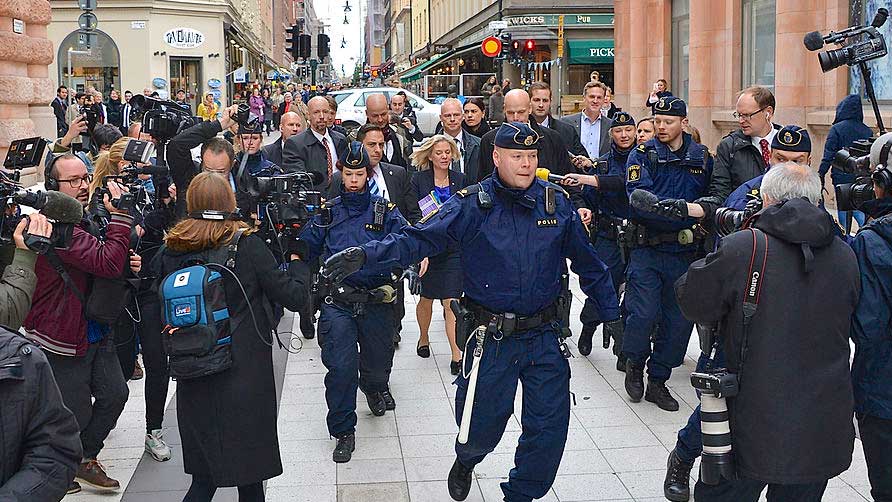
Not a perp walk. A budget walk. It’s a long 400 meters for the previous Minister of Finance.
source: Etuna news https://tinyurl.com/54zuc8hw

November 8th is Budget Day! For those who are interested in all things political, this is exciting – but it’s also kind of a spectacle. The 400 meter long Budget Walk, or budgetpromenaden, is its own Wikipedia entry. It’s that good. 

The stack of A4 paper that the budget is written on, wrapped up in a blue and yellow ribbon  and carried by the Minister of Finance while being mobbed by journalists and tv cameras, is actually the representation of a government’s idea for the country. The budget is a tool the government has to make its political ideas real – it shows how much money the government is planning to spend on the 27 different expenditure areas it comprises. These areas are, for example, items like financial support for students, industry and trade, energy, the EU, and financial security for the elderly. What items’ budgets get changed will reflect how the government realizes its priorities. 

The budget’s Top Three

The largest government outlay in Sweden always goes to the local, municipal governments. Most of this amount falls under the Swedish equalization principle. This effort guarantees local governments an equal financial ability to provide services to their inhabitants – regardless of tax base, population size, or other structural difference. To further income equality, for example, the richest fifteen municipalities pay a percentage of their local tax income to the government. That amount is then distributed to the remaining 275 other municipalities. 

”Health care, medical care and social services” is the second largest outlay in the budget, and ”financial security for those with illnesses and disabilities” is third. The full list can be seen on the government.se website here

The majority of the allocations to the different  expenditure areas don’t change more than incrementally. Most of the budget is basic services, which are not that controversial. However, there are a few budget items that may change significantly this year – the defense, international development cooperation, and police budgets. 

Guns and roads

Currently, the defense budget is around 71 billion kronor, which is about the same amount budgeted for communications (roads and trains and the like). By 2025, the defense budget is expected to go up 55 percent, to 110 billion kronor. The government has said it hopes to get Swedish defense spending up to 2% of GDP (meeting Nato expectations) by 2026. With prices skyrocketing, though, who knows how much materiel this will actually buy.

The amount budgeted for International development and humanitarian aid will go in the opposite direction. Instead of 1% of GDP, the government has flagged for a figure around 0.88% of GDP. Sweden’s aid competitor Norway also just abandoned the 1% of GDP goal for a 0.75% goal. With Russia out of the picture, however, Norway has been raking in money hand over fist by supplying oil to the world: Its 0.75% will be a huge amount. Sweden’s 0.88% will still remain a world-leading number, though. 

Finally, the Minister of Justice Gunnar Strömmer announced that the police will receive a bigger allowance, a raise of 1.4 billion kronor. In budget terms, though, this is again somewhat of an incremental increase. 

But we thought you were going to help

What happens with election promises is still a question. Perhaps most memorable were the promises regarding help with coming electricity bills and cheap gas prices, particularly diesel. These supports would likely come out of the budget surplus, which is thought to be around 30 billion. With the dismal economic forecast, though, including raging inflation, the government will have to be careful if it’s going to help, and not hurt. Besides, that ten kronor per litre gas price was a flag that SD flew, and they’re not officially in the government. 

The budget walk on November 8th will no doubt be televised per usual, and there will be a lot of people swarming around the Minister of Finance. But the real attention will be on that beribboned stack of paper she’ll be holding. 

What’s a chair?

The Swedish government and ice: Things we don’t know
source: https://tinyurl.com/bddyepfp

We know so little. We don’t know why the universe exists. We don’t know why we fall in love, or why prime numbers are so weird, or even why ice is slippery. We also don’t know who’s in charge of Sweden right now.

Ulf Kristersson’s right block won the election nearly a month ago, but they haven’t managed to actually field a winning team yet. Kristersson pops up like a human Ulf-in-the-box and says “nothing’s ready until it’s all ready” and then ducks back down again. Meanwhile, the Social Democratic party keeps holding press conferences on Nord Stream like the governing party they aren’t, really.

Who will sit in the government is a great unknown. We do know, however, that the Sweden Democrats will be chairing several heavy-weight committees: the justice, business, employment, and foreign affairs committees. These positions look important and eminently respectable – and therefor elevate the Sweden Democratic party several huge steps from its dirty, extremist history. The parliamentary system of government in Sweden, however, makes committee work slightly more visible than powerful.

The deets

In Sweden, elected members of parliament become members of one committee or another: Here the details and wording of motions and propositions are negotiated. There are 15 committees, plus one for the EU. In each committee there are 17 members seated proportionate to their respective strength in parliament.

The chair

The chair of each of these committees wields the gavel, but can largely only bang on the desk. The real work of passing budgets and laws in Sweden is done by the government. For example, it was not a problem for the last Social Democratic government that some committees were chaired by Moderates. The government got its will through committees with nary a bleat from the parties or the press.

The government sits on, and has the advantage of access to, enormous investigative and information resources (what fun would it be otherwise?). In many cases, and even now, we can assume, many questions have been worked out in advance. The members of the committees can be expected to bring them up and work together to get them done.

This isn’t to say that chairing a committee is only symbolic. Chairing a committee does have pluses, but as is so often the case, also more work. The chair arranges the agenda, arranges for guests to address the committee, meets and greets, is sometimes the only person in the committee to meet a source, and through all of this, gets training, practice, and insight. It’s valuable, in other words, but mostly indirectly advantageous. It’s the long game.

In addition, being the chair gets lots of visibility when reporters crowd around wondering what the committee is talking about. Being a chair but not in the government also handily allows them to not have to take the fall if the results don’t work out.  A win-win for the Sweden Democrats.

In tied cases, the chair of a committee will be the deciding vote. What party holds the chair will then very much decide what goes forward to parliament. But it is the parliament where the final decision on a budget or law’s final yea or nay is decided.

In Sweden’s parliament the right-led block has a majority now – but not a strong one. Lots of interesting things can happen but they’re not likely going to come from a committee chair position.

Where they will come from is just another thing we don’t know.