idle threats?

Looking rather peaceful at the moment.
image source: viator.com viator.com https://tinyurl.com/yc6vcwum

Edited to add – I was wrong. The government today announced it is going along with the Sweden Democrats and reducing the amount of biofuel that is mixed in with regular fuel. This is just the beginning – there are still questions. The question of what happens if/when Sweden doesn’t meet its climate goals, how this announcement is met by the general population, and where Sweden might have to try and make up for increasing CO2 elsewhere, remains to be seen.

The Sweden Democrats threatened the government with pulling their support and causing a governing crisis twice this week. There’s nowhere else they can go on these particular subjects, so the response has been a collective ho hum. But the fossil fuel reduction obligation and immigration are two issues that are not going to go away.

The price at the pump

The Sweden Democrats garnered a lot of votes with their promise to cut gas prices. A large part of the cut was to come from drastically reducing the percentage of biofuel mixed in with regular fossil fuel.

In 2018, Sweden passed legislation to successively reduce the percentage of fossil fuel at the pump – hence the name “reduction obligation” (reduktionsplikten) – in favor of a larger percentage of biofuel. However, biofuel is almost entirely imported (di.se) and expensive to make, which raises the pump price. 

Define “minimum”

The Sweden Democrats want to lower the amount of biofuel to the lowest level possible under EU rules and by that, decrease the cost of gas. The EU hasn’t set a fixed percentage, but instead has a general carbon emissions goal in the transport sector that nations can reach the way they want. Therefore, the Sweden Democrats think the required percentage might be zero.

No one else is going along with zero. Finding other ways to cut carbon emissions to meet EU rules and avoid paying a fine is a huge headache that might lose voters. That SD loses some votes isn’t keeping anyone other than SD up at night.

immigration shwimmigration

Reducing immigration, however, is more than a one-off election promise for SD. It’s their reason for existence. After three years of negotiations, the European Parliament passed a proposal this week on how the EU will manage asylum and immigration. One passage has every single hair on SD’s head standing straight up. The proposal allows the EU to require member states to take in a certain number of third country nationals should a crisis arise.

SD’s Mattias Karlsson demanded that the government stop the EU agreement. Otherwise, he tweeted, it would be “hard to see how their cooperation with the government could continue.“

As it is quite a long road between a parliament decision to EU law, the government doesn’t seem to be sweating the threat. The negotiations between the parliament and the council of ministers over a final wording are likely to take time. It’s not until next year a binding vote might be taken. By that time, Sweden’s presidency will be long over, and with it its responsibility for shepherding the law through the system.
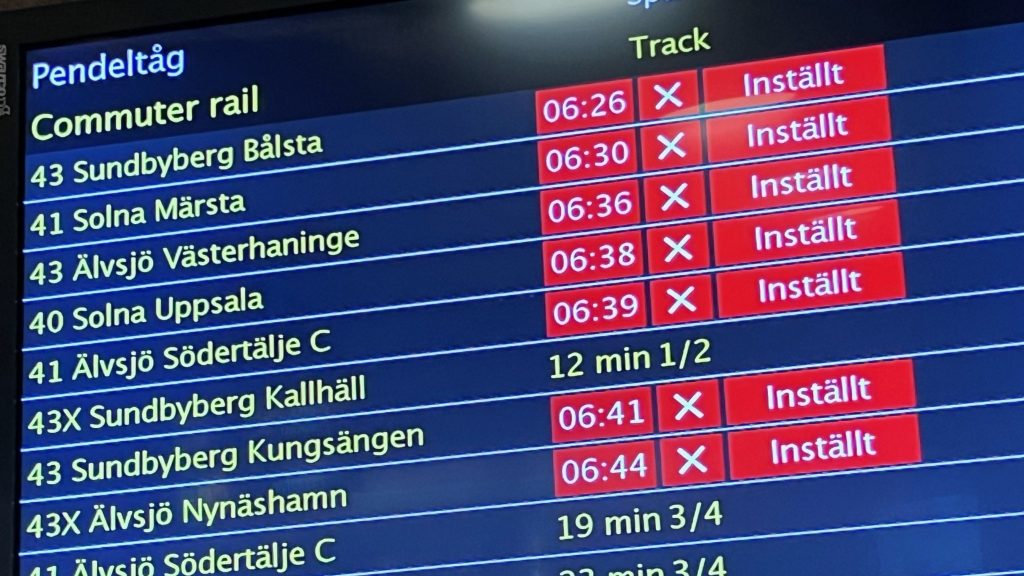
Strike!

Have fun getting to work.
image source: sverigesradio.se https://tinyurl.com/46e5w4mk

Thousands of Stockholm commuters this week were inconvenienced by striking train conductors. The strike by 20-30% of commuter train conductors in Stockholm resulted in many canceled and delayed rides. It did not result in any change in the staffing plans that the conductors struck to prevent.

“The Swedish model”

Strikes are rare in Sweden, especially since the 1990s. Up through the 1930s, however, there were many. The government at the time finally stepped in and told both employers and employees to sit down and work it out. Which they did.

The outcome of the negotiations, the Saltsjöbaden Agreement of 1938 (updated), was groundbreaking. In it, it was decided that the employer had the right to distribute work as they saw fit. Employees, on the other hand, were free to join a union. The government was to stay out of it. The employers and employees would arbitrate workplace issues themselves through collective agreements.

When these signed, collective agreements were in place, an obligation to maintain peace in the workplace (fredsplikt) was also understood. In other words, strikes would not be allowed as long as there was a collective agreement.

Breaking the law

This is what the striking train conductors broke in their so called “wild strike.” There is a collective agreement in place, but they struck anyway and disrupted the workplace peace. The strike is considered illegal, even by the union.

The train conductors knew this even as they considered their cause important enough to risk being sued and even dismissed. So far, however, Stockholm Region’s decision to replace train attendants with cameras, alarms, and other technology stands. Conductors will likely be the sole employee on commuter trains in the future.

Plastic bag politics

Plastic bags – not as simple as they look
image source: www.varldenidag.se https://tinyurl.com/ydtk2a8t

The tax on plastic bags was, at first, a relatively obscure item listed in the January Agreement (2019) between the Social Democratic, Green, Center, and Liberal parties. But it did not remain obscure. Instead, a heated debate on the pros and cons of plastic grocery bags took place. The tax’s enaction was both celebrated and hated. Now, it might be going away again.

Good or bad?

In the debate, many argued that the grocery bags sold at the checkout counter were basically always reused as trash bags. Others argued that Sweden didn’t have the problem that the tax was supposed to address – plastic bags blowing around and polluting the seas, oceans, streets and forests. Numbers telling consumers how many times reusable bags needed to be used until they “made up for their manufacture” added to the debate. Whether for the environment, or for the income, the tax went into effect in June of 2000.

The tax had an immediate impact on consumption. When grocery bags began to cost seven kronor or more, sales of plastic bags to pack groceries in dropped over 80%. On the other hand, according to Wikipedia, sales of paper bags in grocery stores went up about 70%. Nine of ten Swedes said they were now bringing their own bags to the store. Sales of plastic bag rolls went up 75%.

Regardless of how much it did or did not do for the environment, the tax effectively put a damper on the sale of plastic bags at checkout – and the expected tax windfall. Expressen reported that in 2020, at least, the state received nearly two billion kronor less than what it had expected to take in. SVT reports, however, that the tax drew in more than twice as much last year – meaning that more people bought bags last year than had previously.

Not so fast

The Sweden Democratic party has now gone out and stated not only that the plastic bag tax was never effective, but that it will go away in the new year. Minister for Climate and the Environment Romina Pourmokhtari, of the Liberal party, was quick to counter. The plastic bag tax will only be evaluated, she said. A decision will only be taken “during the fall budget negotiations.”

Sweden’s climate goals are already a friction point between the government and its support party, the Sweden Democrats. The plastic bag tax might seem unimportant in the larger scheme of things, but it symbolizes the conflict well.

Books, Nato, and opinion polls

These kinds of images are not going away
image: Reuters.com https://tinyurl.com/3h6mjk8s

It’s not often a Swedish administrative law makes international, political news. But when a Stockholm court decided that the police did not have a legal leg to stand on when they denied permission to burn the Koran at two different demonstrations, it did not go unnoticed.

Burning books part II

An administrative court is where a conflict between a state agency and a private person (or business) is decided. In this case, both a private person and an association calling itself “Apallarkerna,” appealed the police’s decision to not allow either of them to burn a Koran in public. The private person wanted to burn a Koran in front of the Iraqi embassy to protest Islam in general. The association thought (perhaps not incorrectly) that burning a Koran in front of Türkiye’s embassy, à la Paludan, was a good way of preventing Sweden from joining Nato.

The police denied both demonstration applications on the grounds that their actions would threaten national security (see this post). However, the court found that according to the way the law is written, national security is not a legal reason for denying permission to hold such a demonstration.

Sweden’s Nato application

This will not do anything to further endear Sweden to Türkiye. In a recent meeting at Nato headquarters in Brussels, Türkiye’s foreign minister even drew a parallel between the court’s decision and Nazi Germany. “The Nazis started by burning books, then they attacked religious gathering places, and then they gathered people in camps and burned them to achieve their ultimate goals. That’s the way these things start” he is reported to have said.

Should it be illegal?

If (or more likely, when) a burning next takes place, Türkiye may not be the only who is seriously upset. A recent DN/Ipsos poll found that 51% of Swedes think that it ought to be illegal to burn holy books like the Koran or the Bible.

In an interview with SvD, former prime minister Carl Bildt said that he was not sure if burning a book was actually a protected right, but that it was complicated. “It is quite obvious that it is not freedom of expression to burn down a mosque. But burning a book, is it freedom of expression? Leave it to the lawyers to draw boundaries, but it is reasonable to think that somewhere there is a limit to what you can burn as part of freedom of expression.”

Others are not so sure it is time to change Sweden’s laws. “Only a few months ago we were proud that we allowed book burning – it was proof of our freedom of expression” Antje Jackelén, Swedish archbishop emeritus, commented. “Then along comes Erdogan, and our Nato negotiations break down, and suddenly we think completely differently. It’s a little meager.”

In the same poll, support for a ban on publishing images that denigrate religious symbols, or a ban on ridiculing religious scriptures in a text, was just under 30%. It is unknown what support there is for a ban on other actions, like putting a glass of wine down on a religious book or otherwise not showing respect. Those actions may or may not go unnoticed in the future.