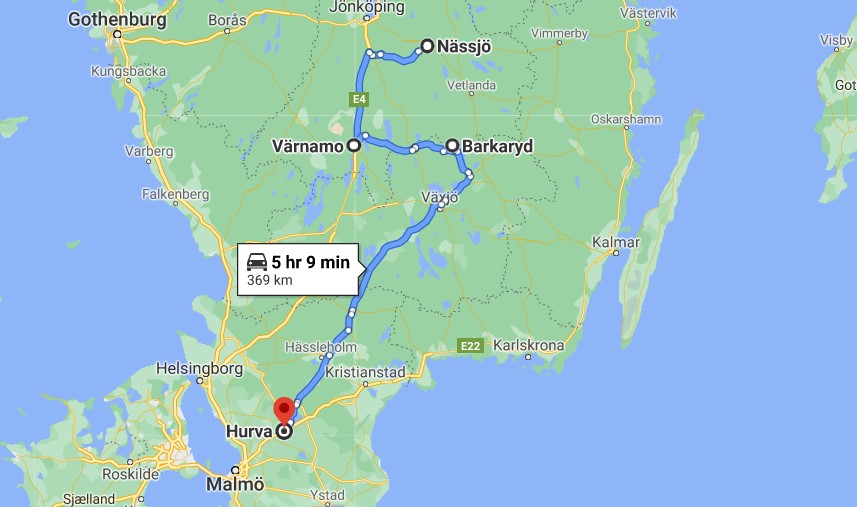
Two days ago, and with so little fanfare that I didn’t hear or read about it until today, a new electricity transmission cable was turned on. The Southwest Direct Electrical Current Link – SydVästlänkens likströmsförbindelse – is great news! Running underground to Barkaryd, and from Barkaryd to Hurva on poles, it greatly widens the electrical bottleneck that used to reduce electrical capacity in southern Sweden. The potential for new companies and new jobs is cause for rejoicing.
The bad news is that it cost seven billion kronor, and took six years longer to build than expected. As Naod Habtemichael at DN correctly notes, the process was “a horrifying example of the state building infrastructure.”
I’m thrilled about it finally happening (see the abundance of posts in this blog about Sweden’s electrical challenges) but, omg, it has to become faster and easier if everyone is going to plug in their cars.
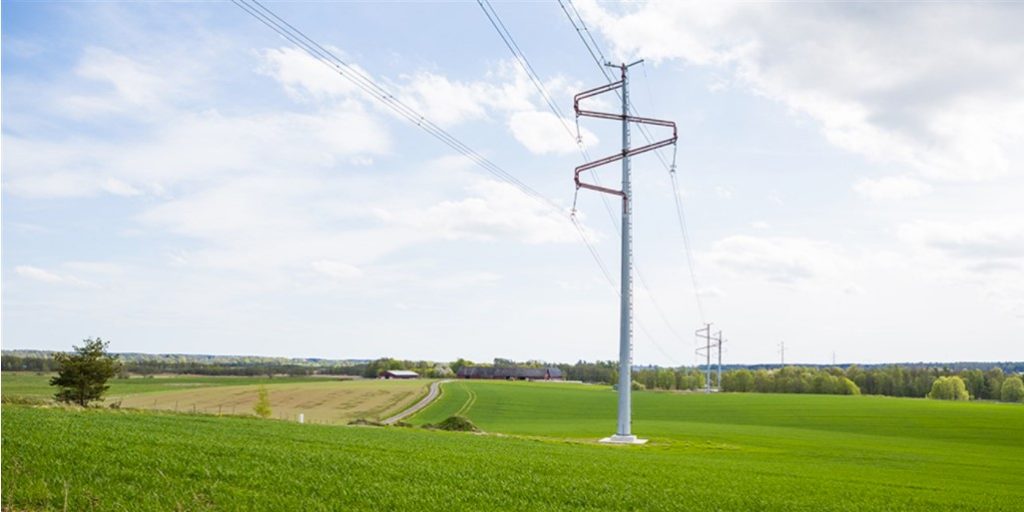
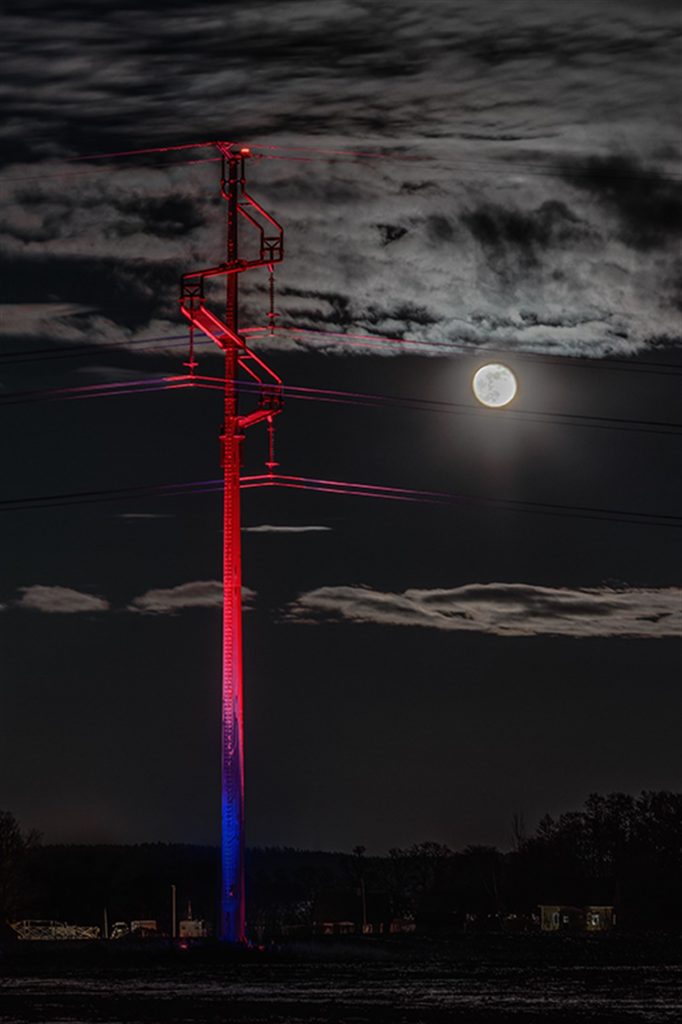
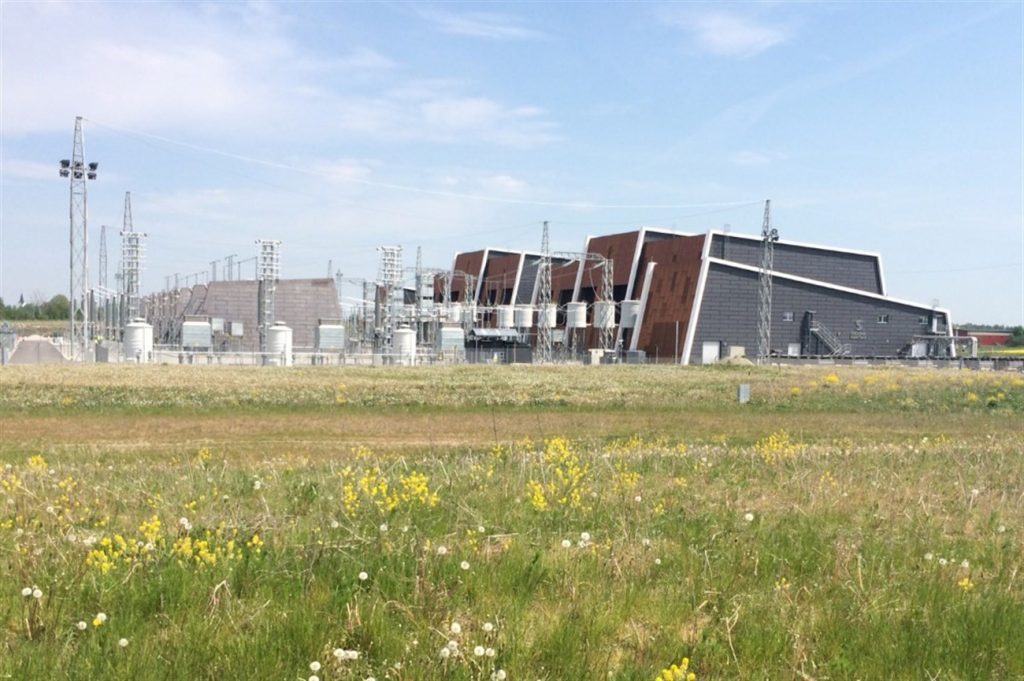
It is pretty though. Svenska Kraftnät – yes, that’s what they call themselves in English – brought in some pros to make the different elements in power transmission fit into the landscape. Below are pics from their website.
transmission poles by day…
and by night.The power station at Hurva, designed to reflect the surrounding landscape.
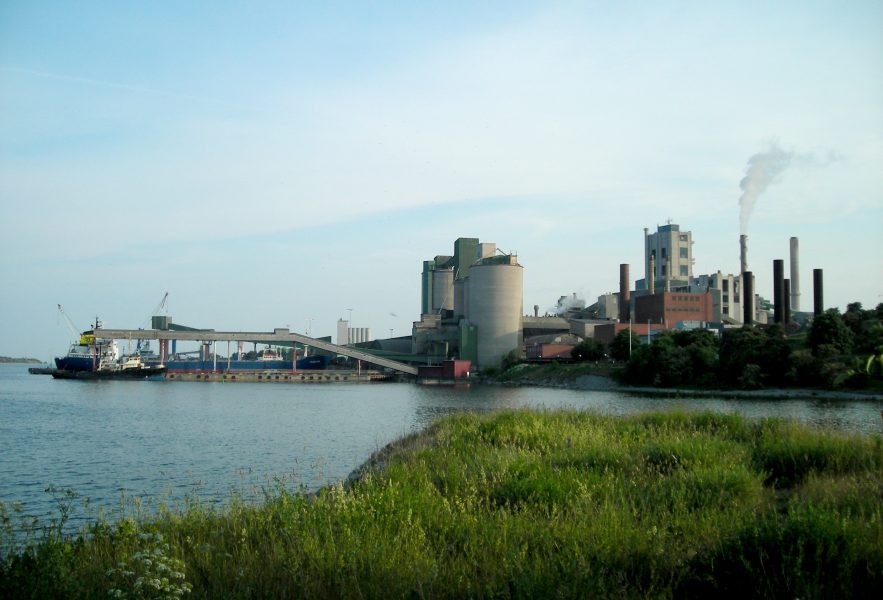
Cementa’s site in Slite, Gotland image: Wikimedia commons
Gotland has a lot of limestone. Limestone is largely composed of calcium carbonate, a key ingredient in making cement. In a chemical reaction called hydration, water and cement combine to create concrete.
Cementa is a cement production company that provides cement to create the concrete used in building. One of the things that concrete helps build is apartment buildings. Sweden needs apartment buildings – the pace of building housing is such that every Swedish government promises / brags about how much housing it will create or has created. Housing, of the lack of it, has been blamed for everything from segregation to bad school results to rising crime rates. So it’s a big deal that the court of property and environmental affairs (mark- och miljödomstolen) overturned its own, earlier, positive decision and said no to Cementa’s application to continue mining limestone in Slite, Gotland.
Originally, the court had said yes. Cementa has been mining limestone in Slite for over a hundred years and the court said it could continue to do so. However, the Swedish Environmental Protection Agency (Naturvårdsverket), Gotland’s Botanical Association, the County Administrative Board of Gotland, and the Swedish Society for Nature Conservation (Naturskyddsföreningen) appealed the decision. On the second time around, the court found that Cementa’s impact on Gotland’s groundwater level had not been sufficiently investigated, and denied Cementa’s application for continued mining.
The outcry
The Swedish Construction Federation (Byggföretagen) is the trade association for private construction companies and employers. They were not late in decrying the decision, saying that 280,000 jobs were being risked. Cementa provides over half, and even up to 75% of all cement in Sweden, and it follows therefor that up to 3 of 4 building projects are at risk of not happening. Layoffs may start as early as August, according to SvD.
also carbon dioxide of course
It must also be mentioned that the Cementa factory at Slite currently stands for about 3% of Sweden’s carbon dioxide emissions. However, Heidelberg Cement, of which Cementa is part, only recently announced that the Slite facility was slated to be reorganized for carbon capture and become carbon neutral already 2030. Also this technology is threatened.
to the rescue?
Minister of many hats – Business, Industry and Innovation – Ibrahim Baylan has confirmed that he is set to invite interested parties to a meeting on the matter. Naturally and quite rightly so, judicial independence limits any particular actions, so who knows what he can do.
Over the last weeks, no fewer than four lawyers have been expelled from the Swedish Bar Association. The latest ousting was for passing on information from two jailed clients to persons involved in their respective cases. According to DN, Edip Samuelsson contacted, and passed on information to, his client’s alibi in a murder case. In another instance, he is reported to have provided financial information from a client to the client’s wife at the same time as this client was suspected of a serious financial crime. In both these cases, Samuelsson was found by the Swedish supreme court to have acted in violation of the restrictions imposed upon him by these cases.
Originally, the Swedish Bar Association had decided to not expel Samuelsson for his actions. Instead, he was given a 50,000 SEK fine, the highest fine allowable. However, the office of Chancellor of Justice didn’t think the Swedish Bar Association came down hard enough, and took the case to the supreme court. The supreme court turned out to agree with the Chancellor, and voted to disbar the lawyer.
“I think it is important to get clarity on how to look at this kind of violation of restrictions because it has a big impact on how the legal profession is seen” Chancellor Mari Heidenborg said after the decision. “It is incredibly important, she continued, “not least for the detained: The risk with violating restrictions is that it can actually be worse for the detainee themselves.” For more on the Chancellor of Justice, see below.
more cases
In other cases this year, the Bar Association did do enough. Last month, it expelled two lawyers for leaking information on police investigations to various people connected to gang activity. Their real names, as well as their codenames “The Prince” and “the King”, were found in the now-famous Encrochat files. They were relieved of the lawyerly duties and privileges.
Also earlier this year, another lawyer was permanently vacationed when she, too, was found to have abrogated detainee restrictions. In this case, the lawyer played mail deliverer, delivering letters from her client, who was detained in a big narcotics case, to her client’s wife.
The Swedish Bar Association has not always been a vocal supporter of tougher punishments for convicted criminals. The association called doing away with the “punishment rebate” (a praxis in which the number of crimes committed automatically decreases the punishment for each crime) a “badly thought-out and criminal-political opportunistic idea trend.” But where the Bar Association might fall short, it seems the Chancellor of Justice is ready to pick up the slack.
check out the cranes
Basically, if you want to claim damages against the state, you contact this office. Or, if the police do something wrong, this office makes the judgement call. They also are charged with protecting freedom om expression and will act as prosecutor if this right is restricted in any instance. Plus, it can also, apparently, get involved with disciplinary errands involving lawyers due to its capacity to act in the interests of the general public. (Who has heard of this agency before?)

The office's symbol, besides the usual three crowns, includes two cranes. The one crane holds the traditional scales of justice. The other crane is holding a stone - if the crane falls asleep, it will drop the stone on its own foot and wake up. The cranes are meant to refer to the Chancellor of Justice's task of making sure that courts and other authorities fulfill their obligations according to what justice and the law require.

Cranes. I like it.
sitting pretty good right now image: socialdemokraterna.se
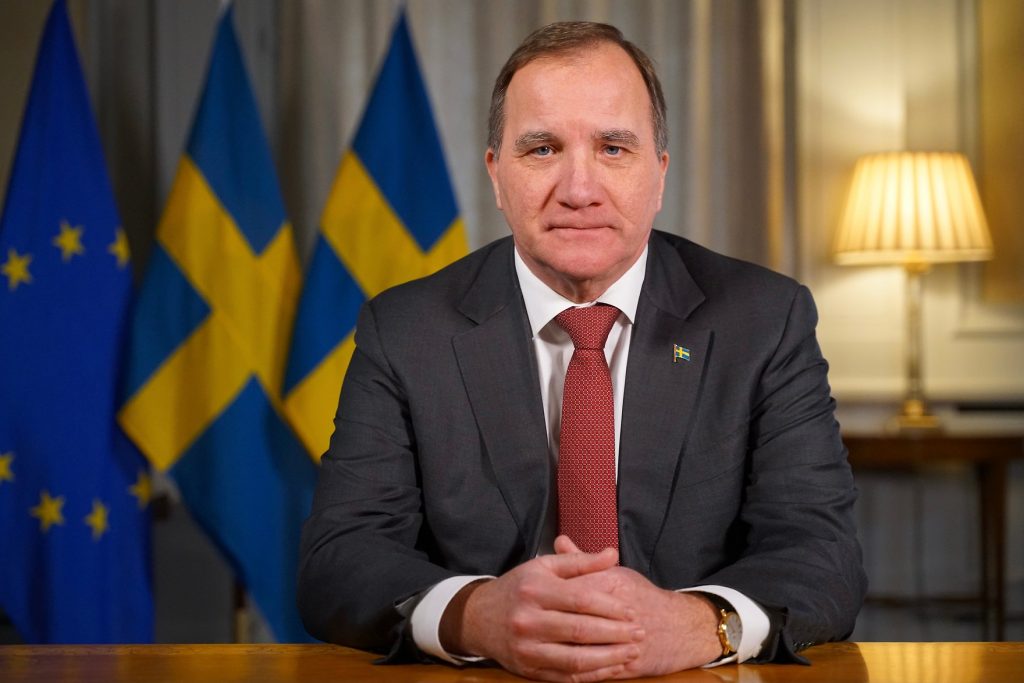
Löfven has most likely managed to pull together the votes to be reinstated as Prime Minister, and will even likely remain so until the next general election in the fall of 2022.
There have been a lot of hiccups, and perhaps some more will come along. However, Löfven has got to be feeling pretty confident right now. Kakabaveh can be handled, the Green party with whom he shares the government has said they’ll vote green for him, and Center party’s latest demands aren’t something that can’t be massaged into palatability.
Kakabaveh has not yet said she has been placated. Kakabaveh gave Löfven a list of demands to get her vote, and they were all heavily left of center. However, most of them can be fobbed off with promises of putting together a committee to look into the matter. For Kakabaveh, a right-leaning government would be even worse, so she is likely to go along with giving Löfven her tacit support and vote with the yellow card.
In a press conference today, Center said that they will vote with a yellow card as well. In return, the Löfven government, she said, has gone along with three of Center’s, frankly, watered-down demands:
making into law the changes in employment regulations (LAS och omställning – in which, among other things, the last-in first-out rule was relaxed)
less restrictive rules on shorefront building (försvagning av strandskyddet), and
that landowners (we’re talking in particular about forest owners) will have more control over how they manage their own property (förstärkt äganderätt för skogsägare)
The twist here is that the Green party, a party that together with the Social Democrats officially forms the government, has absolutely not gone along with these three conditions that the Center party claims “the government” has gone along with. In an interview after Center party’s press conference, Green party co-leader Marta Stenevi said that the Green party was not at all behind these concessions. In fact, they are supposedly red lines for the Green party. Yet, Stenevi said that the Green party will vote red to a Kristersson (Moderate party) government and will vote green on Stefan Löfven for Prime Minister. They say yes, she continues, to a Green, Center, Left and Social Democrat constellation, but a big no to what the Center party says they have an agreement on with the government.
What does this mean!?! Almost nothing. The Green party has historically twisted itself into so many configurations to match the space allowed for them in a government coalition, that it is unlikely in the extreme they will stop a Löfven-led government from returning to power. The bottom line is that although she says no to these supposedly agreed-upon demands from Center, she won’t vote against reinstating Löfven.
Löfven has therefore 175 votes – if not positively for him (green), then at least not against him (green and yellow together, versus red) and that is all that matters.
But wait, there’s more
However, there is potentially a little, little spanner in the works, and that is the budget that needs to be passed in December. But it likely won’t be important. Here goes:
Center’s position, from the beginning, has been that the Left party may not in any way be a contributing partner in budget negotiations. However, what fikas the Social Democrats have with Left party members at the lower levels where the budget is actually hammered out, is not something that Center is going to police. If the Social Democrats and the Green party present a budget (for which they earlier have gotten the Left party’s acceptance) then Center can most likely go along with it.
And even if one of the Löfven-cooperating parties doesn’t go along with the budget, who cares? Löfven has promised to call for new elections if his budget doesn’t pass. The budget comes up for a vote in December. If the government falls over the budget, an election would have to be held latest March. The next general election is in the fall, about six months later. No one – really, no one – wants to have two elections in a six month period. Ergo, no party that doesn’t vote against Löfven now is going to vote to bring down Löfven then. Löfven wins! He gets his government and he gets his budget.
Who knew that the two extreme parties, the Left and the Sweden Democrats, could work so well together for the Social Democrats? Did Center? Not a chance. But did the Social Democrats? Who knows? It’s brilliant, though.
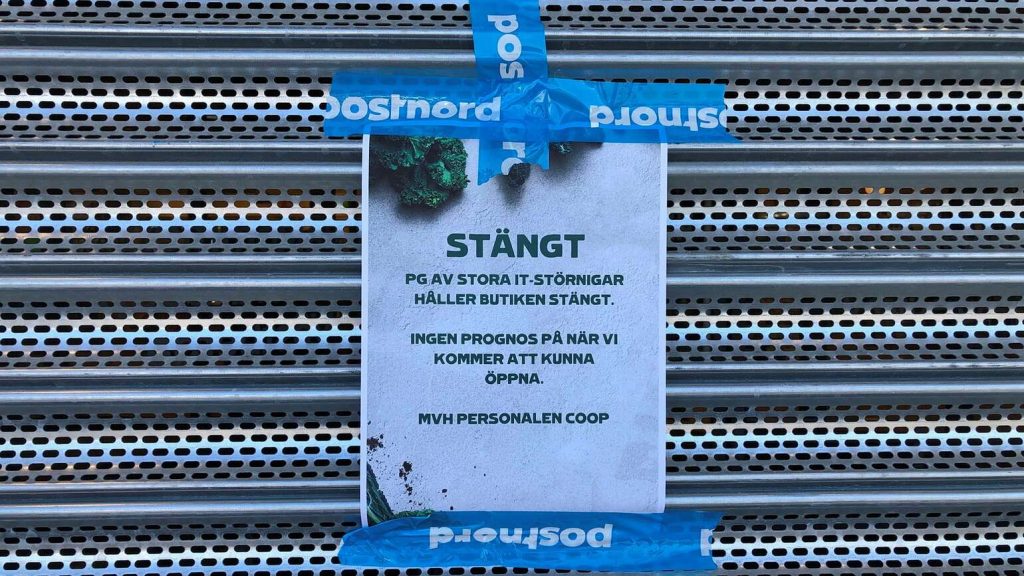
The old and the infirm, as well as the young and beach-going, went to Coop yesterday only to be met by locked doors. Hastily printed signs were tacked up on entrance doors saying Coop was closed due to IT issues. Not just Coop but companies across the US and here in Sweden like security firm Gunnebo, pharmacy chain Apotek Hjärtat, Sweden’s railroad SJ and even the convenience stores connected to gas stations St1. All were hit by a ransom attack that shut businesses down on all fronts and in entirely different financial sectors.
The factor in common for all these businesses was the Kaseya software that they were all running. Kaseya offers software for remote management operation. The hacker is suspected to be REvil, an outfit straight out of Russia, and the same ones that shut down the beef supplier JBS in the US last May.
According to the Jonas Milton at the Swedish Civil Contingencies Agency (also known as MSB or Myndighet för Samhällsskydd och Beredskap), says to DN that both companies and society must prepare itself for more of these attacks. For companies, this can mean having a back-up, non-digital way of paying, having more suppliers in case one gets hacked, and that people need to be able to survive without stores for a few days.
In larger towns, of course, there’s usually an ICA not so far away. If ideological stances aren’t in the way, (grossly simplified – Coop historically being in the left camp and ICA in the right) there are alternatives. Unless, that is, you’re not just on your way to the waterfront but are rolling your way to the only store your wheelchair will get you to.
“Yes, I said the truth out loud” Ebba Busch did not say. image: Alexander Mahmoud (DN)
Ebba Busch, the leader of the Christian Democratic party, admitted today to committing gross defamation (grovt förtal). Busch referred to a person representing a man against whom she is embroiled in a court case as a convicted felon. The person actually is a convicted felon. In Sweden, this is still considered gross defamation.
Busch admits to committing a punishable offence, but that in her “heart and soul” she does not believe she is guilty: There are, according to Busch, judicial ambiguities (juridiska oklarheter), but she explains that she is putting these issues aside in order to “lead a country with considerably bigger problems than my personal honor.” She is, Busch continues, admitting to a crime in order to put an end to it, and says that she doesn’t “have the time to go through with examining a legal precedence that today is not clear.”
By admitting guilt, Busch skips the public grilling that a court case would give rise to. But her declaration that her case highlights legal equivocality is simply wrong, says DNs legal reporter Martin Schultz. “It has been well documented over the last few years that even the truth can be defamation” Shultz says. “By bringing up earlier crimes, she has called a person a criminal – which is technically a defamation.”
In American law, a statement must be false to be defamatory. Such is not the case in Sweden.
In American law, a statement must be false to be defamatory. Such is not the case in Sweden. Busch wants the complaint done and gone, but at the same time doesn’t want to really say she was in the wrong. It remains to be seen just how well Busch’s admission (and the real estate court case that gave rise to it) goes over with Swedish voters.
“Who cares if the Prime Minister is Löfven or Kristersson if they’re both following a conservative agenda?” asked Kakabaveh, the political independent formerly of the Left party. And with that simple question, Löfvens fairly clear path to reinstatement got suddenly just a little bit rougher.
Kakabeveh created headlines nearly two years ago when she left the Left party – just before she was kicked out. Being too outspoken on behalf of women (read an old post on this topic), and putting the blame for women’s situations in the world squarely on both sides of the political spectrum, was her crime.
Now she’s saying that if the Social Democrats are just going to follow the same conservative policies as “the blue team”, she is prepared to vote no to the Social Democrats (DN.se), and upset her colleagues as much or more than she has done in the past.
(Side note: the right side of Swedish politics is the blue side, and the left side of Swedish politics is the red side. This is the opposite of American political color characterization. For the record, the Sweden Democrats are called brown.)
For Kakabaveh there isn’t anyone else to vote for, so she’d just be voting no to everybody without anybody gaining her vote. The crux is that her vote is needed to make up the 175 votes for Löfven over the 174 votes stacked against him. If she votes no, she could put Sweden on the path to an extra election.
Political “wildings” are members of parliament who were put in parliament due to being on the party ticket, but who for one reason or another, have left their party. They remain in parliament, and pull down a sweet salary, without actually taking part in the working of parliament. Kakabaveh is just slightly better than many other cases in that many people actually wrote her name on the Left party ballot when they voted. Her mandate in parliament is therefore more personal and stronger than just being put on the party list via an internal popularity contest.