16 Oct. – municipalities still mostly broke

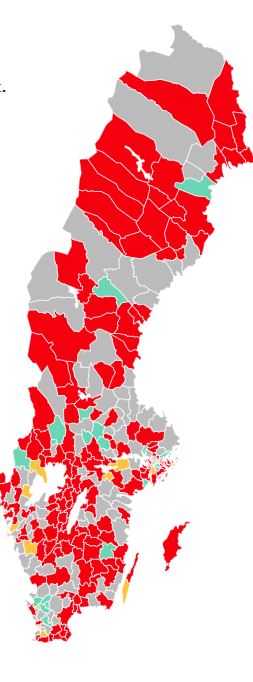
Things are not looking good on the municipality front. The results from Dagens Nyheter’s municipality survey is just in – 4 out of 5 municipalities will be cutting some services in the coming year (DN.se/municipalities). Meanwhile, one would be hard-pressed to find a political party that didn’t swear on every bible in 20 counties that they weren’t supportive of the local communities every waking moment. Something isn’t adding up.

When talking about cutting services, it generally means elder services, social services and schools. To that end, or rather to try and prevent that end, the government and their supporting Center and Liberal parties have promised 5 billion kronor during the rest of their term in office. (Just for fun, you can compare the 5 billion kronor they are promising with the 90 billion kronor Minister of Finance Magdalena Andersson says is needed by 2026.)

According to Helsingborg municipality, “the working population is just not paying enough taxes to cover the costs of taking care of both the young and the old – and the government isn’t helping bridge the gap.” So far, Helsingborg says, they’re not going to raise the municipal tax – but every tenth municipality, of the 197 municipalities that answered, says that they are. (There are a total of 270 municipalities in Sweden.)

According to questionnaire results, the top reasons for the deficit are:

  1. costs are rising faster than income
  2. demographic changes
  3. high costs
  4. less income

The most common expense they were planning on reducing was:

  1. everything (all verksamhet)
  2. unspecified (ospecifierad)
  3. care and services (vård och omsorg)
  4. schools

The overwhelming majority wrote in “everything” to DN’s question, which one can’t help but read in as a certain degree of hopelessness. Some municipalities have been running a deficit for many years, despite good times in other parts of the country. DN notes that saving on schools is particularly troublesome because school is not just a right but an obligation – if your kid isn’t attending school you’re actually breaking the law. Not providing for schools is therefore, in a sense, breaking contract (DN.se/contract). On the other hand, it’s hard to find a tax that doesn’t imply that the government is obliged to deliver something in return, be that hospitals, roads, defense, infrastructure, etc. It’s why we pay taxes.

While the government pays homage to the municipalities – without actually paying – the countdown to the presentation of the budget – this November – is already ticking. Perhaps this latest survey will be a kick in some direction, either a declaration of massive funding – or a declaration of “No, sorry, we can’t keep this up”. More likely, however, there will be many words of little substance. This survey, while fresh, is still, sadly, old news.

15 Oct. – Turkey gets a cold Swedish shoulder

not going anywhere
pic: bruninginternational.com

Turkey’s ambassador expressed how disappointed he was in Sweden yesterday, and today he’s sure to be even more disappointed: The government decided today to stop all war materiel exports to Turkey. Sweden’s exports to Turkey have already been discussed here, but to recap, the numbers regarding how much Swedish exports, what it exports, and in what year, differ.

According to Sweden’s Inspection for Strategic Products (ISP, or Inspektionen för strategiska produkter) Sweden has no weapons system exports to Turkey, but has exported some gunpowder and other explosives (DN.se/weapons). These exports were part of agreements made several years ago, that Swedish companies will now renege on. No new agreements have been signed on war materiel since 2017.

The most part of the shipments were, according to SvD, other things like electronics, plating, machine parts, programs and technical assistance. Also, as Expressen already reported, things like bandages and first aid kits were a part of the exports.

Whatever they were, they aren’t anymore. Things are moving very fast in Syria, and surprisingly fast in Sweden as well. Everyone’s mad at Turkey, so decisions like these are admittedly low-hanging fruit, and Erdogan’s fans don’t vote here. Sweden will continue to work towards an EU-wide ban of war materiel exports, no doubt making the Turkish ambassador still more disappointed.

14 Oct. – Löfven reported – again

the hot seat of a KU committee interview
pic: axisimagingnews.com

Moderate party leader Ulf Kristersson has reported Prime Mininster Stefan Löfven to the Committee on Constitutional Affairs (konstitutionsutskottet). When Stefan Löfven said in an interview the other day that Sweden needed to take in fewer refugees, coalition partner the Green Party hit the roof: Taking in fewer refugees is not their party line at all, so how could Löfven have said that? Löfven responded that he was only speaking as party leader of the Social Democrats at that particular moment.

“But who would know that?” is the Moderate party question. As Prime Minister, Löfven speaks for the government. In all that he says, goes the the thought, one “should be able to count on that the statements coming from the Prime Minister are correct” (fplus.se). To Expressen, migration policy spokesperson Maria Malmer Stenergard from the Moderate party said that she would not have reported it if she hadn’t believed that a wrong had been committed (fplus.se).

A report to the Committee on Constitutional Affairs sounds serious, perhaps, and it should be, but it’s not, really. The committee is made up of 17 parliament representatives from all the parties, supported by an small office of civil servants. Their job is to review the performance of government ministries and the handling of government affairs. (They also go through documents from the various government offices to make sure that laws and praxes were followed in all cases.)

When someone is reported, they interview the person. These interviews are public, so they can be awkward. Most of the time, that’s the point. However, if a charge is leveled then it goes directly to the Swedish supreme court. This has happened exactly once since the mid 1800’s. Generally, someone gets mildly slapped on the wrist and told not to do whatever it was again, but in a next-to-worst-case, a committee report can be used as the basis for a non-confidence vote.

According to Expressen, Stefan Löfven was reported to the committee (KU-anmäld) 27 times before he’d even completed a full term of office (Expressen.se/KULöfven). Most of the reporting has been leveled at him from the Moderate party, naturally enough. But every party except the Green Party has reported him at least once. In his ten years of office, ex-Prime Minister Göran Persson was reported “only” 26 times, so we’re talking about a huge increase in reporting especially in the last few years.

This has, of course, watered down the seriousness of being reported significantly, and seems now mostly just a show for public consumption – well, what’s more likely is that it’s a show for privately disgruntled and frustrated opposition party members. The public, at this point, is mostly just rolling their eyes.

13 Oct. – Swedes in Syria

Al Hol camp
pic: telegraph.co.uk

Around 800 prisoners in the Kurdish-controlled camp of Ain Issa have escaped due to the invasion of Turkish forces in north-east Syria. This disturbing news item is included in this blog on Swedish politics because there were Swedes in that group, as well as Norwegians and many other Europeans (DN.se/AinIssa). Other reports say only 100 prisoners escaped, but, all were agreed that the situation is pretty much sheer chaos.

Bringing back the Swedish children and their families who are living in the refugee camps and prisons is now even more difficult due to the Turkish offensive. Not that it was ever easy, as the government had yet to formulate a position on it even before the invasion. Hopes have been held out, ever since the camps were set up, that the European Union would do something – then Sweden wouldn’t have to figure out the right thing to do on it’s own – but so far it’s been nada from the EU.

Back in April, then-Minister for Foreign Affairs Margot Wallström said that the children of Swedish IS terrorists would be taken home. But besides the 7 Swedish orphans that were flown back to Sweden due to the well-publicized, and on-site, efforts of the children’s grandfather, nothing else has been done that has made it to the papers. There are estimated to be about 57 Swedish children, plus their mothers who joined IS back in the day, in the camps. Most of them are in the Al-Hol camp in the north east. Until now, the Kurds have shouldered the responsibility to run these camps, but now that will likely fall to the Turks, assuming their take over continues.

“It is very, very olyckligt” said Minister for Foreign Affairs Ann Linde yesterday. Olycklig can be translated many ways – unfortunate, wretched, infelicitous, unlucky, grievous, sad, unhappy, dismal – reader’ choice. “We want to bring the children home” she continued. “But it is much, much more difficult than we thought. Partly because there are laws that say one can’t take a child from its mother, or take a child from a Swedish mother whose father comes from another country. Partly also we have international law. There are so many obstacles – which I don’t think we knew about in the beginning” (DN.se/AnnLinde). According to Linde, other European countries are having the exact same problems. “Furthermore, it isn’t always easy to be certain of their identities, or who the child’s parents are” (SvD.se/AnnLinde).

For others, however, it seems identity is not at all an issue. SvD was in touch with a man in Sweden whose daughter and grandchildren are in the Al-Hol camp. In a conversation with his daughter last week, she expressed fears that the Kurdish forces will leave to fight the Turks, and leave the camp on its own. “The fear is that they just open the doors, and it will be up to each person to make their own way. How women and children will make it, out in the countryside, in an aggressive environment, I have no idea” said the anonymous man. “My daughter wants to get out of there. The question is how one does that (SvD.se/daughter).

That is the question. In a recent poll instituted by Save the Children, Sweden, 42% of respondents thought that the children, together with their mothers, should be allowed to return to Sweden – if, that is, the mothers’ possible crimes and their suitability as guardians were investigated. 11% thought the children alone should be brought back to Sweden, while 29% felt that both mothers and their children should remain in Syria. 18% said they didn’t know (SvD.se/ISpoll). This was before Turkey invaded, so that percentage that is for bringing them back to Sweden has likely risen.

12 Oct. – Turkey, first aid kits and return to Syria

Swedish exports?
pic: if-sakerhet.se

The pressure is on for Sweden to cut its weapons export to Turkey due to its invasion of the Kurdish-controlled region of Syria, like Finland has done. The only thing, is that Sweden last exported war materiel to Turkey in 2017, and that even then the total was for approximately 100,000 kronor, which in weapons export terms is almost nothing (DN.se). Of course, that doesn’t help if you get hit, or hurt, with what was almost-nothing-but-not-quite.

Swedish peace organization Svenska Freds said yesterday that Sweden exported 300 million kronor’s worth of material to Turkey last year alone, which is a completely different number. This number, according to Minister for Foreign Affairs Ann Linde and DN, was not, however, war materiel but for shipments consisting of things like fire blankets, first-aid kits and steel plates. According to Finnish sources, Turkey bought war materiel last year to the tune of 170 million Swedish kronor total. But steel plates, for Finland at least, are on the list of things that may not be exported as they can be used in war for things like tank plating. (SvD.se/plating).

Numbers are difficult, and so is the balance between export and income, market forces and ideals. What is not debatable, though, is that the Kurdish controlled region in Syria can no longer be considered quite as safe as previously. In August of this year, The Swedish Migration Agency (migrationsverket), had deemed parts of Syria safe enough for people who were denied residency to return. Now they’re having to give it another think, and a new assessment will be forthcoming (DN.se).

This isn’t going to change very much – it isn’t like Sweden had stepped up its deportations to Syria. “There are generally a few people that have returned to Syria” wrote the migration agency in a mail. “We’re talking about people who have decided themselves to return.”

10 Oct. – Danish border controls, and more

Hi, why’re you coming to Denmark today?
pic: thelocal.dk

Going from Sweden to Denmark? Bring some good ID, because new border controls are on the way. In response to an uptick in explosions in the Copenhagen area (13 this year, according to DN today), the Danish government will be instituting random ID checks on train, ferry and car crossing points starting November 12th.

This is only one measure in a packet of measures to combat crime that were announced in Denmark today. Although the Danes are not saying that Sweden is the source of their crime wave, they were certainly not pleased that at least two serious crimes were committed by Swedes criminals in Denmark recently (see this post).

Swedish police have been checking the IDs of travelers from Denmark to Sweden since 2015, in the beginning because of immigration issues with non-Danes, not Danish criminality. The border controls have since been justified as a way of averting terror attacks. Minister for Home Affairs Mikael Damberg said he welcomed Danish efforts to fight crime in the Öresund region, and took the opportunity to mention that, by the by, house break-ins went down in south Sweden after Sweden instituted its border controls (SvD.se/Damberg). (They did?)

Among other things, the new Danish measures will allow more cameras, will allow digital recognition of license plates, and make an attack on an official building also an attack on the Danish state. Also the punishment for possession of explosive material will be more severe.

Damberg, being part of the more right-wing flank of the Social Democratic party, might just be looking a little more green than red when looking at the Danish measures. Similar (if less strong) crime-fighting ideas for Sweden were dashed when the multi-party talks failed in mid September (see posts here and here).

Having border controls between two EU countries goes against EU rules, and exceptions like the Swedish-Danish border must be approved and be temporary. The current Swedish border controls expire on November 11th – (coincidentally?) the day before Denmark’s are supposed to kick in. Sweden has had border controls for Denmark and Germany in place for four years, but it’s getting harder to keep justifying them, even for terror reasons. Government coalition partner the Green party is opposed to the border controls.

Still, Sweden and Denmark are hardly alone in re-constructing borders within the previously border-less EU. According to a roundup by DN here, France has a 4 meter high fence in Calais to prevent migrants gaining access to the Channel Tunnel. There are also fences of various construction along Hungary’s southern border, between Austria and Slovenia, between Slovenia and Croatia and between North Macedonia and Greece.

More than ever, Sweden’s own Ylva Johansson, the likely EU Home Affairs Commissioner, will have her work cut out for her on the issue of migration.

9 Oct. – no such thing as free coffee

A lot of the news is centered in Stockholm – ask anyone who lives outside of Stockholm. Also Brussels is a news hog, since the laws we live under here have to comply with laws created there. Today’s blog, though, goes up north to Kiruna, even as it also goes to the very heart of this coffee-loving nation.

First, some background. Schools around the country are going to have to make do with less money in the new budget year. Kiruna municipality is cutting the number of its student assistants from 75 to 25 as one of its cost-cutting measures, Aftonbladet reports. Then, one of it’s municipality workers posted on facebook: maybe spend the money we spend on coffee on student assistants instead? “Many people think offering a coffee is about the only thing the municipality does, and we need it. But we work here anyway so maybe we can afford to bring our own coffee” she said to Norrköping newspapers.

Kiruna spends just over a million kronor a year on coffee in its office machines. And it’s true that a million kronor would pay for a couple of student assistants for a year. But it’s not going to solve the budget problem, nor are municipality workers living high on the hog at the workplace. Coffee is likely the one perk they have, and no one needs coffee like a teacher. Making coffee a scapegoat for budget problems isn’t the way to go.

8 Oct. – Johansson: the verdict, later today

commissioner-to-be? Ylva Johansson
pic: europeaninterest.eu

Ylva Johansson, Sweden’s candidate to the European Commission, will find out today if she has to return to sit before the EU parliament for further questioning, or whether her written answers were good enough. Johansson is up for the position of Commissioner for Employment and Integration, a posting that has got to be one of the most difficult and visible positions in the commission.

After the initial 3-hour long interview a week ago, there were several disgruntled listeners. Johansson was accused of being unclear on several points, from asylum and migration goals to human rights and security issues. Only the Progressive Alliance of Socialists and Democrats party (S&D – in which group Sweden’s Social Democratic party belongs) and the Alliance of Liberals and Democrats (ALDE) gave her the thumbs up right away. After the interview, she was given a list of questions to answer in written form, and 48 hours in which to answer them. These answers were sent to the committees for each EU party (who are different than Sweden’s party constellation) for their consideration.

We’ll find out later today if her answers are sufficient.

Update: her answers were sufficient, so Johansson wasn’t asked to come back for a second round of grilling. This means that she is on track for approval, when, on October 23, the EU parliament votes thumbs up or down on Ursula von der Leyen’s entire slate of commissioners.

7 Oct. – a royal fuss

The Royal Family always makes the headlines in Germany
pic: gala.de

The political news for the day is that the court of His Majesty the King of Sweden Carl XVI Gustaf announced today that some of his grandkids, the children of Princess Madeleine and of Prince Carl Philip, will no longer officially be considered Royal Highnesses.

They’re still part of the royal family, of course, but not in the official sense whereby they must work for Sweden and represent in some way. When they go somewhere, it will be as regular people and not official representation with expenses covered by tax payers. They’ll still retain their various duchess and duke titles (although their future children won’t), but now they are free to actually work, and even join a political party and run for office. Just like everybody else, sort of (SvD.se).

As head of state, the King receives compensation for the work he does representing the country. This money comes in the form of a lump sum which he can distribute among the family as he will. Since 2013, the Royal Court has had to account for its income and expenses, but within that reckoning, they do not have to account for what are private expenses and what the expenses are associated with their representation.

In the larger scheme of things, like the state budget, the royal apanage is not much more than a drop in the bucket – but to many people it’s a completely unnecessary drop that doesn’t fit with the modern democratic society that Sweden otherwise prides itself on being. For others however, the Royal Family is charming and traditional and a bit of color in an otherwise not so exciting state apparatus. These folk will be happy that at least Victoria, Crown Princess of Sweden, Duchess of Västergötland remains the heir apparent to the Swedish throne for whenever her father decides it’s time to step down. Victoria and her family, plus her parents His Majesty King Carl XVI Gustaf and Her Majesty Queen Silvia of course, remain officially royal.

The decision, a pretty unique one in the history of royalty apparently, is likely a way of circumventing a more visible debate on the status of the Royal Family in Sweden. Although a committee hadn’t yet been put together, a decision to form one, and look over the apanage, was taken by Parliament earlier this year (DN.se/apanage). It’s unclear whether the King’s decision will obviate such a committee. Word is, that the apanage amount won’t now be reduced either. Representation costs and duties are as high as ever, reports Marshall of the Realm (riksmarskalk) Fredrik Wersäll (SvD.se).

The German gossip papers were all over the news. The Swedish Royal Family is an enduring and popular page-filler for a dozen-odd papers. “What an upset!” ran Gala’s headline (Svd.se/Skrall). If you thought that the Nobel prize in medicine would top all news today, you’d be wrong.

6 Oct. – electricity bills are coming

bills are coming
pic: mumby.com

It’s been written about on this blog before (this, this and even this), but here it is again. Electricity prices. Why are they so high? Who’s in charge? And why are the bills so hard to understand? Has anyone seen where Sweden is on a map?

All these questions have sort of a “Nobel prize in economics” character. But it’s being taken up again today, because although the electricity network fee you pay is likely to be lowered this year and the next few, the Swedish Kraftnät is about to raise their prices. This will affect you and your wallet, and not in a good way.

Kraftnät (“powernet” is the closest translation) is the state-owned enterprise that is responsible for the country’s national electricity grid. Its customers are electricity producers and grid owners who pay for transporting electricity on the national grid (svk.se). Electricity producers are actors like Vattenfall, E.On, Fortum and Sydkraft. Regional grid owners, like E.ON Distribution, Vattenfall Distribution and Ellevio pass on electricity to local grid owners or directly to large consumers. All in all, there are about 170 variously-sized grid companies, one of whom sends you a bill (swedishsmartgrid.se).

Of the ten different items your electricity bill is made up of, only one of them is your actual usage. Four other items are dependent on how much you use and 5 items are set fees you have no control over (I got this info here).

This isn’t wrong per se, of course – if complicated, and if the prices are justified. Because the Swedish government didn’t think the prices were justified, they stepped in earlier this year and told the local electrical companies they had to lower their prices. Some people could get up to 20% off their 2020 bills. But wait, there’s more.

  • First off, the EU is not at all happy about the government getting involved with market prices. The government might get slapped on the wrist and have to take it back.
  • Second, the electricity companies are not at all happy about the government getting involved in market prices and are suing (like they’ve done before, and won).
  • Third, now that Kraftnät is going to raise their prices, any reduction in price that might have happened may be moot (because the other companies aren’t going to just sit back and take it).

All in all, your coming winter electricity bills might not be the save-fest they might have been.

The meteorological winter in Sweden started already the 18th of September of this year (five days, no above-zero temps, in Tarfala, Norrland). According to the Farmer’s Almanac, thick hair on the nape of a cow’s neck is a sure sign of a hard winter on the way. Barring that, you might look for ants marching in a line, rather than meandering like it’s Sunday morning. Alternately, look for an unusual abundance of acorns. Whatever method you choose, in the immortal words of the Snows (see: Game of Thrones): Winter is coming.
