Space needed

A time-out in the Nato process
The light by which you see.
image source: Reuters: Umit Bektas https:www.abc.net.au

A thorough review of the Swedish Nato and Turkey carousel would take meters of space. But here’s twenty centimeters on the subject.

The invasion and the reaction

In response to Russia’s invasion of Ukraine, Finland abandoned their careful and delicate handling of their eastern neighbour and threw their hat in the ring with Nato. Sweden abandoned its neutrality doctrine (that had some holes in it, but was a popular idea) and did the same. The membership process was largely smooth sailing, with Nato members accepting the two countries’ applications with no problem or debate. Then there was Turkey.

In a surprise, and despite previous assurances, Turkey said no to Swedish Nato membership on the same day that Sweden said it would apply. Erdogan accused both Sweden and Finland of giving safe haven to terrorists, namely PKK, PYD and YPG members.

Who?

PKK stands for the Kurdish Workers’ Party and is a militant political party based mostly in southeast Turkey and northern Syria and Iraq. Their aim is to establish a Kurdish state, or at least gain autonomy. Using violence to that end is fully sanctioned. PKK’s attacks and Turkish reprisals – as well as Turkish attacks and PKK reprisals – have been going on for decades. The PKK is officially regarded as a terrorist organization by the USA, the EU, and others.

Turkey considers both the Kurdish PYD and YPG to be terrorist groups as well, but Nato and the EU don’t. Sweden has given safe haven to persecuted Kurds, and allows demonstrations at which the PKK flag can be seen vigorously waving. In addition, the previous Social Democratic government signed a deal to support the Kurdish PYD (if not its military branch, the YPG) to get an important yes vote from parliament member and Kurd Amineh Kakabaveh. (Kakabaveh’s yes vote was necessary for Magdalena Andersson to become Prime Minister.) In sum, Sweden hasn’t given Turkey the impression that it respects Turkey’s side of the Kurdish conflict.

We thought it was a done deal

After more negotiations, however, a 10-point agreement was reached between the three countries for Turkey to accept Sweden and Finland as Nato candidate countries. Two points in particular regarded strengthening and enacting new measures against terrorism – mostly PKK terrorism and the Kurdish YPG/PYD organizations. Sweden has indeed taken measures, and Nato’s chairman Stoltenberg stated that he considers Sweden’s and Finland’s responsibilities fulfilled.

Turkey didn’t exactly agree. Instead, Sweden got lists of people Turkey wanted extradited. When the judiciary or Immigration says there are no grounds for extradition, though, then there are no extraditions. Turkey remained displeased. 

PR disasters

When a life-size doll of Turkey’s president Erdogan was hung by the feet outside of Stockholm’s town hall a few weeks ago, it confirmed Turkey’s suspicions that Sweden wasn’t quite discouraging these actions. Of course, Turkey’s government knows exactly how much, or how little, Sweden can do about such actions (hello freedom of expression), but Erdogan has an election coming up. Accusing Sweden of disrespect is perfect for appearing the strongman.

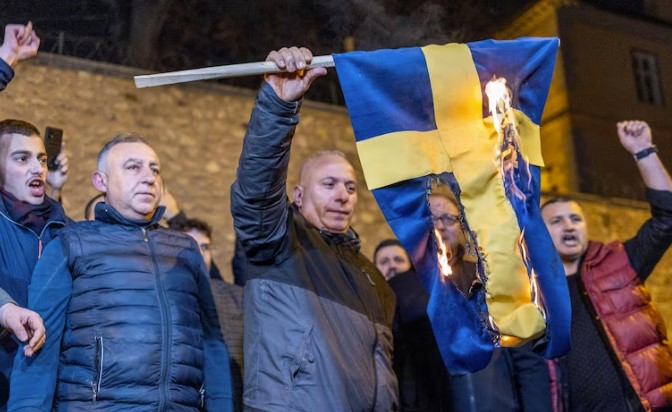
Things got worse this last week when the far-right activist Paludan was allowed to burn a Koran in front of the Turkish embassy (freedom of expression again). Now, most of the Muslim world has exploded in indignation. Swedish flags are burning, and Erdogan looks like a hero.

As for the Nato membership process, ranking diplomats have said it’s time to take a long step back and let tempers’ fires burn themselves out. To stop responding to everything, and to stop with the press conferences. Don’t give it so much space, you might say.

Safer, freer, and heavy weapons

Sweden to send in the big guns
image source: Andrea Adriani https:esgnews.com

Greener, safer, freer. With these words, Prime Minister Ulf Kristersson summed up Sweden’s vision for the EU during its presidency. A large part of the “safer and freer” bit is shoring up, and even increasing, support to Ukraine. A few days, later, and to that end, the government announced that Sweden will be sending the biggest package of military help to Ukraine than it has ever sent before.

“Fastest Howitzer in the world”

The Swedish package consists of the artillery system called Archer, the infantry carrier called “90,” as well as other military items. The Archer is a relatively zippy and mobile wheeled vehicle, that can send artillery grenades over a 50km range and can go 65 km/hour. The gun carriage is mounted on a long bed truck from Volvo and that tips up to fire. As it can be controlled via computer, a soldier doesn’t need to leave the relative safety of the cab to operate it. Youtube’s Extreme World calls it “the fastest howitzer in the world,” and Ukraine has been asking for it for months.

Sweden will also send around 50 armored infantry light tanks called “90,” that can transport up to eight soldiers and that has a mounted 40mm automatic canon. The package will also include the light, portable, Next generation Light Anti-tank Weapons (NLAWs), mine clearing equipment and assault rifles according to USNews.

Gathering dust anyway

It will take months for the main events, Archer and 90, to arrive in the Ukraine and be up and running. Ukrainian soldiers need to be trained on the Archer system somewhere – perhaps here in Sweden, which would be new. Also, the Archers that Sweden may now send to Ukraine are not the latest model, but the Archer B model that are mostly sitting in garages under car covers. The latter is due to the fact that Sweden must still be able to mount a defense itself should it be attacked, while the former’s time factor is due to current laws on weapons export. 

In the future, the time lag might be shortened. To enable Sweden to send Ukraine these heavier munitions, Sweden and Ukraine have to enter into an agreement to cooperate on defense equipment procurement. This way, Ukraine can jointly order defense equipment with Sweden, allowing Sweden to place additional orders to existing contracts and give the equipment to Ukraine. Time and money saved.

All this is not 100% uncontroversial, but a full-scale war happening on the European continent has changed everyone’s notions on what the future was going to look like. To be greener, we’ll need safer and freer.

Napkin sketches and thought bans

a nuclear story that ends in dancing

Yes, then no, then don’t even think about it, then yes again.
image source: https://www.youtube.com/watch?v=mIs3OhnLPDM

Nuclear power in Sweden is a jagged graph between opinion and economy. With the backdrop of the current energy crisis, the government has opened for the possibility of allowing more than ten nuclear reactors, even in places other than the current sites. This is only the latest move in a decades long nuclear story.

Sweden began its nuclear journey soon after the end of WWII. By 1986, there were 12 commercial nuclear reactors in the country. However, the accident at Three Mile Island in 1979 affected opinion, and a referendum was held on the future of nuclear power in Sweden a year later.

Not if but when

The question on the ballot was not if nuclear power had a place in Sweden’s energy mix. The three options differed in how quickly the nuclear power plants were going to be dismantled. The second option won: nuclear power was to be phased out “as fast as possible, given the need for electrical power to maintain employment and welfare” (Vattenfall). Consequently, in 1980, parliament legislated that no new nuclear power plants be allowed. In addition, the existing ones would be dismantled by 2010 (thirty years and political eons hence).

The thought ban

That wasn’t enough, though. In the wake of Chernobyl in 1984, it also became criminal (and punishable by jail time) to “prepare construction drawings, calculate costs, order equipment or take other such preparatory measures with the aim of building a nuclear power reactor within the country.” Not even a napkin sketch, in other words.

This was generally referred to as the nuclear “thought ban” and there was opposition. Still, it took 20 years before the Persson government proposed it be taken away. In its proposition, they wrote that the so-called “prohibition of thought clause” gave “unwanted associations in a democratic context.” Nuclear research and development was “both permitted and desired.”

Nuclear gyrations

Two reactors in Barsebäck were shut down by 2005, but already in 1997 parliament had changed its mind and voted to abandon the 2010 deadline. Then in 2016, the government parties as well as the opposition agreed that even new nuclear reactors could be built (maximum ten), though only at existing nuclear locations.

It has been back-and-forth on nuclear power for decades. Now, how many power plants, and in what places, may be revised again. For some, spontaneous dancing is called for. Doing just that will soon even be legal.

Kick off your Sunday shoes

Since 1956 it has been illegal to cut footloose in private spaces without getting permission from the police in advance. Dancing is often drunken, after all, and definitely disorderly. At least in theory, under the current law, a pub owner has to break up any spontaneous dancing by guests or else they can be considered to have organized the dancing, and be fined.

As late as 2016, a commission established that getting permission for dancing was perhaps not absolutely necessary – but not requiring permission wasn’t exactly risk-free either. An event’s number of attendees, their potential drunkenness, and the reason for the event were risk factors that still needed to be considered in granting dance permission. The law remained.  

Not anymore. The government proposes to scrap the law (almost) entirely. Instead of being required to get formal permission to allow dancing, you should, as a rule, just let the police department know that there may be dancing. Expect some wild craziness starting July 1st.  

Used BankID lately?

Confess. How many times a day do you use it?
source: https://8sidor.se/vardags/2022/11/nytt-bank-id-kan-komma/

It is surprising to many people that Sweden does not come up to the EU’s highest e-identification requirements. According to SvD, Sweden (together with Greece, Bulgaria, Cyprus and Rumania) only has the second highest eIDAS level.

What?! Why?

eIDAS is the EU regulation that concerns itself with e-identification. eIDAS’ problem with Sweden is that the Swedish state is not the guarantor of its citizens’ e-identity. We use BankID or FrejaID for our e-identification – but BankID is owned and controlled by banks, and Freja is listed on the stock market. These are not financially uninterested actors. In addition, if you don’t have a bank account (or if all that clicking and remembering another security code is too much), and you don’t have an e-identity issued by one of these private entities, it’s difficult to obtain even government services.

How does it work, anyway?

Using BankID is about the same whether you are logging in to the Swedish Tax Agency or buying toothpaste on line. Here’s a short summary: Say, for example, you want to buy something from Store.com. Likely, you have downloaded the BankID app from your bank (together with 89% of all Swedes in 2019). By doing so, you have chosen your bank as your e-identification issuer. At checkout, you enter your person number to start the identification process. Store.com asks you to choose a method to e-identify yourself, and you choose mobile BankID. Alternately, Store.com sends out a question to BankID’s servers asking if a bank there has your person number, and then asks you to login with BankID.

At this point, you grab your mobile, and tap in your security code. By using the right security code, you authenticate your identity to the identification certificate provider (your bank). This provider then runs some checks, for example, that your ID hasn’t been blocked. If it’s happy, the provider (your bank) then sends an ID certificate back to Store.com. Store.com, in turn, runs a quick check that the ID certificate provider is legitimate, and then authorizes your access or payment.

What state?

You’ll notice that the state has not been involved in this identity-confirming transaction. BankID was developed in 2002 when the major Swedish banks got together and started a company called Finansiell id-teknik. It’s been run independently, successfully and profitably since then. According to itself, bankid.com, BankID was used 6 billion times in 2021 (almost 200 times a second).

The BankID process described above, however, using your person number and a security code, comes to only a “substantial” level of assurance. (By level of assurance we mean level of online security.) It does not reach eIDAS’ “high” level of assurance. A high level of assurance involves registering in person at an office and thereafter using a smart card, like a state-issued, national ID, for ID certification.

Time for an upgrade

You might wonder what we are doing about this slightly embarrassing level of identification security. We’ll soon find out. DIGG, Sweden’s Agency for Digital Government, has been tasked to present its plan for upgrading Sweden’s e-identification status at the end of January. In its current form, at least, we might soon be waving BankID good-bye.