30 Dec. – part 2: the new rules for 2020

more new laws for 2020
pic:domstol.se

As promised, a review of the new laws and regulations for 2020, part 2:

  • Banks must maintain ATMs throughout the country. The major banks are now required to keep a minimum service level, including cash services, within certain distances from populated areas. For more, see this post that explained it already last June.
  • A reduced tax on gas and diesel. Everytime you fill ‘er up you pay a tax for the energy you use, and the CO2 you produce, while driving. This tax is going to be reduced, to make up for the increased cost for gas and diesel you’ll pay because distributors need to meet the requirements for the “duty of reduction” (reduktionsplikten). This is a requirement that requires that they mix in more biogas, which is more expensive, which they will pass on to drivers, so in turn, the government is reducing some of the tax you pay at the gas station.
  • The punishment for murder is increased. A life sentence may now be the penalty if a murder was carefully planned (föregåtts av noggrann planering), was particularly shrewd or clever (förslagen), was part of another crime, resulted in particular suffering (svårt lidande) or was in some other way particularly ruthless or unscrupulous (hänsynslös).
  • The minimum penalty for buying sexual favours from children is increased from fines to time in jail. The maximum sentence is 4 years.
  • Interfering with the work of first responders (blåljuspersonal, or blue-light personnel) is now punishable with time in jail. Sabotage mot blåljusverksamhet can give up to a life sentence. Also threatening or attacking a civil servant (tjänsteman) can land you in jail for anywhere from one to six years.

In other news, the previous name of the different administrative sections of Sweden was “landsting” but from now on and everywhere it is officially “region.” For example, landstingsfullmäktige (the body of representatives at the landsting level – those who have fullmakt (in this case, a mandate) – will now be regionfullmäktige. A region is bigger than a municipality, but smaller than the country. Stockholm is a region (used to be landsting) and Jönköping is a region, but also all of Värmland is a region.

source: Omni.se

new laws all ready to be applied
pic: tyda.se

In these last days of 2019, several sources have come out with the new laws and regulations (förordningar) that will apply from Jan. 1, 2020. From omni.se, here’s a short list:

  • The UN’s Convention on the Rights of the Child (barnkonventionen) becomes Swedish law. Expectations for what will be its effect vary. Some worry that a parent’s right to raise their child religiously will be limited (this article), that sport coaches will be hamstrung (this article), that finally children’s playgrounds will be forced to be bigger (this article), and that the cuts in hospital’s operating budgets will make following the law impossible (this article). In other words, a lot of different people, with different issues that are close to their heart, have different expectations on what the implementation will mean. What most people can agree on, according to Sweden’s radio, is that it will likely be expensive for the municipalities, at least in the beginning, as everyone figures out how the law is to be practically applied.
  • Civics classes for new immigrants will be expanded. As of Jan. 1, municipalities must increase the number of hours of introduction “welcome to Sweden” classes (samhällsorientering) from 60 hours to 100 hours.
  • Immigrants’ right to welfare payments is reduced for those who move to a “vulnerable zone”. Asylum seekers who move to an area of socioeconomic hardship (utsatta områden) will no longer be eligible to daily benefits (dagersättning) or special payments for asylum seekers according to the Law on Reception 1994:137 (särskilt bidrag enligt lagen om mottagande av asylsökande). The hope here is that fewer new arrivals will move to areas already strongly populated by other immigrants, and by that, will become integrated in Swedish society faster.
  • The emergency austerity tax/extra wealth tax (värnskatten) will go away. This was a condition for allowing the Löfven government to remain in power after the 2018 election (see this post, and this post for more information) and means that the extra 5% in taxes that the wealthy paid (because they were wealthy, because they should share that wealth) will no longer be due. Needless to say, this measure is actually not at all popular with the Social Democratic party, and is a large, waving red flag for the Left party. However, this was the price Löfven and co. agreed to pay the piper, and now the bill is due.
  • It will now be easier to set up camera surveillance. Not by you and me, but the police, Swedish Security Service (säpo), Coast Guard (kustbevakning) and Customs (tullverket) will, as of Jan. 1, be able to set up camera surveillance without jumping through a lot of bureaucratic hoops and politely asking permission from the Swedish Data Protection Authority (Datainspektionen). The Data Protection Authority still has a supervisory role, but the police, etc., will be able to decide for themselves whether or not, in certain cases, surveillance is more important than the general public’s right not to be watched.

But wait, there’s more! They’ll be taken up tomorrow.

28 Dec. – Swedish course participation

start cracking the dictionary?
pic: glosbe.com

One of the 73 points in the Policy Agreement between the Social Democratic, Center, Liberal and Green parties – aka the January Agreement (januariavtalet) – back in the beginning of 2019, was that some Swedish language criteria would be implemented for citizenship, and even for financial social assistance (försörjningsbidrag). A proposition (lagförslag) specifying language course participation has now been sent out to various authorities, agencies, departments and bureaus for their consideration and comments (remissvar).

In point 40 of the agreement, under the somewhat disconcerting heading Integration and Honor-related Violence (integration och hedersvåld), the agreement states that “Sweden has an integration problem. Those who get a residency permit should quickly be given the opportunity to become a part of our country, stand on their own two feet and learn Swedish.” Later on in point 40, it states that they have agreed to “implement a duty of language (språkplikt) for the person who seeks asylum or who receives social assistance.”

The proposition that is being sent out proposes that the law on social services (socialtjänstlagen) is changed so that a person seeking social assistance should have to participate in language training or SFI if the authority deems it necessary. “If you are going to be able to support oneself in the long run, you need a job. And if you are going to try and get into the job market, you need knowledge of Swedish” Minister for Health and Social Affairs, Lena Hallengren, said in a statement. “It is therefore reasonable to require participation in a basic course in Swedish in order to receive social assistance (SvD.se).

At the moment, different municipalities have different requirements to receive assistance. Some require participation in a language course, others don’t. The idea behind the proposition is that language course participation requirements for social assistance eligibility will be the same for the whole country.

This does not mean, however, that a certain level of Swedish is required to be eligible for social assistance. The premise (utgångspunkten), Hallengren stated, is that it will be “a duty to take Swedish language training if Swedish language knowledge is considered to be lacking.” “Assistance is only supposed to be temporary” she continued. “In the end, one has to find a way to support oneself, and for that, language is absolutely necessary” (SvD.se).

Comments, questions and concerns on the proposition will be received until the 27th of March, 2020. The law is expected to go into effect sometime in 2021.

By the way, point 41 in the January agreement discusses a language requirement – as in passing a language test – as well as some kind of civics test, for citizenship eligibility. The current proposal, above, is not there, but can be seen, perhaps, as a step in that direction.

27 Dec. – 2019’s new words

the official dictionary additions for 2019 is finally here
pic: svenskaakademin.se

The list is out! Gretaeffekten (the Greta effect), smygflyga (flying in secret) and tågskryta (train brag) are just a few examples of the new 35 words for 2019. The list is put together by the Language Council (Språkrådet), a division of the government’s Institute for Language and Folklore.

English speakers will often recognize a “new” word (immersiv, and sharenting, for example), and other languages also often make an appearance: This year, a new word is “benim” which is a Turkish pronoun for I or me, and is found largely in Swedish rap.

However, one of the reasons for a large number of new words is the ability of the Swedish language to easily form compound words. “Compound” is not actually a correct description as, in English, two words that are put together should form an entirely new word – like “brain” and “storm” become brainstorm. In Swedish, compound words (sammansatta ord) are very much dependent on the two (or more) words they’re made up of for their meaning – see nagellackborttagningsmedelsradioreklam.

For Swedish radio, the author Mara Lee described the Swedish language’s ability to admit compound words as characteristic of Sweden’s flexibility and adaptability. On one side, she says, there is the Swedish nature, which is largely monosyllabic (skog, mark, äng – forest, field, meadow), and which is often reflected in Swedish poetry. But on other side, Swedish is also known for its innovation, which expresses itself also verbally – taking the best of what’s around and putting it together.

Funktionshinderombudsman” (public advocate for physically challenged persons) may be an awkward word, Lee suggests, but it reflects a complex reality. “I’d rather live in a land that has the word funktionshinderombudsman than in a country that doesn’t have it.” A literary linguistic undertaking is never just about reflecting reality, she continues, “it’s about creating reality” (sverigesradio.se).

The new word list for 2019 is just that – reflecting reality, as well as helping to create it, by giving it recognition and a platform. Here are the new words, in all their glory:

Animoji, Antivaxxare, Artdöden, ASMR, Aspludd, Benim, Beteendedesign, Cybersoldat, Deepfake, Deplattformering, Digital tvilling, Dra åt helvete-kapital, Eldost, Fimpomat , Gretaeffekten, Grönt körfält, Hjärtslagslag, Hundvissla, Hybridkrig, Ikigai, Immersiv, Klimatdiktatur, Klimatnödläge, Klimatstrejk, Källtillit, Lågaffektivt bemötande, Menskonst, Nattborgmästare, Popcornhjärna, Sharenting, Smygflyga, Syssna, Tågskryta, Växtbaserat kött, Övervakningsekonomi.

(source: språkrådet http://www.isof.se/sprak/nyord/nyordslistan-2019.html )

19 Dec. – great interest in 0% interest

champagne bubbles are also small zeroes
pic: 123rf.com

Whether or not you’ve been waiting for this moment for years, or dreading it, it’s happened – the Swedish Central Bank, Riksbanken, raised the repo rate to 0%, ending five years of minus interest.

The case of “Sweden and the minus interest rate” will be one for the economic books in the future – did it help? did it make things worse? The jury is still out. For one thing, the minus interest rate was a large contributing factor (although not the only factor) to the weak krona. It made Swedish goods cheaper, but imported goods more expensive. Many arguments have been made, also by the Swedish Fed chief Stefan Ingves, that the weak krona turned companies into “zombie companies” – surviving basically because of the cheap and available credit (SvD.se/krona). Even huge and stable companies like Volvo didn’t love the negative interest rate because, it was said, it gave a false picture of economic reality. Finally, the other driving reason for the negative interest rate was to try and keep inflation at, or close to, 2%. See this post for earlier info on the topic.

Sweden’s inflation has not made it up to 2% yet, despite all the efforts. The negative interest rate didn’t work. Many are starting to even question the link between inflation and interest. Furthermore, many economists don’t see a violent end to the huge growth Sweden’s economy has enjoyed over the last 5-10 years, believing instead a sort of economic “levelling off” is more likely. In the end, it seemed that most economists were for raising the rate, and for making it slightly more normal. And now it’s done.

Most Swedes will not be wildly affected by the change. 0% is still an unbelievably low interest rate. SvD’s Joel Dahlberg rated it as still being able to drink “glass after glass” of champagne without having to suffer a hangover.

Not everybody gets to drink the champagne though, just as when the interest rate was minus. Retirees and others who survive on their money in the bank or in their retirement accounts gaining a little in value due to interest are still out of luck. The other worry that won’t be lessening any time soon is the ballooning debt of the average Swedish household – it’s been cheap to get a loan, and it’s still cheap to get a loan. When the interest rate rises, which it is bound to do at some point, those loans will get expensive.

But that isn’t now, and Ingves has said that the rate will likely remain the same for a few years assuming nothing untoward happens. That will be a thin comfort if crash happens, but, now that a minus interest rate has been normal for so long, it’s become something that can be done again. As Ingves put it for DN: “Zero is not the bottom for interest. Periods of negative interest can come again. But this is all hypothetical, and we are not there today.”

18 Dec. – a new school plan

What to teach?
pic: mullsjö kommun

After the hullabaloo about scrapping Ancient History (those Romans and Greeks you learned about in school) from the Swedish school plan (läroplanen), the final version of the new school plan was presented to the government today. Although there are hopes it will be implemented as early as the beginning of the next school year, a more likely scenario is 2021.

Ancient history is back as required teaching in the middle school years, rest assured (see this post). Even the national anthem shall be mentioned, as well as the bible, and even a few common psalms. As a whole, there is to be a bigger focus on relaying facts in the early school years, leaving analysis and critical analysis to the later school years.

The major focus, however, is making the school plan, and grading, more transparent. The Swedish National Agency for Education, Skolverket, wants both students and their parents to better understand what is required for a certain grade. However, Skolverket emphasizes, the actual knowledge requirements for a grade have not been reduced in any way (SvD.se/läroplan).

How to squeeze in all the knowledge that needs to be taught in the current number of school hours is still the million dollar question. DN reports that the Swedish Association of Independent Schools (Friskolornas riksförbund) would like to see a change in the number of hours that is spent on each subject ( changes in the timplan), while the Confederation of Swedish Enterprise (Svensk Näringsliv) is reported to think that increasing the number of hours spent in school might be a reasonable solution.

Where the money to increase the hours of school would come from could perhaps be called the ten million dollar question. Minister for Education Anna Ekström has ducked just that question by DN, saying it was a question “for another context.”

The next step is that Skolverket‘s plan is approved, or not, by the government and its supporting Center and Liberal parties.

The current number of hours each subject has during elementary school years (1-9):

Swedish/Swedish as a second language: 1490
Mathematics: 1230
Social studies (samhällsorienterande ämnena – SO which includes geography, history, religion, civics): 885 hours
Science (naturorienterade ämnen – NO): 600
Physical Education (idrott): 600
English: 480
Shop (slöjd): 330
Music: 230
Art (bild): 230
Home economics (hem- och konsumentkunskap): 118
Students’ choice: 177

See skolverket.se.

16 Dec. – get your healthcare here

which way to healthcare?
pic: aftonbladet.com

DN published the results of an investigation today in which it is reported that people with private health insurance were receiving care at clinics and hospitals many times faster than patients who were only part of the Sweden-wide general health insurance. Of the ten healthcare providers DN contacted, nine reported that they gave priority to private health care clients.

At the end of 2018, DN reports, over 618,000 Swedes had private health insurance; one person in seven. Insurance companies provide their clients with access to networks of doctors and other specialists with whom appointments can be booked without getting a formal referral (remiss) – something that patients on the tax-payer financed insurance need to do.

The official care guarantee is backed by law: Patients have the right to meet with a specialist within three months. Within three months is also the time a patient is supposed to have the operation or other treatment they need. However, the number of people who have had to wait longer than three months, sometimes much much longer, has risen from 14% to 30% over the last five years.

For patients with private insurance however, DN writes, a person can meet with a specialist within a few days even without a referral, and get the needed operation as fast as two weeks later. Even getting an x-ray or a blood test is a quick process.

It isn’t entirely bad news for the tax-payer insured though. Only four of the healthcare providers do not provide care within the regulatory three month guarantee time, meaning that although they may prioritize privately insured patients, five of the health care companies make sure their publicly-insured patients can still see the doctor they need to see within the required three months. Small mercies.

Of course, this wasn’t the way it was supposed to be when health insurance was first made available. Private health insurance was, and is, touted as relieving – unburdening – the public healthcare system. The Swedish Health and Medical Service Act (Hälso- och sjukvårdslag) stipulates that healthcare is provided with respect to the equal value of all people and for the dignity of the individual. The patient with the greatest need is always to be attended to first.

Reports like this indicate, though, that something is sick, and it’s not the patients.

15 Dec. – Löfven’s Christmas speech

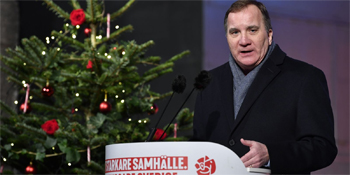
Löfven holding the Christmas speech on Gotland
pic: Henrik Montgomery/TT

Prime Minister Stefan Löfven held his Christmas speech today in the ruins of the Church of St. Nicholas in Visby, on the island of Gotland. The church was part of a Dominican monastery built in the 1230s, and was burnt down in 1525 by an army from Lübeck. It is unclear why the speech was held just here, but there was at least fika and a mingle in the ruins before the speech.

Löfven spoke of how the season is representative of something bigger – of caring, and of not being indifferent to how others in society are faring. “When colleagues are chatting about how stressful it is to buy presents, others are wondering how in the world there will be money to buy even a single present to put under the tree for the kids” Löfven said. “That – sickness, loneliness, and poverty – can never be reduced to being one person’s problem. It is our collective responsibility.”

Löfven also threw in a note of thanks to the police and nurses who will be working during the holiday. “Many of us can be relatively free over the holidays, while nurses and the police continue working. They celebrate without their families so that we can be secure while celebrating with ours.”

A few pointed political comments were also thrown in, in a change from last year’s speech. Regarding the challenges forming a government after the results of the 2018 election, Löfven exclaimed that “We still succeeded in building a government led by the Social Democrats. Not least after brave decisions by the Center and Liberal parties, who chose to stand on the right side of history.”

Löfven also pointed a finger at the Moderate party leader Ulf Kristersson, SvD reports, saying that he had betrayed his promise not to cooperate with the Sweden Democrats: Kristersson only said that to keep the old Alliance parties together, Löfven claimed. It was also, Löfven expounded, “morally reprehensible” to have said to a Holocaust survivor that they would not cooperate with SD, and the turn around and do it” speaking of Kristersson’s meeting with Hédi Fried in June of 2018, and then his lunch with Jimmie Åkesson earlier this month.

Löfven also spoke the need for fast integration, and about the fight against crime. “Crime doesn’t have anything to do with the color of one’s skin or one’s religion, but with social class (samhällsklass) and a feeling of community (gemenskap).”

He also promised more money would be coming to the municipalities around Sweden. “We will not desert any municipality, any region, any part of the country. This means that we need to hold together” (SvD.se/julspeech).

14 Dec. – health care protests in Stockholm

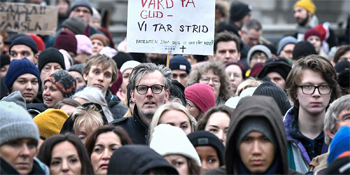
healthcare workers hit Stockholm streets in protest
pic: Claudio Bresciani/TT

“The section is closed,
and the patient is dead,
“but everything’s fine”
the hospital board said.” *

So went the poem (roughly translated, and with a good dose of poetic license) by medical student Alexander Radkiewicz, at the demonstration protesting hospital staff layoffs in front of the parliament building in Stockholm today (SvD.se/demo). As written about earlier, in this blog post, a total of 1350 layoffs have been announced over the last several months, and an additional budget cut to the tune of 1.1 billion kronor has been mandated by Stockholm Region council.

The facebook group behind the demonstration has 16,000 members. “The younger people are the ones that are the first to be affected by the layoffs” said Laura Björnström to SvD. “This can wipe out an entire generation in health care” added Akil Awad, one of the demonstration organisers. “You hear it all the time – it’s like a mantra – that patient safety isn’t at all threatened (by these layoffs)” he continued. “But for us who are there working, we see that it is. We see it all the time.”

Anna Starbrink, Region Stockholm councilperson responsible for healthcare, told SvD that she understands the tough situation: “Obviously, a lot of thoughts go through one’s head when you see such a demonstration. At the same time, you need to remember that it’s fantastic that so many are so engaged in the healthcare issue.”

Be sure to remember that, next time you need health care in Stockholm.

* “avdelningen är stängd/och patienten är död/men på patientsäkerheten går det iiiiingen nöd