29 Nov. – China, Sweden, Huawei and Lind

FOI’s who’s who in ownership
pic:unctad.org

Due to a lack of cooler political news, the topic today is the Swedish Defense Research Industry’s report that came out this afternoon on how much China has invested in Sweden. It’s not peanuts.

You’ve driven, perhaps, a Volvo? Enjoyed some Oatley with your morning cereal? Seen a movie distributed by Filmstaden, or sung along to a favorite playlist on Spotify? These companies-of-Swedish-origin, and many more, are entirely, or partly, owned by Chinese companies. The purchase price of the biggest nine companies is 94 billion kronor (SvD.se/China).

Sweden isn’t the only supermarket where China’s shopping. Huge American companies like Smithfield and Hoover and AMC Entertainment and many (many many) more are also Chinese owned. Other countries’ businesses own US companies too, of course. Gerber, whose pureed peas have fed millions of American babies, is owned by a Swiss company.

But China isn’t Switzerland, mainly because it’s a major economic and political-system competitor with an economy controlled by the state with muscles they regularly bring to bear to sway, ignore, or break market regulations. US President Trump ordered companies to move their business out of China last August, but CNBC reports (here) that many companies were already on their way out. China, on the other hand, is not ordering its companies out of anywhere.

The Chinese telecom company Huawei’s forays into the 5G network being set up in the US has been stopped, also in Australia and Japan, due to security concerns. Two laws in particular were too worrisome to dismiss: one was the Chinese 2014 Counter Espionage law that said that companies could not refuse to provide information if or when the state security organ requests it; the second was the 2017 National Intelligence Law stating that “any organization or citizen shall support, assist and cooperate with the state intelligence work in accordance with the law” (CNBC.com/China). Although Huawei has insisted they would never, ever, access their network for nefarious purposes, there’s still a niggling worry at the back of a lot of people’s minds.

Seemingly not in Sweden (although one must assume Ericsson has the corner on building Sweden’s 5G network?). Many European countries haven’t made a final decision on whether to allow Huawei a role in building their 5G network. But a change might be coming. Germany was all set to embrace Huawei, and have them build their 5G network, when just the other day, members of Merkel’s own party threw a monkey wrench in the works and refused to back her plan (FI.com/China). Surprise! There are worries that China will respond, at a time when Germany’s economy is not at its strongest.

Which only illuminates the economic issue. No matter how bad China might act, Chinese ownership of big companies distributed over different industries makes it hard for a country to protest. “Biotech, electronics and industrial products are the most common investments” reported Oscar Almén, one of the investigators at FOI.

When Minister for Culture Amanda Lind went ahead and presented the Swedish PEN prize to Gui Minhai, the Chinese ambassador was not pleased at all (see this post). Speculation is, that China’s refusal to distribute a Swedish film, Cold Case Hammarskjöld, as well as another Swedish film, is an act of reprisal (DN.se/China). If so, let’s face it, they clearly aren’t that mad at Sweden. But it’s still a jab. A 5G network is a much bigger issue. As is ownership of sensitive companies or building out Stockholm’s subway system. For more information on why Sweden always takes the lowest bidder’s offer, and where that can lead, see this post.

28 Nov. – Johansson at the gate

Ylva Johansson finally on the job
pic: epthinktank.eu

The European Union’s Commision is finally fully staffed, approved, and ready to get to work. With a vote of 461 for, and 246 against, the commission headed by Ursula von der Leyen was approved by the EU parliament yesterday after an occasionally bruising interview process.

Sweden’s own Ylva Johansson (see this post) officially begins her stint as Commissioner for Employment and Integration – in other words, Migration – one of the most visible and controversial posts in the EU (see this post). She is starting off with getting her boots on the ground in Greece, where she will speak to Greek representatives and NGOs to discuss how they can move forward.

The Greek refugee camp at Moria has been regularly labelled a human rights disaster for its wretched conditions, most recently in a report from EU’s auditors (you can read it for yourself here) describing situations of 16 boys sleeping in a container built for max 10, people and families living in tents in the bush, and more. Although the initial contact regarding asylum is supposed to take place only a few days after arrival, the average time is 218 days for a decision at the first level. Asylum seekers who arrived in 2018 have appointments for 2023.

Greek officials are in the process of closing the camp, and transferring the refugees inland, but nothing is expected to essentially change just because of a new location.

One of the suggestions for an EU-wide migration policy is that countries would pay to not take refugees – in which case a price would be attached to each migrant.

“Not a suggestion I would choose at first go” said Johansson. “What’s been discussed between member countries, that I’ve heard, is that they could contribute in a practical way with personnel or other efforts. That’s perhaps a better track to start discussions on.”

Von der Leyen has gone on record to say that “Migration is a phenomenon that is not going to disappear. Our job in the EU is to develop an overall migration model that is humane and effective. A model that can make us an example for the rest of the world in how migration can be handled” (DN.se/UvdL).

No pressure for Johansson, in other words.

27 Nov – unavoidable poll results

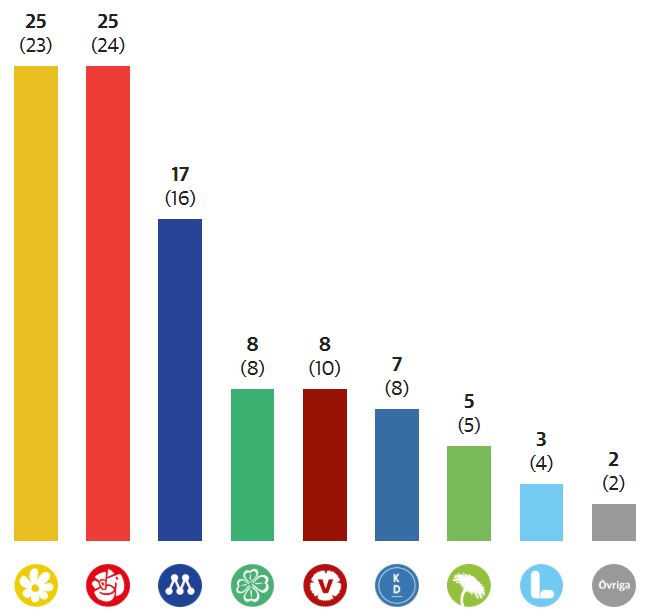
It happened again – the Sweden Democrats tied for first place in the latest poll. This time it was the Dagens Nyheter/Ipsos poll, whose results came out this afternoon. In the previous poll, the Sweden Democrats (SD) and the Social Democrats were also equal at the number one spot, but the margin of error negated the certainty of results. This time’s results confirm the trend (DN.se/Poll).

For a party that all the other parties wouldn’t speak to – ignoring them like children in a playground – the Sweden Democrats have done ok. More than ok. And the irony is that they’ve done so well – arguably – because everyone else was excluding them from their games and policy making. The Sweden Democrats have gotten votes from everyone who blames immigration for Sweden’s woes, from those tired of the current parties, and from those who protest how things seem to be going in Sweden – all the while being spared from having to face voter fire and ire because they haven’t been responsible for any of it: They’ve been kept away from any formal position of power, but also from responsibility.

The changes in percentage points were small and can easily sway another way come next poll. However it appears clear that Nyamko Sabuni is not raising her Liberal party’s numbers, and that Moderate party leader Ulf Kristersson is going to have a very hard time over the next few months (weeks?) making the decision of how close to the Sweden Democrats he’s willing to get. If he’s willing to formally stand with SD, the right block composed of (theoretically speaking) the Moderates, the Christian Democrats and SD get 48% of voter support, in contrast to the 42% the consortium of Social Democrats, Center, Liberal and Green parties have together. However, these parties have the support of the Left party: However unhappy the Left is with the Social Democrats, it’s highly unlikely they’ll help to vote them out. The Left gets generally at least 8% of voter support, which tips the scale.

The problem with lumping the right block parties together is that SD isn’t really a conservative party, but instead has often actually voted with Social Democrats on policy questions. What unites them with the right block is largely opposition to the current Social Democratic and Green party government, and a promise for a tougher stance against crime. How close they really want to dance, especially at future balls, is hard to say.

As mentioned in this blog the other day, the Sweden Democrats have made a lot of platform changes, making themselves over into a party you could invite in without having to be too scared of what the neighbours might think. They are, and have been for years, much too big to ignore. 25% of the population, at last poll, is ready to come to any party where SD is included.

25 Nov. – layoffs causing anxiety

clouds gather over South Hospital
pic: stockholmdirekt.se

It seems to be going around. “It” being hospital staff being laid off.

First it was the two Karolinska hospitals- the old one Karolinska University Hospital, and the new, but disaster-prone, New Karolinska Hospital in Solna. This newest hospital in the country was going to be the bestest and most specialised care available for money. (Bestest isn’t a word, but the superlatives used in describing the hospital ran amuck when the hospital was being built.) Alas, they have no money. After the cost of building the new hospital came to twice the original estimate (and it still doesn’t work well – see lack of sterilized instruments, specialised child care but no play rooms, phones not working, and the list goes on), Stockholm region couldn’t cough up any more money to cover the hospital’s budget deficit this coming year. Three weeks ago, the hospital administration gave notice to 600 doctors and nurses’ aides – this even after it gave notice to 550 administrative positions earlier this spring (SvD.se/Karo).

Today, both Danderyd Hospital and South Hospital (Södersjukhuset) gave notice they’re letting personnel go – 100 jobs at Danderyd (so far undetermined which categories), and 25 doctors, 25 nurses and 25 others at South Hospital.

Göran Stiernstedt, chair of Region Stockholms common board for Danderyd, South and Södertälje hospitals, said the budget deficit is to blame. Cutting staff was the only way to manage the budget, he explained. “I understand if patients are concerned. It is our ultimate goal that care will be affected as little as possible” Stiernstedt wished aloud to SvD. “But there are no guarantees that the personnel retrenchment (åtstramningen) won’t go unnoticed. There is that possibility. It can’t be avoided.”

Left party care spokesperson Jonas Lindberg called it a complete catastrophe. Also the main opposition party in Stockholm, the Social Democrats, took issue: Opposition counsellor Aida Hadzialic (see this post) said that the notices can be a threat to patient safety. “I’m seeing all the warning lights blinking. Care for the sickest patients in Stockholm is threatened. Patient safety is threatened – there’s a wave of notices being given at our hospitals at a time when we know staffing is a problem” (DN.se/Karo).

Even Moderate party Stockholm veteran, responsible for finance, Irene Svenonius called the situation serious – and she’s one of the major players in the issue. “Naturally, it’s a serious situation when a hospital must let people go to manage a budget deficit. And they must redimension their operation in regards to the agreement they have with the health and hospital board” (DN.se/Karo).

(By the way, substitute her “And” for “But” and the sentence makes more sense. This rhetoric trick is making the rounds from schools to businesses.)

Green party Environment and Public Transport counsellor Tomas Eriksson added his voice to the issue, saying he understands if Monday’s announcements cause worry, but: “At the same time, the hospital runs a deficit, and more care is being moved closer to the patient level – it isn’t tenable. The resources need to move as well” (DN.se/Karo).

But back at Kommunal, the largest union in Sweden and the main union for health care workers, managers were angry. Anne-Li Rosengren, a negotiator for Kommunal representation at South Hospital, got word of the notice only in the morning. “It’s been a couple of hours since I heard. At first, I was sad. Now I’m mad as hell (fly förbannad)” (SvD.se/South).

Sweden has one of the highest number of doctors per capita, although this varies a lot by region (see a report here). It also has some of the longest waiting times for surgery, and the fewest number of hospital beds per capita in Europe (see this report).

24 Nov. – SD’s land days of plenty

SD’s Jimmie Åkesson revels in his popularity
pic: SVT.se

The Sweden Democrats are in the middle of their “Land days” (landsdagar) congress in Örebro and the changes in their platform have been several. A change of heart? A maturing social and political awareness? Or a paint job to look a little more up to date?

The official SD political platform will likely include the following changes:

  • ok for homosexual couples to adopt kids: “all children have the right to have a mother- and father figure in their lives” they write
  • will go along with the current, legal 18-week limit for question-free abortions (not their previous platform of a 12 week limit)
  • no upper age limit for free mammograms or cervical cancer screenings (SvD.se/congress).

As Ewa Stenberg at DN writes, SD’s core ideology is still intact, though: people who come to Sweden must adjust to Sweden, or leave; the number of people emigrating to Sweden must decrease – in fact, more should leave than stay; SD will see a minimum of language differences, cultural differences and religious differences; public service radio and television should act to increase social cohesion, and; previously convicted, repeat offenders can just be tossed into jail again without trial – if they’re really, really hopeless cases.

Moreover, the party held that: asylum seekers should only come to Sweden first via the United Nations’ quota system, and that preference should be given to women, children and persecuted minorities such as HBT-persons and Christians; the requirements for citizenship should be raised and more clearly be coupled with high degrees of societal integration; citizenship can be recalled if the person lied on their application or if they joined a terrorist organization; police training can be paid in some cases; legal parameters for crime fighting should be widened and that it should be made illegal to join a criminal organization.

SD’s group leader (soon to be ex-group leader) Mattias Karlsson raved that only SD could save the country. “The situation for Sweden is a total catastrophe. Sweden is, seriously, in a do or die position” (SvD.se/congress).

22 Nov. – moderation in advertising

An open road to the gold!” “Lightning fast payments!

too risky to see
pic: play.diabetes.org.uk

According to Swedish law, gambling advertisements must be on the temperate side, nothing too crazy: They must be in moderation (vara måttfull). In December of last year, the Swedish Consumer Agency’s ombudsman sued Elec Games, the owners of Ninja Casino, for breaking the law – for not being moderate in their advertisements.

As evidence in their lawsuit, KO (Consumer Ombudsman) named Ninja’s slogans such as “Play now!” “Your win at your bank in five minutes” and “250 games and chances for miljons of kronor are only a click away. What are you waiting for?” as being much too obtrusive. A pop-up ad was deemed particularly egregious. Everyone recognized that one person’s egregious could be another person’s yawn, so the court’s decision was looked forward to (SvD.se/case).

Today, the Patent and Market Court of Appeal (patent- och marknadsdomstolen) agreed with the plaintiff and ruled that Ninja Casino’s advertisements were over the line. 20 advertising phrases that Ninja used, as well as the pop-up ad, did not meet the requirement for moderation. Furthermore, any future slogans “with the same meaning” will also be considered in breach of the law. Should Elec games ignore the judgement, a half million kronor fine awaits them (SvD.se/gambling).

Gunnar Wikström, who worked the case for the Consumer Agency, said that the verdict was important to establish how the word “moderation” should be interpreted. “It’s a pretty general concept, and therefore this case could provide answers. It’s been said in the preparatory legislative work that it was up to the court to draw that line, and that’s what the court has done now. “

“The court has judged that there is a connection between gambling advertisements and gambling disorders, and has taken into special account the effect that advertising has on persons who have, or who are danger of developing, a gambling disorder” wrote Chief Judge Alexander ramsay in a statement (DN.se/gambling).

Ardalan Shekarabi, the Minister for Social Security, was understandably glad. Shekarabi brought the responsibility for the gambling issue with him from his previous job as Minister for Public Administration because it bothered him so much (see this post). “This is a huge victory for everyone who has been engaged in the fight against aggressive gambling ads” he said. “Now no gambling company can say that the law is unclear.”

21 Nov. – another no confidence motion in the works

Sjöstedt has no confidence
pic: Jessica Gow/TT

Jonas Sjöstedt, leader of the Left Party, has threatened to set a no confidence vote into motion against Minister for Employment Eva Nordmark (read about no confidence votes here). Sjöstedt has made five demands, of which the first one is the big one:

  1. the government stops the privatisation of the Swedish Public Employment Service, aka Arbetsförmedlingen,
  2. the government allocates extra funds to stabilize the Employment Service’s ongoing work,
  3. the government creates an economically detailed and timely plan for stopping the closing of Employment Service offices, and ensures a continued presence across the country creates a plan and make the necessary decisions in the law or in regulations to maintain and develop the Employment Service’s special competencies regarding special needs and support for the disabled,
  4. the government states that any reform of the Employment Services will first be fully investigated in all relevant aspects, including cost estimates and transition procedures, before any part of the Employment Service is changed. An important part of this investigation is how municipalities’ responsibilities and economic situation is affected.

Reforming the Employment Service was a condition set by the Center Party to not vote down the Social Democrats in their bid to remain in power after the last election. Together with the Liberal party, the Center party and the two government parties agreed to a 73 point plan (also known as the January Agreement) that was filled with demands, including a total change in how the Employment Service was set up.

Many of the changes were anathema to Social Democratic voters, let alone Left party voters. The point that likely most sticks in the Left party’s craw is where it says ““This agreement means that the Left Party will not have influence over the political direction in Sweden during the coming term of office” (socialdemocraterna.se).

Sjöstedt is now considering calling the government’s bluff. Only together with the Left party does the government, together with the support from the Center and Liberal parties guaranteed by the government fulfilling the 73-point agreement, have the votes to pass legislation. Up until now, and even with the clause that was created to shut them out, the Left party has not withdrawn their support for the government: The alternative was clearly worse for them.

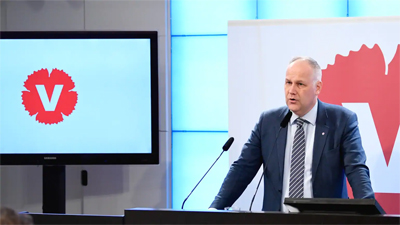
However, it seems that the Left party’s acquiescence is over, and that they’re even willing to accept support for their no-confidence motion from political opponents. The Sweden Democrats are already 100% behind the Left party’s idea, and even the Moderate Party is considering it. “We want to unseat all this government’s ministers, so it’s very likely that we’ll go along with a vote of no confidence” remarked Jimmie Åkesson, leader of the Sweden Democrats. Although reforming the Employment Service has been part of their platform for a long time, the Moderate party has problems with how it’s been implemented. Group leader for the Moderate party in Parliament, Tobias Billström, commented that although the Left and Moderate parties have very different ideas on how the Service should be run, the current plans for reforming it are “poorly thought out and badly instituted” and lack parliamentary support, to boot (SvD.se/Nordmark).

The question is what the government can do to appease the Left party, while not alienating the Center party. Also the Liberal party is left in a crunch situation: they went along with supporting a Social Democratic government largely to keep the Sweden Democrats isolated,and only as long as the January Agreement was upheld by all sides. If the government downshifts on its commitment to the agreement, the Liberals will be left hanging, and this when they are only just barely above the 4% threshold.

Sjöstedt has said that the government has two weeks to respond before he makes a no confidence motion.

20 Nov. – Will the EU renew Sweden’s exemption?

bus biofuel threatened by subvention ending
pic: mostphotos.com

Traveling by bus could be become more expensive if EU has their way with Sweden. Sweden has been enjoying an EU Commission-approved exemption from taxes on biofuels for several years, which has not only spurred use of the environmentally-friendly propellent, but has made it cheaper than regular gas or diesel (pwc.se). According to SVT.se, this subsidy is likely to end by 2021.

All of Stockholm’s busses are fossil-fuel free. 15% run entirely on biogas, and 51% of Stockholm buses run on biodiesel, according to biofuel express.

Just over 10 years ago, ethanol-driven cars were all the rage, and were considered the future. In 2006, the government passed a law requiring all gas stations to install ethanol pumps – those that couldn’t afford it had to close. Then, it turned out that motors didn’t actually handle ethanol that well, and questions were raised about how fabulous it really was if food stuffs were being turned into driving fuel. As SVT reports in this older article, the government also decided, at about the same time, to cut its subsidies for ethanol – as it was all going so well. It was soon curtains for ethanol, and everyone turned to wonder-fuel diesel instead. Fast forward a few years and we find that diesel is bad and electricity is transportation’s future.

Stockholm’s buses, however, have been using biogas very successfully, cheaply and cleanly. If Sweden is to enjoy the current lower cost, a new subsidy application to the EU will be needed. Right now, though, the EU is trying to get Sweden to pay more to the EU budget (negotiations on the next five-year EU budget are already very heated), and the EU isn’t likely to look too favourably on bailing Sweden out on this issue.

19 Nov. – don’t drink and drive even more

a Swedish jail, but still
pic: ticketsnipers.com

Reckless driver? Drunk driver? Repeat offender? The government today announced proposals to significantly increase the penalties for breaking traffic laws.

The maximum sentence for driving unlawfully and/or drunken driving is proposed to be raised from six months to one year. The maximum sentence for gross drunk driving is proposed to be changed from two years in jail to three.

Someone who repeatedly acts particularly recklessly in traffic can get a minimum sentence of 6 months or up to 5 years imprisonment. Recklessly can mean drunkenly, carelessly, and/or unlawfully.

In a written comment, Minister for Justice Morgan Johansson was positive to the proposals. “We cannot allow certain people to put others in danger again and again” (SvD.se/driving).

Johansson might have been referring to a certain case in Kramfors where a repeat offender has racked up 100 convictions for drunk driving, thievery, and threatening behaviour over the past thirty years. As one of his neighbours put it “He’s very shy when he’s sober, but when he’s under the influence he becomes rather a nasty person” (SVT.se/Karmfors).

The new laws are projected to come into effect in January, 2021.

18 Nov. – suicide assistance gave manslaughter

Ångermanland’s district court
pic: domstol.se

A man who helped his wife to commit suicide received a 1.5 year jail sentence for manslaughter today in Ångermansland’s district court (tingsrätt). The woman, his wife, had been sick for many years and had asked for help in dying several times. In both a video and a letter, the woman had expressed a wish to not live any longer.

Earlier in the evening, he said, his wife had not managed to depress the needle’s plunger by herself. In the end, the man gave his wife the deadly dose of morphine and oxycontin. The man did not deny his actions, but pled not guilty of a crime.

The court disagreed. “To take another’s life with intent is a criminal act even if it was with the person’s consent” wrote Chief Judge Lena Wahlgren in a statement (DN.se/dom). “Even if there’s consent, it doesn’t mean that you are released from responsibility if you intentionally kill someone (SvD.se/dom).

The prosecutor was satisfied with the judgment. “There’s no evil in this, it’s not about that. It’s just that one doesn’t want to have this be something that can be allowed” said Stina Sjökvist.

Suicide is not a crime in Sweden, and there are some instances where helping a person commit suicide (medhjälp till självmord) is not a crime either. For example, to give a gun to a suicidal person is not a crime, or to place a pill on a person’s tongue. Then, if the person pulls the trigger or swallows the pill, they commit suicide of their own free will, says professor Madeleine Leijonhufvud in this article.

However, as in this instance, if the person helps in a way that is an independent, decisive and ultimate action, it’s another story.

The minimum sentence for manslaughter is 6 years, but the court found there to be mitigating circumstances, for example that the man’s actions were meant to free his wife from suffering, and that he cooperated in the investigation.

Despite that the sentence he received was well under the minimum, the case will be appealed. The man’s lawyer, ex-Minister and radio personality Thomas Bodström, said in his statement that if ever there was a case that should go to the supreme court, this was it (SvD.se/dom).