1766 to the present

Hats, caps, and freedom of the press

All the news you need to know?
source: Stanford digital https://tinyurl.com/2xej2hb7

Back in 1766, while American colonists were grumbling over the British proclivity for passing laws that abridged their freedom, a similar kind of protest was forming over the Atlantic. In Sweden, three political groupings were having it out – the hats (hattar), the caps (mössor), and the king.

Brimmed and unbrimmed

The king had a weak position during this period, and the real power had been held by the hats – hats with brims – for some time. Two lost wars and a shaky economic situation later, a change came. In 1765, many members of the caps group – the unbrimmed hats – were voted in.

With them came many changes: Censorship was largely abolished; a closer relationship with Britain, as opposed to France, was espoused; the public could access government papers and print as much of it as they wanted (classified documents exempted); and any official who denied such access could be punished. Freedom of the press was born, and even the seeds of the Swedish principle of public access, as well as the Fundamental Law of Freedom of Expression, were sown.

Change

With such a history, it’s no wonder that changing the laws for freedom of the press and freedom of expression has caused an uproar. Changing any part of Sweden’s four fundamental laws requires two parliamentary votes, one on either side of an election. Changes to these laws are meant to be difficult. Yet, such a change has now occurred.

A few days ago, a second vote inserted a clause in Sweden’s fundamental law that criminalizes disclosure of classified information that damages Sweden’s relationship with foreign powers or organizations. The new law’s detractors fear that a journalist can now be charged if, say, they see some misconduct by another state’s or organization’s representative and report on it, thereby damaging Sweden’s relationship with that country or organization.

The new law’s defenders, including the Moderate, Social Democratic, Center, Christian Democrat and Sweden Democrat parties, point to the so-called safety valve. This says that it will not be illegal to disclose damaging information if it’s “justifiable.” What constitutes “justifiable” is not specified, however.

See something say something

A worry is that journalists may in the future decide not to investigate or publish a story if they risk serious jail time. In its coverage of the new law, the newspaper DN listed several instances in which Swedish journalists have irritated other countries – stories that might not have been reported on if the new law had been in place at the time. These examples included information regarding a formation of an EU military unit, the behavior of EU soldiers on missions abroad, on Sweden’s efforts to sell its jet fighter Gripen to Switzerland, and on the conditions facing Swedish soldiers in Mali.

Back in the 1770s, the caps’ changes were short-lived. Only a few years later, King Gustav III disbanded parliament and eroded the press’ freedom until there was nothing left. His son Gustav IV reestablished official censure. However, this didn’t last either – freedom of the press, and by extension of expression, was back in the fundamental law by 1809. Some freedoms are irrepressible.
Where did the money end up?

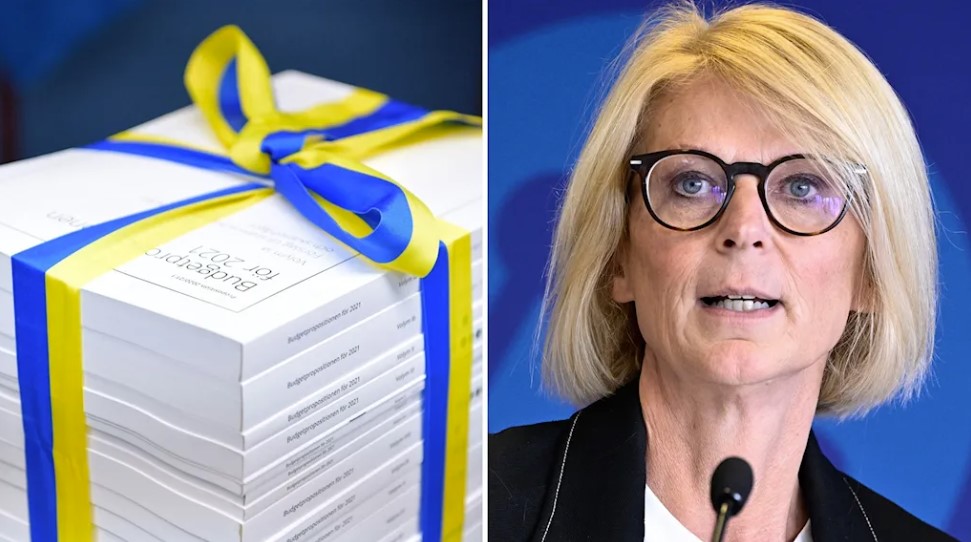
Told you it would have a ribbon. The budget and Svantesson
Sveriges Radio http://www.tinyurl.com/msf6994t Foto: Jessica Gow/TT och Claudio Bresciani/TT

Deceit. Disappointment. Restraint. They sound like tag lines from the latest season of “the Crown,” but they’re actually reactions to the budget upon its release last Tuesday. As soon as the nearly 3000-page document was made available at 8am Tuesday morning, a number of parties, organizations and interest groups made their opinions on it public.

Accusations of deceit were actually the loudest from the Social Democrats. What seemed to be upsetting was that the Kristersson government didn’t announce any big tax cuts or help with coming electricity bills the way they had promised pre-election. It’s natural that the opposition complains, but actually complaining on behalf of the voters who elected the current government was a turnaround. The lesser amount to international aid and even the lesser number of UN quota refugees went by without particular Social Democratic comment (though the Liberals had difficulty with it). It lends some credence to the suspicion that the Social Democrats, in reality, have few problems with the right coalition’s budget.

No. Not happy.

On the other hand, however, many members of the right coalition’s parties were not at all pleased with what Minister of Finance Elisabeth Svantesson presented. Their displeasure was not so much about the lack of broad tax cuts, but what they considered a weak pro-work stance and too many expensive gives. Unemployment compensation remains at the high pandemic-era level (a demand from SD but more the opposition’s idea), and while labor immigration will be more restricted, there were no new economic incentives for those jobs to be filled with Swedish workers. An employee who has to drive to work will have continued compensation, and the price of diesel and gas will sink only marginally. None of these things, it is charged, change the employment dynamic.

Cars and Caravaggio

What was very dynamic was the rush to car dealerships all over the country following the government’s surprise declaration that the electric car rebate would be ending almost immediately. There was not the same rush to state museums following the government’s surprise declaration ending free admission, though. The former means paying up to seventy thousand kronor more, the latter perhaps 100 kronor.

How much for the tree?

Harder to price is the budget’s effect on the environment. As the Tidö Agreement laid out, the Ministry for the environment is now combined with the Ministry for energy, business and industry. Depending on one’s leaning, the consolidation is either a natural development as climate and business are interrelated, or a serious deprioritization. As it turns out, the budget showed a plan to cut the allocation for “General environmental protection and nature conservation” in half by 2025. The tax on plastic bags is still in place, but it’s doubtful that’s any comfort to anyone.

Not moving on the generally hated plastic bag tax is perhaps part of the restraint Svantesson has talked about. Tax cuts have been avoided not to increase inflation. The biggest increased outlays were defense, energy cost compensation, and lower prices at the pump, all of which were no surprise by the time the budget was formally presented, and are already priced in by banks and international agencies. The budget caused no tumultuous waves (see the United Kingdom). So far, the paradigm shift the new government declared following the Tidö Agreement doesn’t seem to have materialized.

Government plans revealed

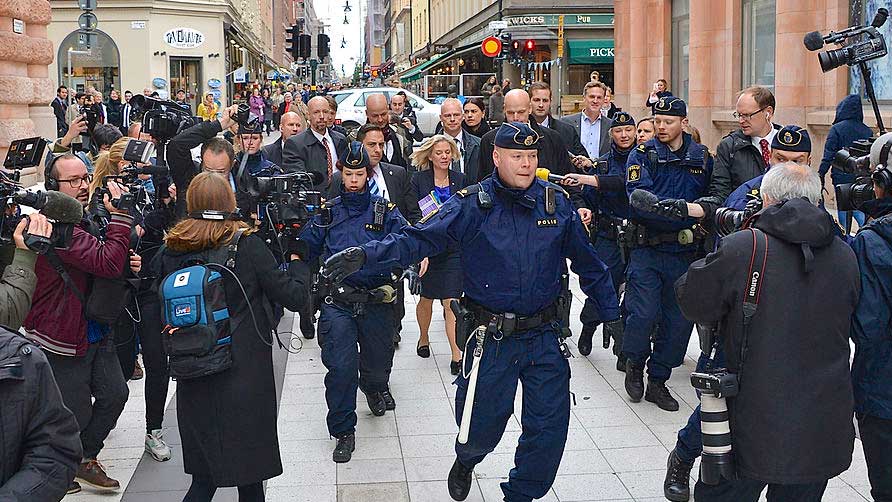
Not a perp walk. A budget walk. It’s a long 400 meters for the previous Minister of Finance.
source: Etuna news https://tinyurl.com/54zuc8hw

November 8th is Budget Day! For those who are interested in all things political, this is exciting – but it’s also kind of a spectacle. The 400 meter long Budget Walk, or budgetpromenaden, is its own Wikipedia entry. It’s that good. 

The stack of A4 paper that the budget is written on, wrapped up in a blue and yellow ribbon  and carried by the Minister of Finance while being mobbed by journalists and tv cameras, is actually the representation of a government’s idea for the country. The budget is a tool the government has to make its political ideas real – it shows how much money the government is planning to spend on the 27 different expenditure areas it comprises. These areas are, for example, items like financial support for students, industry and trade, energy, the EU, and financial security for the elderly. What items’ budgets get changed will reflect how the government realizes its priorities. 

The budget’s Top Three

The largest government outlay in Sweden always goes to the local, municipal governments. Most of this amount falls under the Swedish equalization principle. This effort guarantees local governments an equal financial ability to provide services to their inhabitants – regardless of tax base, population size, or other structural difference. To further income equality, for example, the richest fifteen municipalities pay a percentage of their local tax income to the government. That amount is then distributed to the remaining 275 other municipalities. 

”Health care, medical care and social services” is the second largest outlay in the budget, and ”financial security for those with illnesses and disabilities” is third. The full list can be seen on the government.se website here

The majority of the allocations to the different  expenditure areas don’t change more than incrementally. Most of the budget is basic services, which are not that controversial. However, there are a few budget items that may change significantly this year – the defense, international development cooperation, and police budgets. 

Guns and roads

Currently, the defense budget is around 71 billion kronor, which is about the same amount budgeted for communications (roads and trains and the like). By 2025, the defense budget is expected to go up 55 percent, to 110 billion kronor. The government has said it hopes to get Swedish defense spending up to 2% of GDP (meeting Nato expectations) by 2026. With prices skyrocketing, though, who knows how much materiel this will actually buy.

The amount budgeted for International development and humanitarian aid will go in the opposite direction. Instead of 1% of GDP, the government has flagged for a figure around 0.88% of GDP. Sweden’s aid competitor Norway also just abandoned the 1% of GDP goal for a 0.75% goal. With Russia out of the picture, however, Norway has been raking in money hand over fist by supplying oil to the world: Its 0.75% will be a huge amount. Sweden’s 0.88% will still remain a world-leading number, though. 

Finally, the Minister of Justice Gunnar Strömmer announced that the police will receive a bigger allowance, a raise of 1.4 billion kronor. In budget terms, though, this is again somewhat of an incremental increase. 

But we thought you were going to help

What happens with election promises is still a question. Perhaps most memorable were the promises regarding help with coming electricity bills and cheap gas prices, particularly diesel. These supports would likely come out of the budget surplus, which is thought to be around 30 billion. With the dismal economic forecast, though, including raging inflation, the government will have to be careful if it’s going to help, and not hurt. Besides, that ten kronor per litre gas price was a flag that SD flew, and they’re not officially in the government. 

The budget walk on November 8th will no doubt be televised per usual, and there will be a lot of people swarming around the Minister of Finance. But the real attention will be on that beribboned stack of paper she’ll be holding.