Verdict for returning IS woman

women at Al-Hol
image: Goran Tomasevic/REUTERS)

Taking the law into one’s own hands, with children, is the verdict for a Swedish woman who was sentenced to three years in prison in Lund’s district court today. It’s a difficult concept to translate, but “egenmäktighet med barn” was the charge for keeping her child with her in Syria and therefore denying her son the company of his father. In other words, the woman is charged with custodial interference rather than actively supporting a terrorist organization. (Although being a member of a terrorist organization is not against the law in Sweden, aiding and abetting one is. ) The prosecutor is apparently ok with it, though: “I’d hoped for three to four years, so I see this as a success” said Claudio Gittermann.

The woman claimed that she together with her son made a day trip to Syria during a vacation in Turkey and got caught there, but no one bought that. Then the defense claimed she only became religious when her mother-in-law became sick, and that she was an easy target for conversion because she didn’t speak Arabic: she just wanted to see if the claims about the califat were true with her own eyes. That argument didn’t stick either. Instead, the prosecution’s argument that it was extremely ruthless of her to bring her son into Syria was the winning judicial bid.

Four women and eight children have returned from Syria to Sweden in the last year, SvD reports.

The Liberal party going out on its own

Where will the path lead?
image: colorado.com

Nyamko Sibuni, leader of the Liberal party, announced yesterday that the Liberal party will be actively seeking and supporting a right-leaning government next election. This means that the Social Democrats cannot expect a repeat of the January Agreement next time around.

The January Agreement was an agreement in which the Liberal and Center parties promised their support for a Social Democratic (and Environmental party) government in return for a liberal-leaning 73-point list of legislative demands. The liberal party managed to get through one of their main goals – good riddance to the “temporary” wealth tax first enacted in 1995 – but it has otherwise been slowly circling the drain and has now the support of only 2.7% of respondents. Sabuni’s move is in hopes of pushing that number upwards by regaining the support of right-leaning voters that were off-put by the January agreement.

One of the reasons the Liberal party went along with the JA in the first place was that the result of the 2018 vote made relying on the quiet support from either the Left party or the Sweden Democrats party unavoidable. Relying on the support of the Left party was considered, by former Liberal party leader Jan Björklund at least, less abhorrent than relying on the support of SD. Sabuni is now saying that she and the Liberal party is willing to work with SD on certain issues in order to get a non-Social Democratic government next election.

It’s risky. There are many people who see SD’s ideological roots as too repugnant to make up for whatever program they might trumpet now. For these people, working with SD on even, say, where to put traffic lights, would be giving them too much influence.

Sabuni knows she’s not going to win these voters. And she likely knows she’s going to be painted with a very unflattering brush by Social Democrats, even though their hand will be somewhat stayed by the fact that Sabuni is herself a minority. The question is whether or not she will be able to win back the Liberal voters that left when they joined up with the Social Democrats.

That outcome is extremely uncertain. But at least it’s interesting. The Moderates and Christian Democrats will be pleased, not to mention of course, the Sweden Democrats. It also gives a shot in the arm to the opposition, without which democracy loses its luster. A peaceful change of government is a hallmark of functioning democracies. Sabuni has said she’s going to work towards that.

LO forced to keep paying member

LO keeping people out, or keeping people in?
image: blogWritingWolf

The verdict is in: Stockholm district court has decided that the Transport Union was in the wrong when they kicked out a paying member because he was active in the Sweden Democrats party.

Mats Fredlund was voted in to local office in Kiruna for the Sweden Democrats in 2018 while also being a member of the Transport Union. While many unions don’t allow active Sweden Democrats to hold union office, the Transport Union didn’t even want them as members. Transport’s union chief Lars Mikaelsson said at the time that while the union didn’t generally get involved in its members political affiliations, it wasn’t possible to be in the union while actively working against it.

Mats Fredlund took Transport to court and won. The court said that Fredlund’s activities in the party are not in contradiction with the union’s activities and that therefore they could not kick him out.

The Transport Union is a member of LO, the Swedish Trade Union Confederation. LO has traditionally been congenically connected to the Social Democratic party: Previously, if you were a member of LO you were automatically also an official member of the Social Democratic party. Nowadays, though, more members of LO support the Sweden Democrats than the Social Democrats, causing all sorts of sleepless nights for the traditionalists. The verdict opens for the possibility that the Sweden Democrats may start to exercise influence over LO the way the Social Democrats have done for decades.

Although that might not be a desired outcome by any other than SD members, the verdict can be considered correct by many. Being able to join organizations in Sweden (basically any and all) is considered a Swedish human right and is enshrined in the constitution as freedom of association (föreningsfriheten). Unions are considered to help and represent members in conflict with employers – if you’re kicked out of the union there is no one to represent you. The court said that having no one to represent you, because you were kicked out of the union, was unfair to the worker.

In something quite unique internationally, more civil servants (tjänstemän) in Sweden belong to a union (72%) than general workers (arbetare”). Only 59% of workers are in a union, and the numbers for some unions, like the hotel and restaurant union, are well below that. At the least, the verdict may cause some unions to reconsider and refine their role and work for the Swedish worker. Maybe a definition of their core task needs to be revisited.

Sweden in the EU and vice versa

EPPs logo – now cleaner
graphic: epp.eu

The Moderate and Christian Democratic party representatives in the European Parliament are cleaning house. Both parties belong to the the conservative European party EPP. (EPP stands for the European People’s Party – but don’t be fooled by the name; it’s a center-right party.) Together, and with the other 160+ members in the EPP, they changed the rules regarding who can be kicked out of the party, and for what. By so doing, Viktor Orban’s representatives, members of his Fidesz party, saw the writing on the wall, and picked up and left.

“We have to be clear on our values, and they are not the same as Viktor Orbans” said Thomas Tobé, a Moderate party representative. “Viktor Orbán is going in an authoritarian direction where he is undermining rule of law, an independent media, and we cannot accept that” he continued.

For a long time, the thinking went that by keeping Fidesz in the EPP family, it could perhaps sway Fidesz and Orban away from grosser predations on democratic norms. Instead, it seemed that the softer approach chosen by the EPP only allowed more trespasses.

Unfortunately for many, most likely Fidesz representatives will just move over to the farther right party, the European Conservatives and Reformists (ECR), thereby strengthening the party that also Sweden’s Sweden Democrats call home. Obvs not a result that the EPP was aiming for, but something that was considered secondary to setting a standard for the party.

Electricity

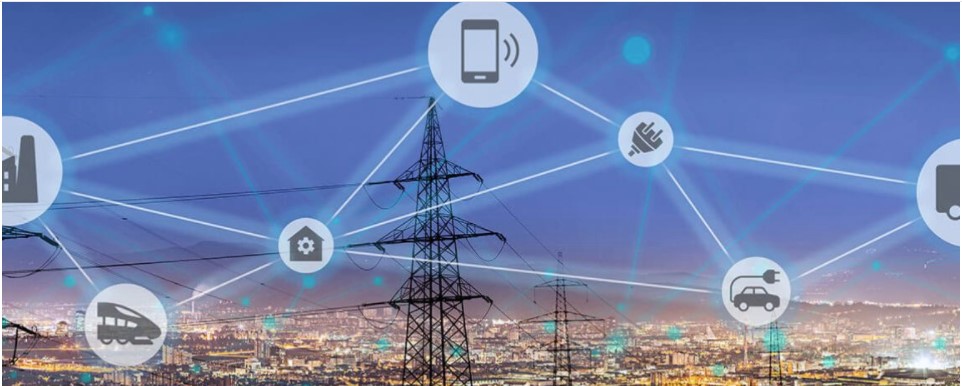
lots of uses, not lots of electricity
image: nexans.com

This blog has talked a lot (a LOT) about the state of electricity in Sweden. Go ahead and search the site if you don’t believe me. I’m going to talk about it again, so make sure your reading device is fully charged.

Anders Ygeman (Minister for Energy and Digital Development) says Sweden has no electricity shortages (“We export more electricity than ever before!!”). Then again, Sweden had to fire up its old oil-burning furnace and discourage people from vacuum-cleaning their homes to avoid brown-outs last month. It’s easy to be confused.

Basically, if you live up north, there is, as a rule, plenty of electricity for a low price. If you live way down south, you can pay 4-5 times more than a northern user. The electricity is there, but you’ll pay through the nose for it to go through the myriad of state and local electricity grids. During the cold snap we had last month, the paper company Holmen shut down large parts their factories because the price of the electricity made it uneconomical to keep them running. Productivity goes down the proverbial toilet, in other words, but more seriously, who will invest in employment-boosting industry in the future?

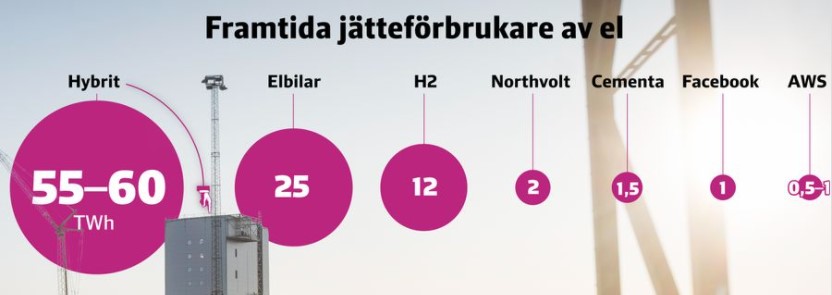
It is not only for the low-cost air conditioning that Facebook and Amazon have server halls up north. Those halls use enormous amounts of electricity. Now, producing fossil-free steel is the latest, and those industries will also be situated up north. There is where the mines are, so it makes sense. But it will also only exacerbate the the electricity problem as their electricity use makes Amazon and Facebook’s use look like a passing blip – unless: Unless hydrogen energy can fill that new need.

Grafik: Thomas Molén
source: SVD.se

Hybrit and H2 are both about producing steel with electricity culled from hydrogen, not fossil-fuel. Electricity is produced by combining hydrogen and oxygen atoms, producing a reaction that produces water, some heat, and electricity. (Thanks eia.gov for this quick explanation.) So clean it squeaks.

For the moment, though, the technology isn’t there. Which has the state Swedish Power Network (Svenska Kraftnät) worried. “I saw that H2 Green Steel will start its production in 2024. That’s tomorrow, from a network-building perspective” technology office Ulf Moberg remarked.

So what’s in store? How fast can we build out windpower? How much more water can we tap? Perhaps we extend the lifetime of the few remaining nuclear power stations. Or perhaps most likely, the southern half of the country, including Stockholm and Göteborg, has to import really dirty power from Estonia and Germany for the sake of clean steel and its accompanying international prestige.

It’s only uncomplicated if one, like Anders Ygeman, holds on to an easy answer and shouts it a lot.